Skip to content

Wrought Iron Gates in Austin, Hand-Worked Detail That Holds Up to Texas Weather

Austin Metal Gates builds and restores wrought iron gates in Austin, TX, and is Travis County's leading shop for ornamental iron entries, specializing in forged scrollwork, cast and forged finials, and rust repair on older ironwork. We offer new hand-detailed gates and restoration of the gate you already have.

  • Free on-site measure
  • Shop drawings you approve
  • Operators set up to UL 325
  • One written price

Request a free site visit

About our wrought iron gates

Our team provides forged and fabricated ironwork with one honest assessment of the joints and the finish, delivering a gate that looks hand-worked for homeowners and lasts through Central Texas storms on residential and commercial properties alike. We bend and weld every scroll in our own shop from drawings you approve first, the same crew measures the opening and hangs the finished gate, and old paint is tested before any of it is stripped.

From the first sketch of a scroll to the last coat of finish, our team handles every detail. Serving Austin along with Rollingwood, Barton Creek and Lakeway, we work on new garden and entry gates as well as iron that has stood at the same wall for decades.

Why Austin Metal Gates

How We Work

No stock panels cut down to fit, and no handoffs. The crew that measures your opening builds and installs the gate.

Measured on siteThe opening, the slope and the ground, measured where the gate will hang
Shop drawings firstYou approve the drawings and finish before any steel is cut
Welded in our own shopFrames fabricated and finished to your drawings, not ordered from a catalogue
Set up to UL 325Every operator installed with its safety devices tested before we leave

Forged, Fabricated or Cast: What a Wrought Iron Gate Is Made Of

A gate sold today as wrought iron is almost always mild steel worked to look hand-forged, and that is a good thing for a new gate. True wrought iron, with its low carbon and fibrous slag, is no longer made commercially, and the little still produced is recycled from scrap for heritage restoration. What really separates one iron gate from another is how each part was made.

Forged parts

A forged part is shaped hot at the anvil. The smith draws a bar out to a taper, bends it into a curl at forging heat, upsets it to thicken a point, or punches and drifts a hole for a picket to pass through. Forged work has the slight irregularity and crisp ends that make an ornamental gate look made by hand.

Fabricated parts

Fabricated parts are cut from bar, tube and flat stock and welded together. The frame, the rails and most pickets are fabricated, because they need to be straight, square and strong more than they need to look forged.

Cast parts

Finials, rosettes and some panels are cast in a mold. Many older decorative gates and fences were cast rather than wrought. Cast iron carries more than 2 percent carbon, is strong in compression but weak in tension, and is brittle, so a cast piece can snap under a blow that would only bend a forged one. Ask any shop which parts of your gate are forged, which are fabricated and which are cast. The answer tells you what you are paying for and how the gate will age.

Scrolls, Collars, Twists and Finials: The Ornamental Vocabulary

The ornament is what you are buying when you choose an iron gate over a plain steel one, so it deserves its own drawing. We sketch the details at full size before any bar is heated, and you approve the drawing before work starts.

The pieces most Austin iron gates draw from:

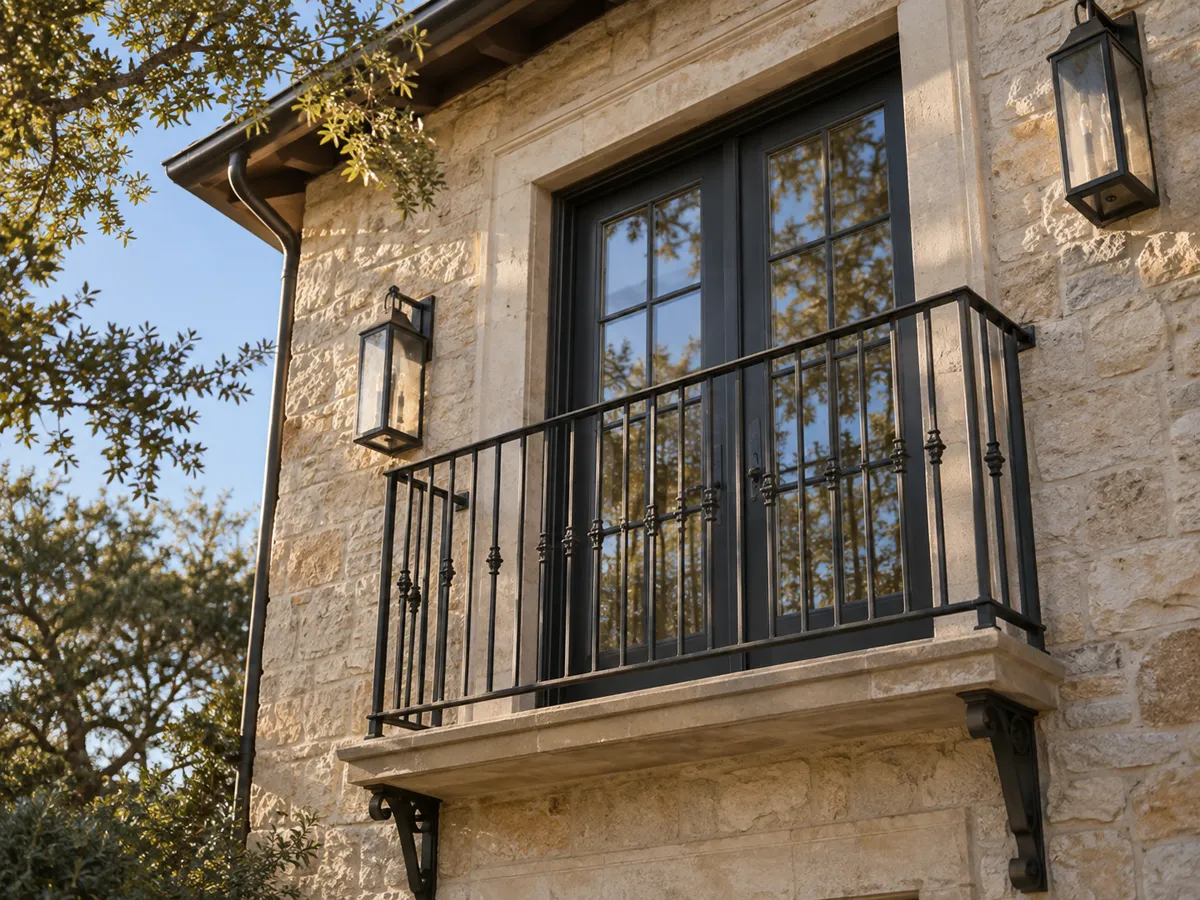
  • C and S scrolls. Curled bar set between pickets or along the top rail. The tightness of the curl and the finish of the end, flat, fishtail or rolled, change the whole look.
  • Collars. Short wraps of flat bar that bind a scroll to a picket or two scrolls to each other. A collar is both a joint and a detail.
  • Twisted pickets. Square bar heated and twisted along part of its length, which catches light and breaks up a long run of pickets.
  • Leaves, rosettes and baskets. Forged or cast accents placed at a crossing or the center of a panel.
  • Tops. Spear and ball finials, an arched or bell-curved top rail, or a flat cap rail over the pickets.

Local rules can decide the top before taste does. Lakeway has banned spiked and open-picket fencing since 2019 after deer were impaled and asks for a continuous flat top, Sunset Valley bans spiked pickets above the top rail, and Rollingwood does not allow sharp or pointed tops on front fences. Some Barton Creek sections set the color too, with brown or bronze iron-style pickets. When a gate sits in a fence line covered by one of those rules, we draw a top that passes it, often a flat cap rail with the scrollwork carried below.

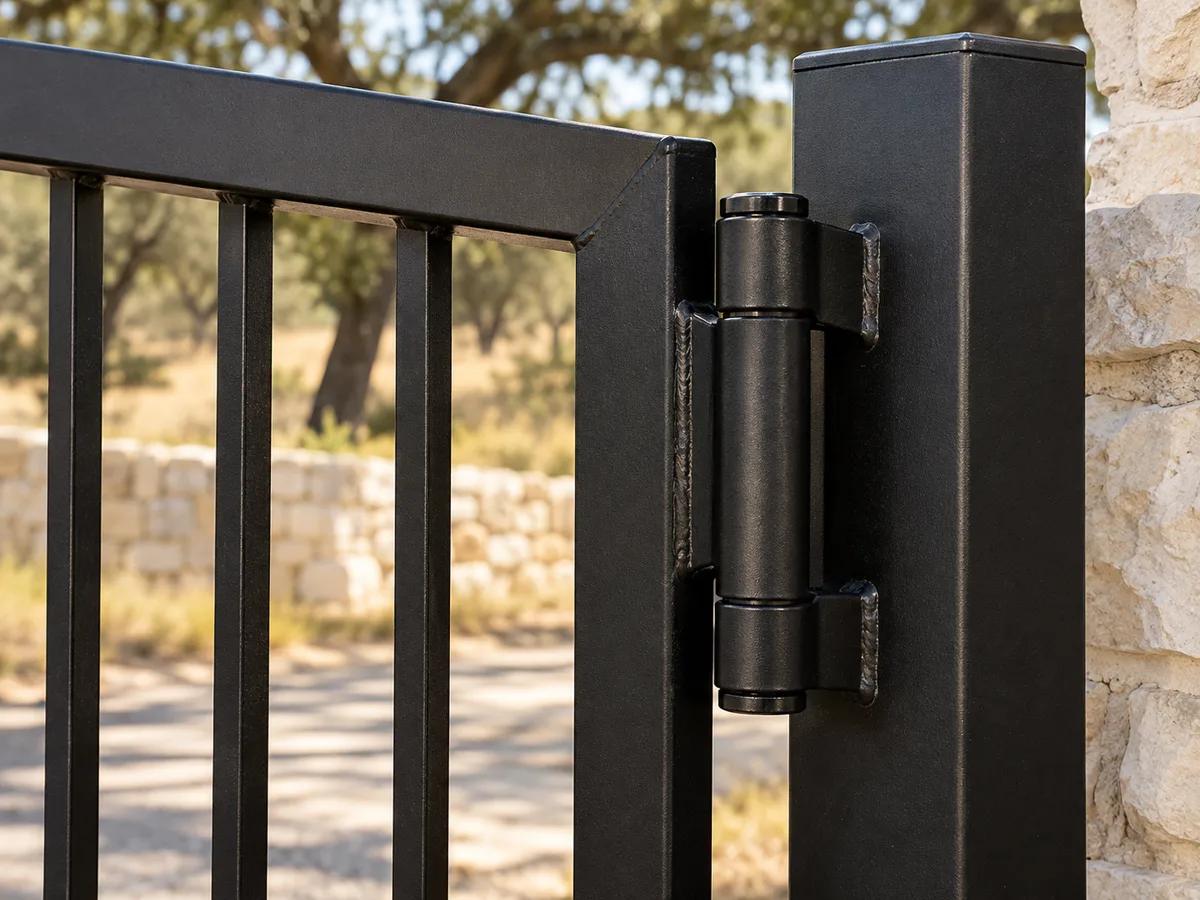
Close view of a black steel gate corner: welded rectangular-tube frame, flat pickets and a barrel hinge on a square post at a stone wall

Why Ornamental Iron Rusts Where It Does in Austin

Rust starts where water sits, and an ornamental gate has far more places for water to sit than a plain one. Rust needs only iron, oxygen and moisture, and water finds its way into tiny gaps and cracks that look solid from a few feet away.

Austin gives it plenty to work with. The city has a humid subtropical climate, highs of 90 degrees or more on about 123 days a year, and thunderstorms that can drop heavy rain in a short time. Heat dries the surface fast, but water trapped in a joint stays behind.

The spots we check first on an iron gate:

  • Behind collars and scroll contacts. Where two pieces touch without a full weld, water wicks in and stays.
  • The bottom rail. It catches splash from rain, sprinklers and wet ground, and it is the first rail to lose metal.
  • Picket ends and finial bases. A pocket on top of a rail, or an open tube end, holds water like a cup.
  • Hinges and latch plates. Moving parts wear through the finish and expose bare metal.

Rust also takes up more room than the iron it replaces. Inside a tight joint, that growth pries the parts apart, a process called rust jacking, which is why a collar can split its paint and lift away from a picket even when the rest of the gate looks sound.

A Finish Built for Ornamental Iron

The finish on an ornamental gate has to reach into every curl and behind every collar, not just cover the flat faces. A finish that skips those hidden surfaces fails first exactly where it is hardest to repair.

For a new gate in mild steel, the frame and ornament can be hot-dip galvanized after welding, so zinc coats the inside of the joints as well as the outside, and then powder coated in the color you choose. Zinc protects the steel even where the top coat is later chipped, because it corrodes first.

An older gate of true wrought iron is different. Wrought iron cannot be hot-dip galvanized the way mild steel can, so a restored antique gate is protected with a paint system instead: the metal cleaned back, a primer worked into the joints, and top coats built up over it.

Two details on our drawings help any finish last longer:

  • Closed ends. Tube ends and the tops of rails are capped or sloped, so water runs off instead of pooling.
  • Full welds where water would sit. Collars and scroll contacts that face the weather are welded or sealed so moisture cannot wick behind them.
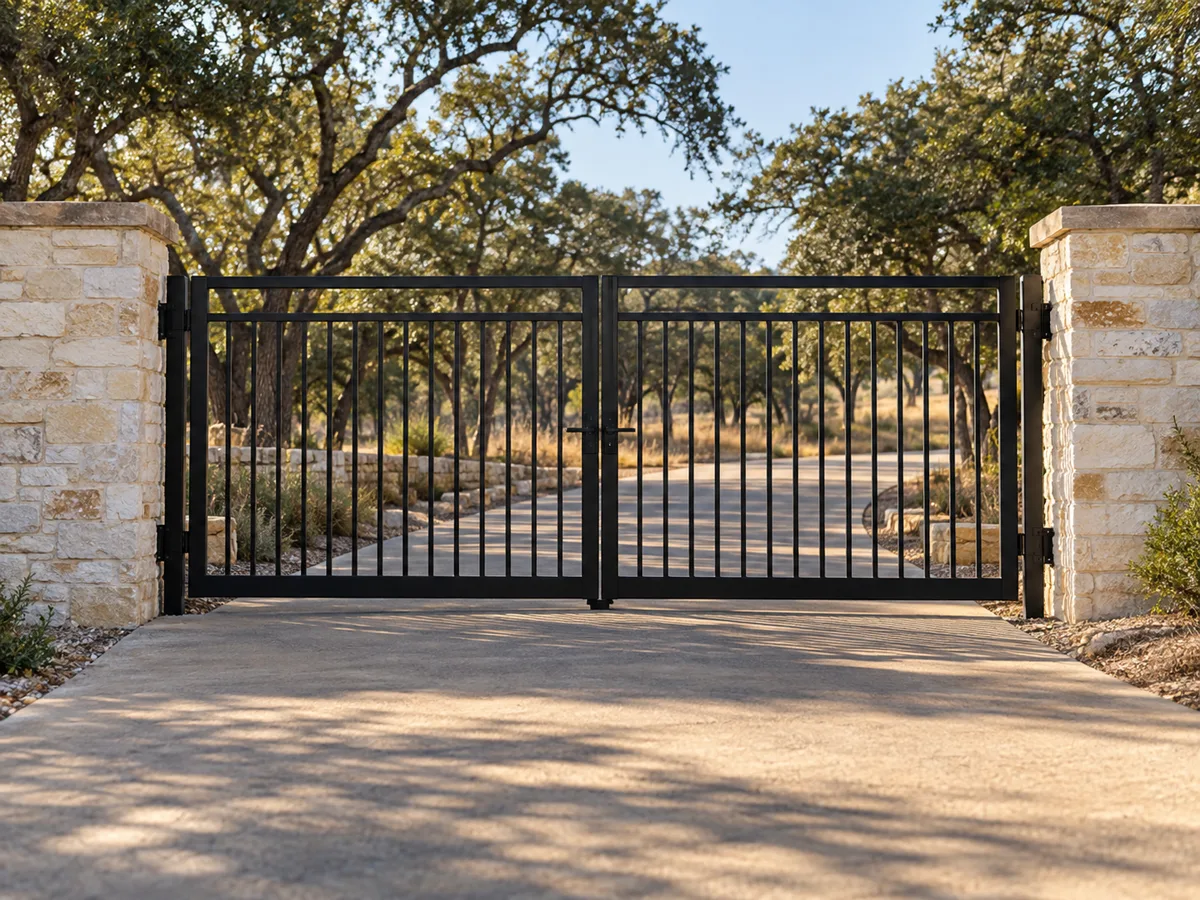
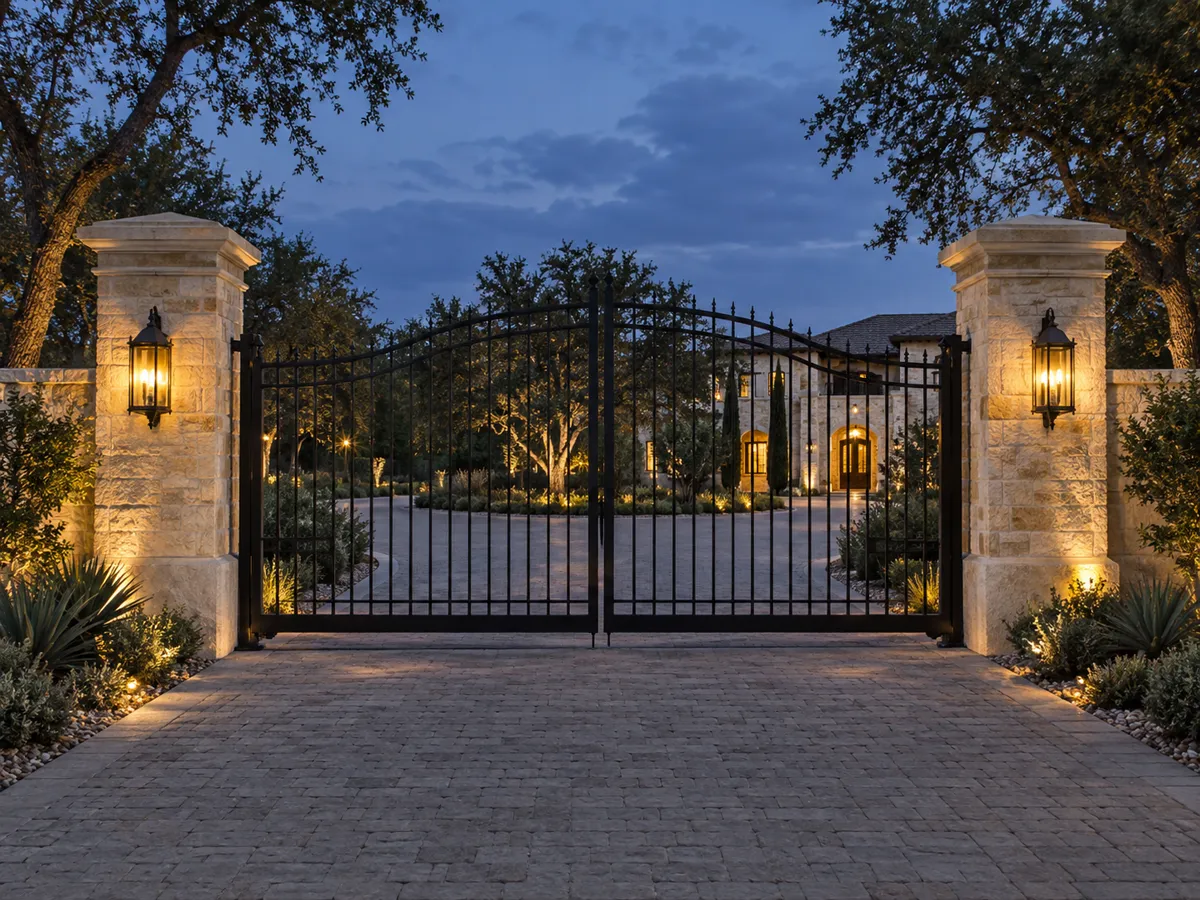
New black steel double driveway gate with vertical pickets, closed between two limestone columns

Caring for an Iron Gate Through the Austin Year

A few minutes of care twice a year keeps an iron gate from needing a full restoration later. The goal is simple: find bare metal early and cover it before rust spreads under the finish.

  • Spring and fall walk-around. Look closely at the bottom rail, the collars, the finial bases and the hinges. A rust bloom or a lifted edge of paint is the sign to act.
  • Wash, then dry. Rinse off dust and pollen with plain water and a soft brush, and let the gate dry fully before any touch-up.
  • Touch up chips the same season. Brush off loose rust, treat what remains, prime and recoat. Rust converters based on tannic or phosphoric acid turn light surface rust into a layer ready for paint.
  • Aim the sprinklers away. A sprinkler that soaks the bottom rail every morning will beat any finish over time.
  • Check after a big storm. Heavy rain and wind find weak spots, and a quick look the next day catches them while they are small.
  • Keep the hinges moving. Lubricate hinges and latches so they do not grind through their own finish.

If a chip has already turned into flaking metal or a joint has started to open, that is past touch-up, and the next section is the one to read.

Repair or Replace: An Honest Call on an Old Iron Gate

Most old iron gates are worth repairing when the frame is sound and the damage sits in the details or the finish. We recommend replacing when the frame itself has lost metal, because a new finish over a weak frame only hides the problem.

Usually worth repairing

Surface rust and failed paint with solid metal underneath. A broken scroll weld or a loose collar. A missing finial or rosette that can be matched with a new casting or a forged copy. A gate that drags because a hinge wore out or the post moved, with the leaf itself still square.

Usually time to replace

A bottom rail or stile rusted through, or pickets that have lost much of their thickness. A cast panel that is cracked across, since cast iron is notoriously difficult to weld and a repair may not hold. A frame twisted out of square that will not hang straight on any hinge.

True antique wrought iron

A gate of real wrought iron is worth extra care. Wrought iron is easily forge welded, and repairs are made with reclaimed wrought iron where it can be found, so the patch ages like the original. Where rust or a break shows a wood-like grain in the metal, that grain is a strong sign the gate is the real thing.

Old paint and lead

An iron gate on a house built before 1978 may carry lead paint under its newer coats. Federal rules require certified renovators when work on a pre-1978 home disturbs more than 20 square feet of lead paint outdoors, and HUD prohibits dry sanding, torching and machine grinding without dust controls. We test old paint before stripping a gate and choose the removal method to match. When replacement is the right answer, our gate replacement page covers what stays, what goes and how a new leaf fits the old posts.

What Shapes the Cost of a Wrought Iron Gate

Hand-worked detail is the biggest single factor in what an iron gate costs, more than its width. Two gates of the same size can be priced far apart because one has straight pickets and the other has a forged scroll panel.

  • Ornament. Forged scrolls, collars and twists take shop time; cast accents cost less per piece.
  • Size and leaf count. A pair of leaves carries twice the hinges, latches and ornament of a single gate.
  • Finish. Galvanizing plus powder coat, or a multi-coat paint system on restored iron.
  • Matching. Copying existing railings, fencing or an old casting adds drawing and pattern time.
  • Restoration scope. Paint testing, stripping, rust repair and replacing lost parts on an old gate.
  • Posts and hanging. New posts, a wall pier or a column core if the old ones cannot carry the gate.
  • Automation. A heavy ornamental leaf needs an operator rated for its weight if it will open on its own.
  • Approvals. HOA or POA review and any city permit for the fence line it sits in.

These are estimate drivers, not prices. We look at the gate or the opening at the site visit, and the written quote that follows sets the price for your job.

The process

From Site Visit to a Gate That Runs

Four steps, and nothing is fabricated until you have signed off on the drawings and the price.

  1. Free site visit

    We measure the opening, the slope and where power can reach, and talk through style, automation and access.

  2. Drawings and a written price

    You get scaled drawings for your approval and for any HOA or city review, with one written price.

  3. Fabricated in our shop

    Steel is cut and welded to the approved drawings, then galvanized, powder coated or both.

  4. Installed and tested

    Columns and posts set, gate hung, operator set up to UL 325 and every safety device tested with you.

More of What We Build

Questions

Wrought Iron Gates: Common Questions

Is my old gate real wrought iron?

It might be, if it is old. A wood-like grain where the metal has rusted or broken is a strong sign of true wrought iron. Most gates made in recent decades are mild steel, and many older decorative pieces are cast iron. We can look at it at the site visit.

Can a rusty iron gate be saved?

Usually, if the frame still has solid metal. Surface rust, failed paint, a broken scroll or a loose collar can all be repaired. A rail that has rusted through or a cast panel cracked across is often the point where replacing makes more sense.

How often does an iron gate need repainting?

There is no fixed schedule. Check the bottom rail, the collars and the hinges each spring and fall, and touch up any chip the same season. Small, regular touch-ups delay a full recoat for a long time.

Can you match the ironwork on my railings or old fence?

Yes. We measure and draw the existing scrolls, pickets and castings, then forge, fabricate or cast new pieces to match, so the gate reads as part of the same set.

Will my city or HOA allow spear tops?

It depends on where you live. Lakeway, Sunset Valley and Rollingwood restrict spiked or pointed tops on fencing, and some associations set color and style. We check the rule for your address and draw a top that passes it.

Does old gate paint contain lead?

It can on homes built before 1978. We test the paint before stripping, because sanding or torching lead paint without controls throws off hazardous dust.

Can an ornamental iron gate be automated?

Yes, as long as the operator is rated for the gate's weight and the posts can carry it. Forged ornament adds weight, so we weigh that on the drawing before choosing the operator.

Should I choose wrought iron style or plain steel?

Choose by the look you want. Both are usually mild steel underneath. An iron-style gate adds scrolls, collars and finials; a plain steel gate puts the money into a heavier frame and simpler lines.

Free site visit

Talk to us about wrought iron gates

Free on-site measure across Austin and the west side. We call you back to set a time.

Call (512) 503-9203

Calls only, we do not receive text messages.

Call (512) 503-9203