Skip to content

Pool Fencing in Austin That Meets the Barrier Code

Austin Metal Gates installs pool fencing in Austin, TX, and is Travis County's trusted specialist in code-compliant pool barriers, specializing in powder-coated aluminum pool fence panels, welded steel picket fencing and self-closing pool gates. We offer self-latching gate hardware and flat-top ornamental sections.

  • Free on-site measure
  • Shop drawings you approve
  • Operators set up to UL 325
  • One written price

Request a free site visit

Or call (512) 503-9203. Calls only, we do not receive text messages.

About our pool safety fencing

Our team provides barrier layouts drawn to the pool code, delivering a safer backyard for your family and a compliant enclosure around amenity pools for both residential and commercial projects. Before we quote, the same crew that installs walks the deck, measures every gap to grade and marks where the house wall joins the fence line, and each gate is welded in our own shop.

From a latch release set 54 inches above grade to the full perimeter around deck, spa and lawn, our team handles every detail. Serving Austin, Shady Hollow, Steiner Ranch and The Hills, we check each enclosure against the local pool rules before a post goes in.

Why Austin Metal Gates

How We Work

No stock panels cut down to fit, and no handoffs. The crew that measures your opening builds and installs the gate.

Measured on siteThe opening, the slope and the ground, measured where the gate will hang
Shop drawings firstYou approve the drawings and finish before any steel is cut
Welded in our own shopFrames fabricated and finished to your drawings, not ordered from a catalogue
Set up to UL 325Every operator installed with its safety devices tested before we leave

What the Pool Barrier Code Asks of a Fence

A pool barrier exists to keep a small child away from the water long enough for an adult to notice. In 2006 alone, 283 children under five drowned in swimming pools in the United States. The code that answers that number is written in inches, and a fence that misses one of them is decoration, not a barrier.

The International Swimming Pool and Spa Code, Section 305, sets the core rules, and the International Residential Code carries a pool appendix of its own. Rollingwood, for example, names Appendix G, section AG105.1 of the 2012 IRC for every pool fence built or substantially altered since April 20, 2016. The requirements we draw to:

  • Height: at least 48 inches, measured on the side facing away from the pool.
  • Bottom gap: no more than 2 inches to grass or gravel, and no more than 4 inches to a solid surface such as concrete.
  • Openings: no gap anywhere may pass a 4-inch sphere.
  • Horizontal rails: where the rails sit less than 45 inches apart, a child can use them as steps, so picket spacing tightens to 1-3/4 inches. Rails 45 inches or more apart allow spacing up to 4 inches.

That rail rule shapes the design more than anything else. A classic iron panel with two rails close together needs tight pickets; a panel with rails at the top and bottom only can use standard spacing.

Self-Closing, Self-Latching Pool Gates That Close Every Time

A pool barrier is only as good as its gate, and a gate that stops closing on its own has quietly stopped being a barrier. The code is specific:

  • The gate must swing outward, away from the pool.
  • It must close on its own and latch automatically.
  • A latch release on the outside must sit at least 54 inches above the ground.
  • If the release is on the pool side, it must be at least 3 inches below the top of the gate, and no opening in the gate or fence within 18 inches of the latch may exceed half an inch.

We build the gate frame in our shop so it stays square, because a gate that sags drags on its latch and stops closing. At handover we open the gate to different positions and let it go. It has to close and latch from each one. If it does not, the job is not finished.

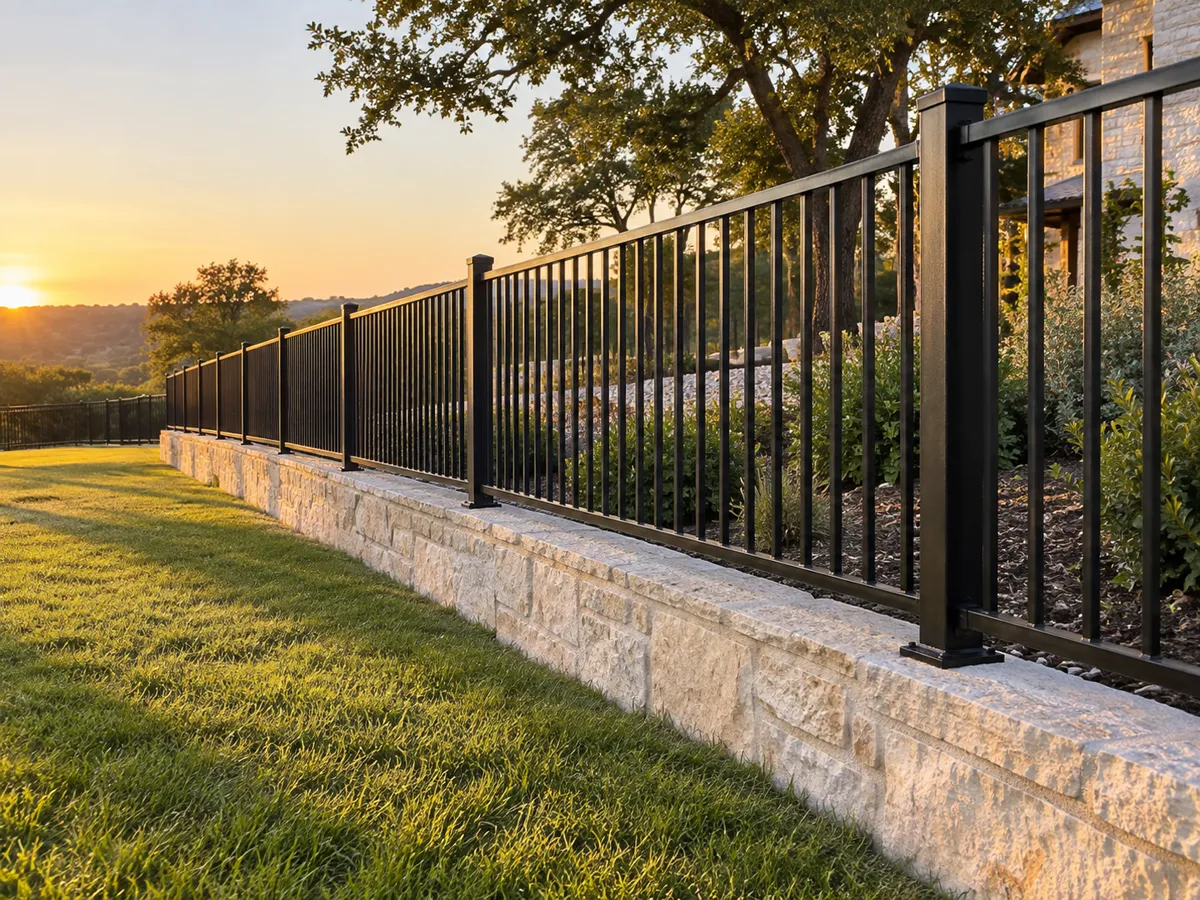
Long run of black flat-top ornamental iron fencing on a limestone curb beside a lawn at sunset

Aluminum, Steel or Ornamental Iron Around Water

Pool fencing lives in splash, sun and irrigation, which is a harder life than a front-yard fence.

Aluminum

Aluminum suits a pool barrier well. It forms its own oxide layer, so it does not rust, and it weighs about a third as much as steel, which makes long runs and removable sections easier. A powder-coated finish adds color and a second barrier.

Galvanized steel

Steel gives a heavier, more architectural look and matches iron gates or railings elsewhere on the property. Around a pool we only use it hot-dip galvanized and then powder coated. The zinc corrodes first, protecting the steel even where the coat is chipped. A salt-water pool deserves extra care, because chloride is one of the things that breaks down the protection on iron.

Flat tops by default

A pool fence should not invite climbing or catch a falling child, and in some cities a pointed top is illegal anyway. Lakeway requires every new fence to be continuous and flat-topped, and Sunset Valley bans spiked pickets and head-trap spacing above the top rail while also requiring pool barriers to meet the adopted pool code. We design pool runs with the top rail over the pickets.

Lake-House, Hillside and House-Wall Barriers

Austin sits on the Balcones Escarpment, and west of it the ground rolls into the Hill Country, down to Lake Austin and Lake Travis. That terrain produces pools that are anything but a flat rectangle in a flat yard.

Sloped yards

The 2-inch bottom rule applies along the whole run, not just at the posts. On a hillside we step or rack the panels so the bottom rail follows the ground, and we measure the gap at each panel before we sign off.

Lakefront lots

Steiner Ranch sits on a ridge between Lake Travis and Lake Austin, and a lot that falls toward the water may put the pool on one level and the lawn or dock on another. A barrier has to enclose the pool itself, and the path from a lower terrace or dock back up to the deck is part of what we map at the site visit.

When the house is one side

If a wall of the house forms part of the barrier, doors and windows with sills below 48 inches that open toward the pool need protection: an entrance alarm listed to UL 2017, self-closing and self-latching doors, or an approved safety cover. We show the house wall on the drawing so you can see where the fence ends and the alarms or closers take over.

City and HOA Rules Layered on Top of the Pool Code

The barrier code is the floor. Local rules add to it.

  • Rollingwood may require an annual visual inspection of a pool fence and gives 30 days to correct anything out of compliance.
  • The Estates of Shady Hollow asks pool applications to show the required safety fencing and confirm every gate has a self-closing latch, and the neighborhood's ACC must approve fences before work starts.
  • Steiner Ranch requires AC approval for fencing that differs from its standard and does not allow gates between a lot and open space.
  • The Hills requires an architectural modification request to the POA before any exterior improvement.

Under Texas SB 711, in force since September 1, 2025, an HOA may no longer ban a perimeter fence, but it still regulates fence type and material. We confirm the current pool code edition and your association's rules when we quote, since both are revised over time.

What Moves the Price of Pool Fencing

We quote every pool barrier individually. What changes the number:

  • Perimeter length and the number of corners and ends.
  • Material: aluminum or galvanized steel, and the picket and rail gauge.
  • Rail layout, since tight 1-3/4-inch picket spacing uses more steel than 4-inch spacing.
  • Gates: how many, their width, and the self-closing hinges and latches each one needs.
  • Slope: racked or stepped panels on a hillside or terraced lot.
  • Mounting: posts set in soil, cored into an existing deck, or anchored to a retaining wall.
  • Finish: standard powder colors or a match to existing ironwork.
  • House-wall protection where the home forms part of the barrier.
  • Approvals: permits, pool inspections and HOA or POA applications.

The quote follows a free on-site measure, where we check every one of these against your actual yard.

The process

From Site Visit to a Gate That Runs

Four steps, and nothing is fabricated until you have signed off on the drawings and the price.

  1. Free site visit

    We measure the opening, the slope and where power can reach, and talk through style, automation and access.

  2. Drawings and a written price

    You get scaled drawings for your approval and for any HOA or city review, with one written price.

  3. Fabricated in our shop

    Steel is cut and welded to the approved drawings, then galvanized, powder coated or both.

  4. Installed and tested

    Columns and posts set, gate hung, operator set up to UL 325 and every safety device tested with you.

More of What We Build

Questions

Pool Safety Fencing: Common Questions

How tall does a pool fence have to be?

The pool code sets a minimum of 48 inches, measured on the outside of the barrier. Some owners go taller for privacy or to match other fencing, where local rules allow.

What makes a pool gate compliant?

It swings away from the pool, closes by itself from any open position, latches automatically, and has its release at least 54 inches above the ground or protected on the pool side as the code describes.

Can an ornamental iron fence also be a pool barrier?

Yes, if it is drawn to the barrier rules: 48 inches minimum, no opening that passes a 4-inch sphere, and tight picket spacing wherever rails sit less than 45 inches apart. We design it that way from the start.

What drives the cost of a pool fence?

Perimeter length, material, picket spacing, gate count and hardware, slope, how the posts are mounted, finish, house-wall protection and approvals. We price it after a free site measure.

Does my HOA need to approve it, and who handles that?

Most associations around Austin require approval, and some, like the Estates of Shady Hollow, ask pool applications to show the fencing and self-closing latches. We provide the drawing and hardware details for your submission.

Our pool is on a slope. Is that a problem?

No, but the fence has to follow the ground so the bottom gap stays within code along the whole run. We step or rack the panels and check the gap panel by panel.

How long does fabrication take?

That depends on the perimeter, the finish and any approvals still pending. You receive a schedule with the drawing, and fabrication begins once it is signed.

Do you serve my area?

We build pool barriers across Austin and Travis County, including Rollingwood, West Lake Hills, Sunset Valley, Shady Hollow, Barton Creek, Lost Creek, Steiner Ranch, The Hills, Lakeway and Volente.

Is the work guaranteed?

Every pool barrier comes with a written warranty, and we test each gate for closing and latching with you before we leave.

Free site visit

Talk to us about pool safety fencing

Free on-site measure across Austin and the west side. We call you back to set a time.

Call (512) 503-9203

Calls only, we do not receive text messages.

Call (512) 503-9203