Skip to content

Electric Gate Repair in Austin, When the Gate Has Power Trouble or Stops Answering

Austin Metal Gates handles electric gate repair in Austin, TX, and is Travis County's leading specialist in the power and control side of a driveway gate, specializing in transformer and fuse diagnosis, control board replacement and surge damage recovery. We offer low-voltage wiring repair and battery, solar and access device troubleshooting.

  • Free on-site measure
  • Shop drawings you approve
  • Operators set up to UL 325
  • One written price

Request a free site visit

Or call (512) 503-9203. Calls only, we do not receive text messages.

About our electric gate repair

Our team provides a methodical trace from the supply to the last sensor, delivering a gate that responds to its remotes and keypad again for both residential and commercial projects. The same crew that traces the fault does the repair, we test the supply with a meter before we touch a board, and the safety devices are re-checked to UL 325 before we leave, with a written warranty on the repair.

From a blown fuse at the transformer to a receiver that no longer hears its remotes, our team handles every detail. Serving Austin, Sunset Valley, Steiner Ranch and Volente, we keep the work on the electronics separate from the steel and the drive unit, so you pay for the fault you actually have.

Why Austin Metal Gates

How We Work

No stock panels cut down to fit, and no handoffs. The crew that measures your opening builds and installs the gate.

Measured on siteThe opening, the slope and the ground, measured where the gate will hang
Shop drawings firstYou approve the drawings and finish before any steel is cut
Welded in our own shopFrames fabricated and finished to your drawings, not ordered from a catalogue
Set up to UL 325Every operator installed with its safety devices tested before we leave

Tracing a Gate Fault From the Supply Outward

An electric gate is a small electrical system that happens to move a piece of steel. When it goes quiet, the cause sits somewhere along a chain: the supply, the transformer, the fuses, the control board, the wiring to each device, and then the devices themselves. Guessing at any link wastes money, so we test in order.

This page owns that chain. If the leaf sags, drags or sticks, our automatic gate repair page covers the steel and the hinges. If the motor, gearbox or arm is the failing part, our gate opener repair page covers the drive unit. We come to this page's work when the machinery may be sound and something upstream of it is not.

The first visit follows a fixed order:

  • confirm there is supply at the gate, and that the breaker feeding it has not tripped
  • measure the low-voltage output of the transformer
  • check the fuses and any surge protection on the supply
  • look over the control board for scorched parts, moisture and burnt contacts
  • test the wiring to each sensor, keypad and receiver

Only after that do we say which link failed, so that the quote covers a diagnosed fault and not a hopeful swap.

No Power: Transformers, Fuses and Supply

The transformer

Most gate boards do not run on house current. A step-down transformer lowers the voltage so the electronics run on a safe, low supply. A transformer can fail from sustained overload, and heat degrades its insulation, so a unit that has run hot for years can quit outright. We measure its output rather than assuming, because a gate that is dead with a healthy transformer has a different fault.

Fuses

A fuse protects the circuit against sustained overload, and it has to be sized to ride through the brief surge of current at power-up. A blown fuse is a symptom. If we replace it without asking why it blew, the new one goes the same way, so we look for the shorted wire, the failing motor draw or the wet board behind it.

The supply run

A gate a long way from the house can lose voltage in the cable that feeds it. Corroded splices in a buried run, a pulled conductor after other work in the yard, or a breaker that has been reset too many times all show up at the gate as a weak or absent supply. We trace the run before condemning anything at the gate.

Surge, Storm and Control Board Damage

Lightning does not need to strike a gate to damage it. A nearby strike induces current in overhead lines, buried cable and metal fences, and that current arrives at the control board as a spike. Voltage transients of that kind are known to destroy delicate electronics and electric motors, and a surge protector works by routing the spike to ground.

Protectors also wear out. The metal-oxide varistor inside a typical protector loses a little of its threshold each time it absorbs a hit, so an old protector that has taken many small storms may be protecting nothing. We test the protection on the gate supply and replace it when it has aged out.

A control board is a printed circuit board, and it fails the ways such boards do. Moisture reduces its insulation, heat stresses solder joints and lifts traces, and corrosion eats exposed copper. A board that has survived a storm may look fine and misbehave a month later.

  • If a component is burnt and the rest of the board is sound, a repair may be enough.
  • If moisture or heat has spread across the board, replacement is usually the honest answer.
  • Either way, we add or renew surge protection on the supply, because a new board on an unprotected line is only waiting for the next storm.

Batteries, Solar Charging and Running on Backup Power

A backup battery lets an operator keep working when mains power fails, and it is one of the first things to age. Lead-acid batteries lose capacity after deep discharge, and a weak battery in a group drags down its neighbours, so batteries in a bank should be replaced together rather than one at a time.

A solar gate has its own failure pattern. The panel has to see the sun, and shading matters more than most owners expect: covering a small part of an array can cut the output of the whole panel by far more than the area covered. A tree that has grown since the install, or a panel moved behind a new post, will slowly starve the battery. A gate that opens well in the morning and fails by evening is often a charging problem, not a control problem.

We check the charge coming from the panel, the voltage the battery holds under load, and the wiring between them. If the battery is spent, we replace it. If the panel is shaded or undersized for how often the gate cycles, we tell you and cover the options in the quote. Our solar gate operators page covers a new solar build from scratch.

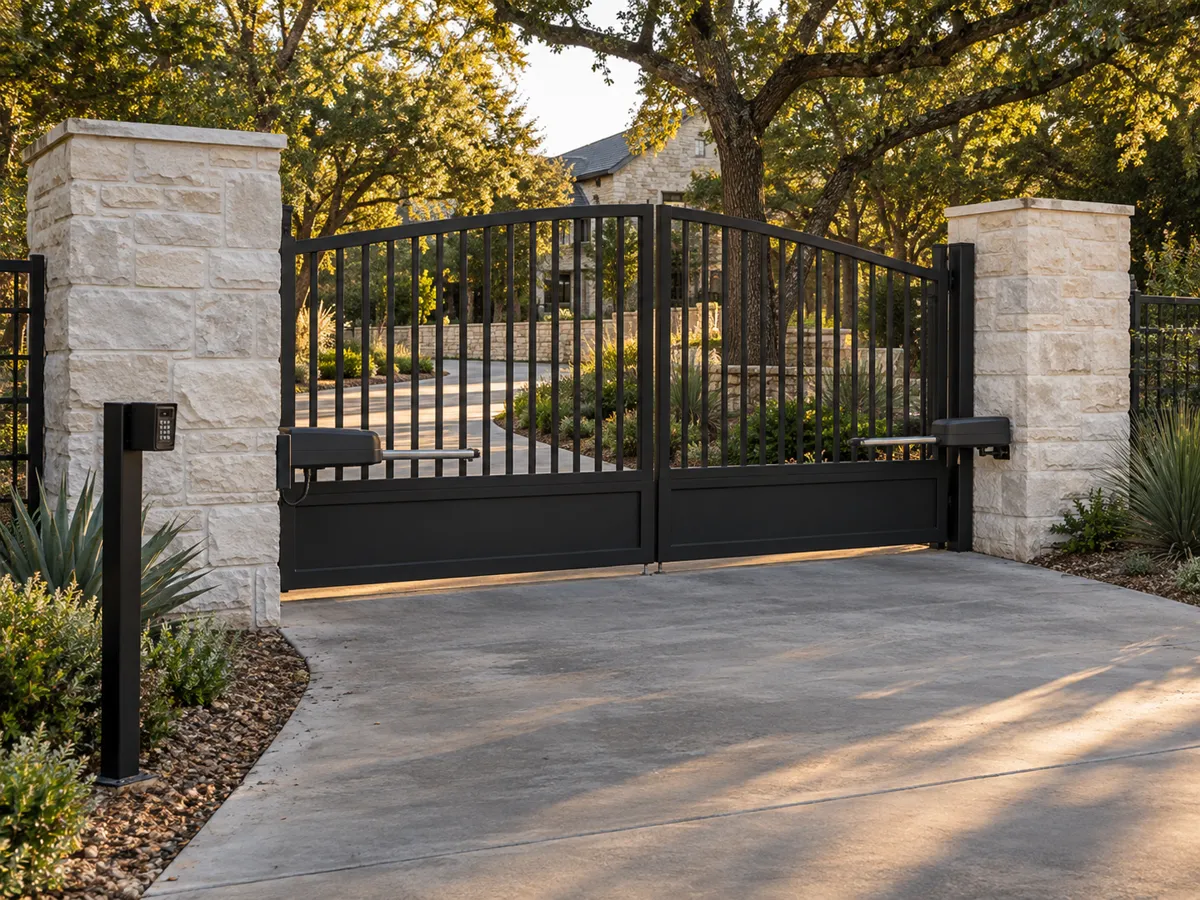
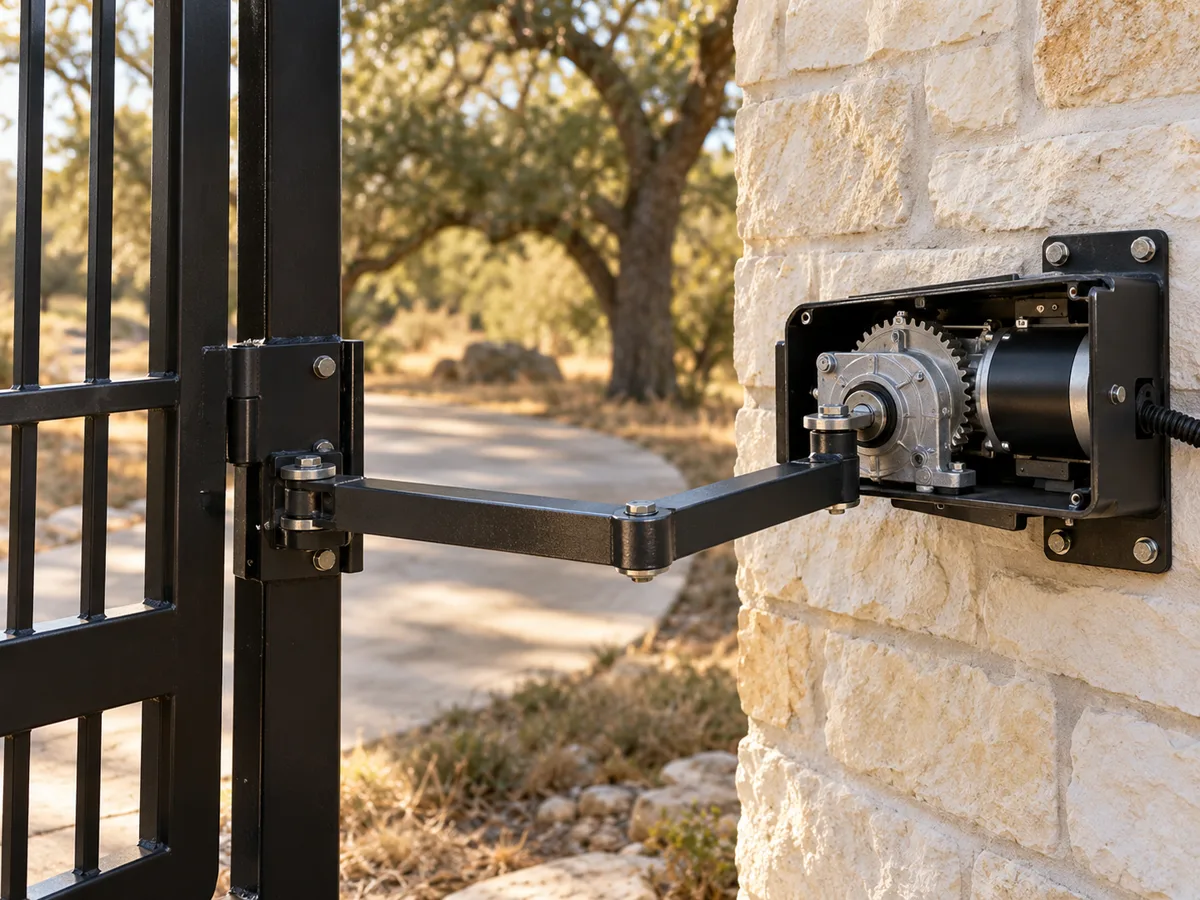
Swing gate operator with its cover off, showing the motor, gear and jointed arm, mounted on a limestone wall beside the gate post

Keypads, Remotes, Receivers, Intercoms and Loop Detectors

Many gates that seem to have failed are only failing to hear the person who wants in. The access side has four common faults:

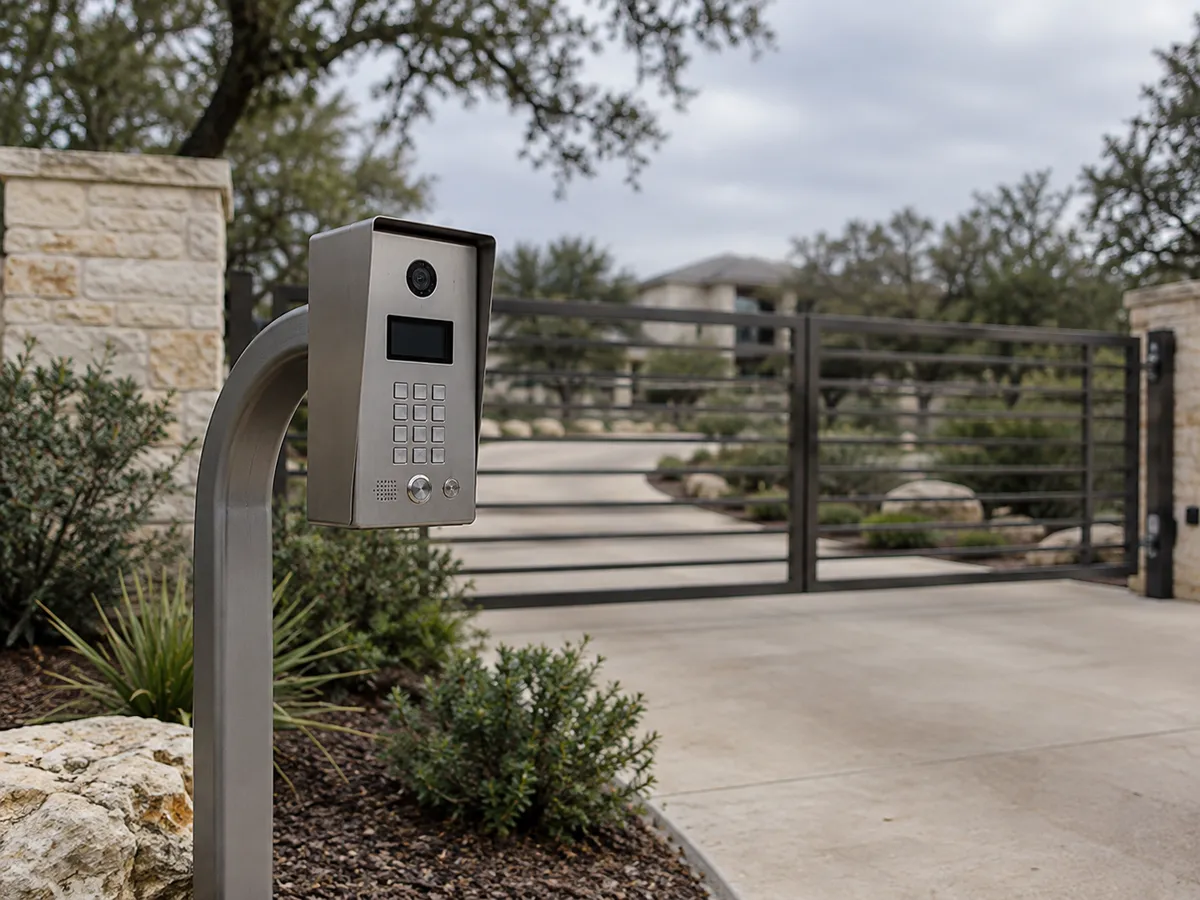
  • Keypads. Weather, worn keys and a dead wire between the post and the board stop a keypad reading a code. We test the keypad and its cable before replacing either.
  • Remotes and receivers. A remote with a spent battery, a receiver that has lost its programming or a receiver whose antenna has been knocked around all look alike from the driver's seat.
  • Intercoms. A wired unit that stops calling out usually has a broken cable or a corroded connection, and a wireless unit can be disturbed by other devices on its frequency. Where the intercom is meant to release the gate, we check the relay that does it.
  • Loop detectors. An induction loop is a wire cut into the pavement, and a vehicle over it changes the loop's inductance. A cut wire, a cracked slab or a detector set too insensitive means the gate ignores cars, and very small metal masses such as bicycles may not register even when the loop is healthy.

A photoelectric safety sensor that has lost its wiring belongs to the same family, and we trace it here before touching the moving parts.

Loops that have been cut by a repaving crew or a trench are sawn in again and tested before we close the slot.

What Affects the Cost of Electric Gate Repair

Electrical faults are priced by diagnosis first and parts second. We do not publish a figure on this page, since a blown fuse and a storm-killed board sit at opposite ends of the range. The drivers are:

  • Which link failed. Supply, transformer, fuse, board, wiring or a single device.
  • Board repair or replacement. Whether the damage is local or has spread.
  • Surge protection. Testing the existing protector and fitting a new one when it has worn out.
  • Battery and solar parts. The number of batteries, the charging equipment and any panel that has to be moved or replaced.
  • Wiring runs. How far a cable has to be traced, spliced or replaced, and whether it is buried.
  • Trenching and pavement. New conduit, or sawing a loop back into concrete or asphalt.
  • Access devices. Keypads, receivers, remotes and intercom hardware, and whether the existing types are still available.
  • Safety devices. Any monitored sensors that have to be replaced to bring the gate back to the current standard.

Any number we quote from the diagnosis is an estimate and is subject to change if a second fault surfaces once the first is fixed. Your written quote sets the final price, and we do not start until you have approved it.

The process

From Site Visit to a Gate That Runs

Four steps, and nothing is fabricated until you have signed off on the drawings and the price.

  1. Free site visit

    We measure the opening, the slope and where power can reach, and talk through style, automation and access.

  2. Drawings and a written price

    You get scaled drawings for your approval and for any HOA or city review, with one written price.

  3. Fabricated in our shop

    Steel is cut and welded to the approved drawings, then galvanized, powder coated or both.

  4. Installed and tested

    Columns and posts set, gate hung, operator set up to UL 325 and every safety device tested with you.

More of What We Build

Questions

Electric Gate Repair: Common Questions

My gate is completely dead. What do you check first?

We confirm supply at the gate, test the transformer output and inspect the fuses, because those are the cheapest links to rule out. Only then do we open the control board.

Can a storm really kill a gate board?

Yes. A strike near your property can induce a surge in lines and metal fences without touching the gate, and the spike reaches the board through the supply or the wiring. We inspect the board and test whatever surge protection is on the line.

Is it worth repairing a control board, or should I replace it?

If damage is limited to one part, repair can make sense. Where moisture or heat has spread, or the board is no longer supported, replacement is safer. We explain which case you have before you approve the work.

Will you work on a gate you did not install?

Yes. We start with the supply and the controls in front of us, and we will tell you if the fault is really in the drive unit or the steel, which are covered on our other repair pages.

What happens if the power goes out?

A gate with battery backup keeps working until the battery runs down. Without one, the operator has to be released so the leaf can be moved by hand, and we go over how yours releases when we test it.

How will the fire department open the gate if the controls fail?

The access hardware your fire district requires, such as a key switch or an access box, is tested after the repair. West Lake Hills asks for an ESD 9 approved access box, and we confirm the requirement for your address.

Do you repair keypads and intercoms?

Yes. We test the device, its cable and the relay that releases the gate, and we replace whichever part has failed rather than the whole system by default.

Will an HOA let me change the access devices?

A like-for-like device usually needs nothing. A new post or a different visible unit may go to your architectural committee first, and we provide drawings when it does.

What does the repair warranty cover?

The repair carries a written warranty, and the quote states what it covers before you approve the job.

Free site visit

Talk to us about electric gate repair

Free on-site measure across Austin and the west side. We call you back to set a time.

Call (512) 503-9203

Calls only, we do not receive text messages.

Call (512) 503-9203