Skip to content

Steel Gate Installation in Austin, Built From Tube and Finished for Texas Weather

Austin Metal Gates provides steel gate installation in Austin, TX, and is Travis County's trusted specialist in fabricated steel entries, specializing in hollow tube frames, hot-dip galvanized finishes and heavy-duty hinge posts. We offer welded swing gates and welded sliding gates.

  • Free on-site measure
  • Shop drawings you approve
  • Operators set up to UL 325
  • One written price

Request a free site visit

Or call (512) 503-9203. Calls only, we do not receive text messages.

About our steel gate installation

Our team provides shop-built frames sized to the opening, delivering a rigid gate for homeowners and a hard-wearing closure for both residential and commercial projects. We weld every frame in our own shop from drawings you approve first, the same crew measures the opening and installs the finished gate, and a written warranty comes with each one.

From choosing the wall thickness of the frame tube to setting the footing that carries its weight, our team handles every detail. Serving Austin along with Rollingwood, Barton Creek and Lakeway, we build steel gates to suit the lots and the rules around them.

Why Austin Metal Gates

How We Work

No stock panels cut down to fit, and no handoffs. The crew that measures your opening builds and installs the gate.

Measured on siteThe opening, the slope and the ground, measured where the gate will hang
Shop drawings firstYou approve the drawings and finish before any steel is cut
Welded in our own shopFrames fabricated and finished to your drawings, not ordered from a catalogue
Set up to UL 325Every operator installed with its safety devices tested before we leave

Tube or Solid Bar: How a Steel Gate Frame Is Built

Most steel gates start with hollow structural section, the square or rectangular tube used for welded frames that must resist force from more than one direction. The picket infill between the rails is usually a smaller bar or tube.

Why the frame is tube

A hollow section has the same wall thickness all the way around and resists twisting well, which matters for a leaf that hangs from one edge and swings on its own weight. It also carries a given load with less steel than a solid section, so the leaf is lighter than a solid frame of similar strength.

Where solid bar belongs

Solid bar suits the parts that are slender by design: pickets, scroll work and decorative elements. Solid stock in the frame itself adds weight that the hinges and posts then have to carry, so we use it where it earns its place.

The grade of steel

Plain mild steel is the usual choice for gate tube in North America, sold under standards such as ASTM A500. It welds cleanly and holds a straight line, which is why it is the workhorse for fabricated frames.

Wall Thickness and Gauge: What the Numbers Mean

Wall thickness decides how stiff a steel gate feels and how long it keeps its shape. Thicker walls resist bending and dents; thinner ones save weight but flex sooner.

Steel thickness is often quoted as a gauge number, and the scale runs backward: the larger the number, the thinner the metal. On the steel scale, 7 gauge is 4.55 millimeters, or about 0.18 inch, while 30 gauge is only 0.40 millimeter. Gauge numbers also differ from one metal to another, which is one reason standards bodies discourage them.

That is why our drawings state the wall thickness of every tube in inches or millimeters, not in gauge shorthand. You can compare two proposals on the same measure, and you can check what arrives at the site against what was drawn. A slim frame on a wide opening is the choice that shows up later as a sagging leaf.

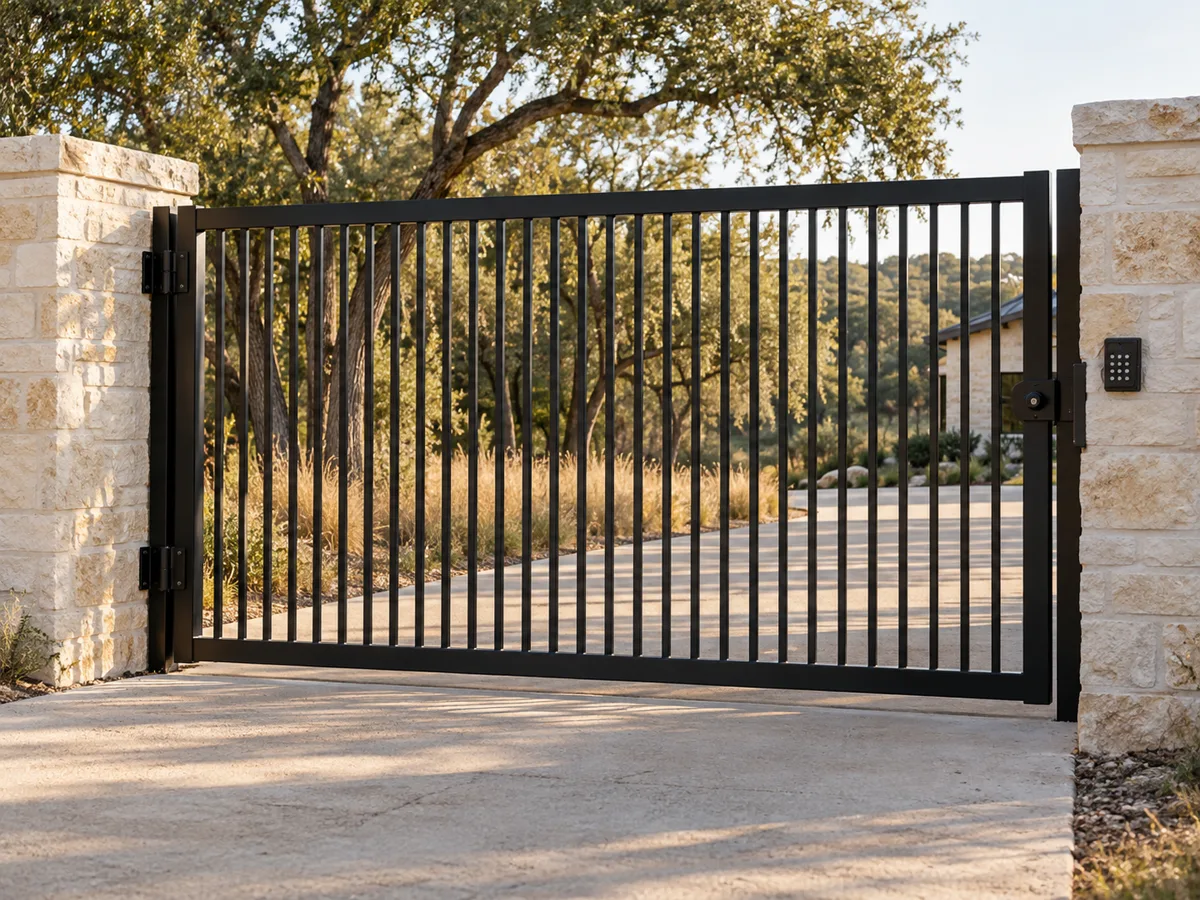
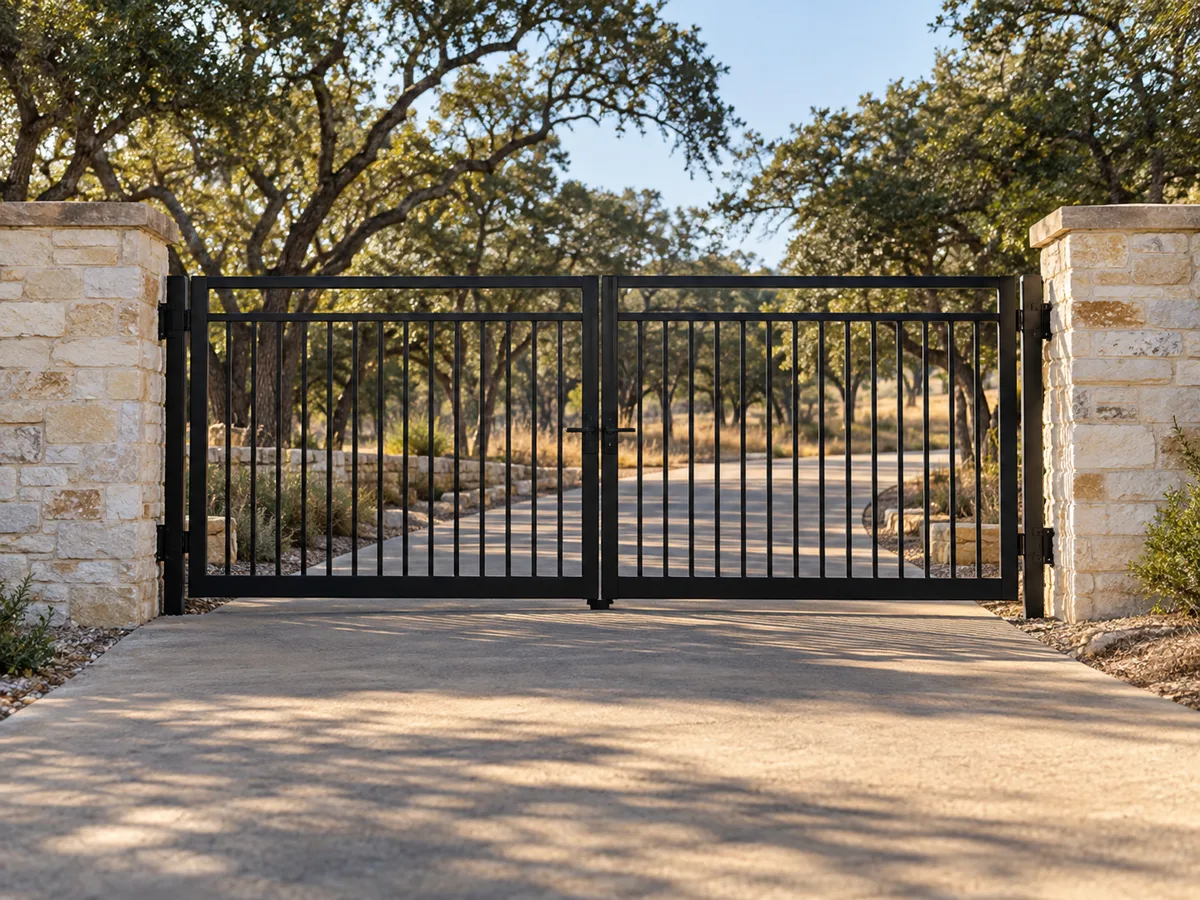
New black steel double driveway gate with vertical pickets, closed between two limestone columns

Weight, Posts, Hinges and Operators

Steel is dense, with a typical density between about 7,750 and 8,050 kilograms per cubic meter, so a big leaf is heavy and everything it hangs from has to be sized to match.

  • Posts and footings. A heavy swing leaf pulls on the hinge post every time it moves. We size the post and its footing to the finished weight of the gate, and in west Austin we set them into limestone under thin topsoil.
  • Hinges. The hinge is a bearing on one axis, and heavy gates call for weld-on barrel hinges or adjustable pivots rated for the load rather than light-duty butt hinges.
  • Wind. A solid steel face acts like a sail. If you want privacy, we can draw louvers or offset slats that spill wind while still blocking the view.
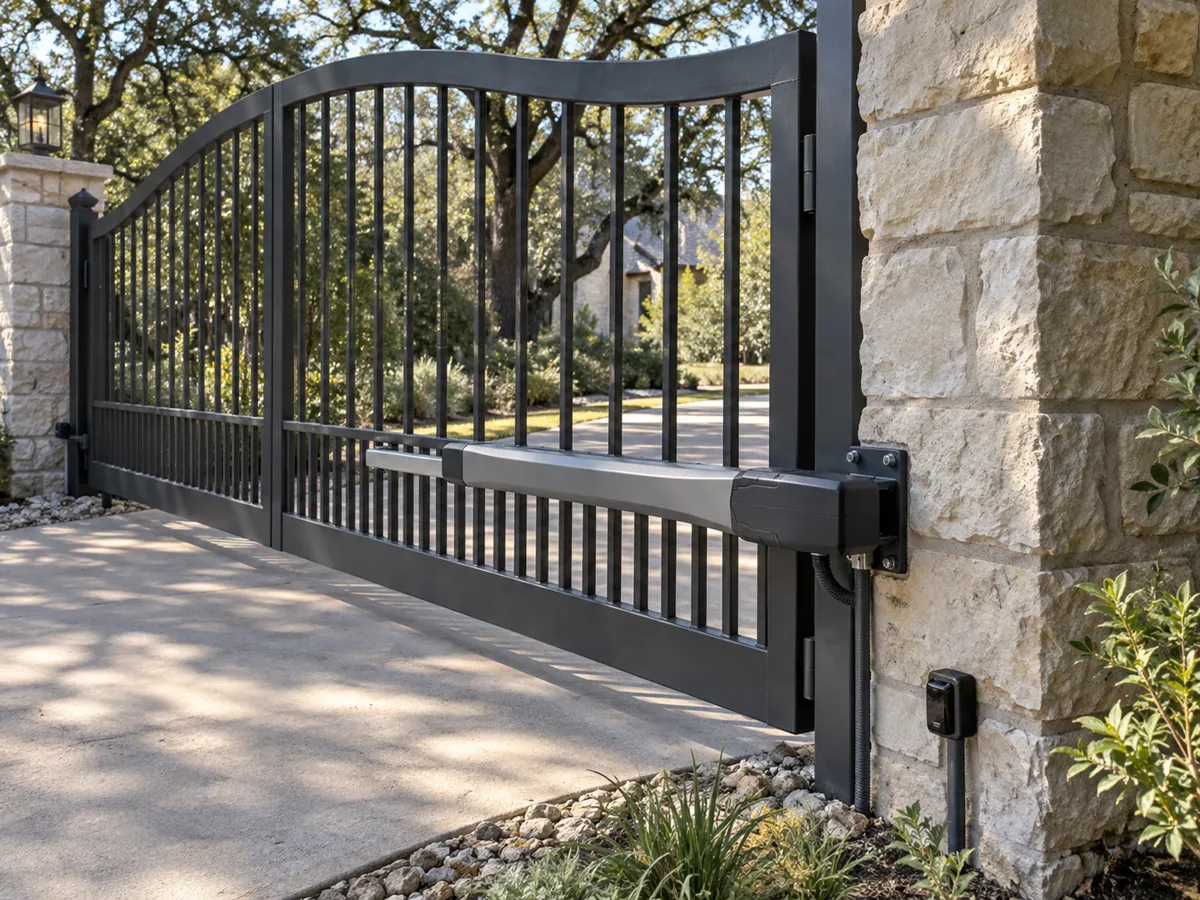
  • Operators. An automatic operator has a rated gate weight. A lighter tube frame keeps the motor working within its range, and the operator is set up to UL 325 when it goes in.

Weight is a design decision, not an accident, and we make it on the drawing before any tube is cut.

Galvanizing, Powder Coat and Rust in Central Texas

Bare steel rusts anywhere moisture reaches it, and Austin has plenty. It has a humid subtropical climate, rainfall of roughly 34 inches a year spread through the seasons, highs near 95 degrees in July and August and a handful of freezing nights each winter. That cycle of wet, heat and cold is hard on any unprotected joint.

Zinc first

After welding, we send the frame for hot-dip galvanizing. The steel is cleaned, pickled to remove mill scale and dipped in a bath of molten zinc near 450 degrees Celsius. Zinc reacts with air to form a dull gray carbonate layer that shields the steel beneath it, and a dip reaches the inside of hollow tube as well as the outside.

Color on top

Powder coat goes over the zinc. It is a dry powder that clings by electrostatic charge and cures in an oven, and it builds a tougher, thicker film than liquid paint without runs or sags. You pick the color from physical samples at the visit.

What still needs watching

Any finish can be scratched through. A chip that exposes bare metal is a place for rust to start, so a small touch-up early saves a bigger repair later. Aluminum forms its own oxide skin and sidesteps this problem, which is worth remembering in the next section.

Steel, Wrought Iron or Aluminum: Which Metal Suits Your Gate

Steel is the right answer for most heavy or wide entries. The other two metals have their own uses.

Wrought iron

True wrought iron has almost no carbon and carries fibrous slag, and the last plant making it commercially closed in 1973. Nearly every gate sold today as wrought iron is mild steel built to look forged, so the choice in practice is between steel styles.

Aluminum

Aluminum weighs about a third as much as steel and grows a thin protective oxide film, which suits lighter leaves and very long spans. It is not as stiff as steel for its size, so it needs thicker sections to carry a comparable load.

When we recommend steel

We lean toward steel when you want a substantial, rigid gate, a security line that resists forced entry, or a wide swing leaf on a driveway. We draw aluminum beside it if weight is the concern, and we note the tradeoff on the sheet. Some Central Texas communities also set the look by rule, so tube size, picket spacing and finish color follow your association's document.

What Drives the Cost of Steel Gate Installation

We do not post a set figure, because steel gates of the same width can differ widely in what goes into them. Here is what sets the price of a steel gate:

  • Opening width and leaf count. More steel and more hardware go into a wide pair than a single leaf.
  • Tube size and wall thickness. Heavier sections cost more in material and shop time.
  • Infill and design. Straight pickets, scrollwork and solid panels take different amounts of labor.
  • Galvanizing and powder coat. The dip, the coat and the color you select.
  • Swing, slide or cantilever. The way it moves sets the posts, footings and hardware.
  • Grade and footings. A sloping drive or rock under the post holes changes the work.
  • Operator and power. Type, duty cycle and whether power arrives by trench or solar.
  • Access control and safety devices. Keypads, intercom, photo eyes and edges.
  • Approvals. Permits and HOA or POA review.

Any range you hear for steel gates is an estimate and can change. The final price comes only from your written quote, which follows the free on-site measure.

The process

From Site Visit to a Gate That Runs

Four steps, and nothing is fabricated until you have signed off on the drawings and the price.

  1. Free site visit

    We measure the opening, the slope and where power can reach, and talk through style, automation and access.

  2. Drawings and a written price

    You get scaled drawings for your approval and for any HOA or city review, with one written price.

  3. Fabricated in our shop

    Steel is cut and welded to the approved drawings, then galvanized, powder coated or both.

  4. Installed and tested

    Columns and posts set, gate hung, operator set up to UL 325 and every safety device tested with you.

More of What We Build

Questions

Steel Gate Installation: Common Questions

Why choose a steel gate over aluminum or wood?

Steel is stiffer and heavier, so it resists sag and forced entry on wide openings. Wood rots and aluminum is lighter and less stiff. We can draw steel and aluminum side by side for your opening.

How thick should the steel be?

It depends on the width, height and whether the gate is automated. Your drawing states the wall thickness of each tube in inches or millimeters, so you can check what we build against it.

Will a steel gate rust in Austin?

Bare steel will. Ours is galvanized and then powder coated, which protects it in Austin's humid weather. A scratch through both coats can start rust, so early touch-up is worth doing.

Is a steel gate the same as a wrought iron gate?

Almost always. True wrought iron stopped being produced commercially in 1973, and gates sold as wrought iron today are mild steel made to look forged. We tell you what you are getting.

Can my existing posts hold a steel gate?

Sometimes. Steel is heavy, so we check each post for lean and footing size at the measure, and we say plainly if one needs a heavier footing first.

Can a steel gate be automated?

Yes. We build the leaf with operator mounting plates and a conduit path, and the operator is sized to the gate's weight and set up to UL 325.

What does steel gate installation cost?

It depends on width, tube size, finish, footings and whether it will be automated, so any range is an estimate. Your written quote sets the final price.

Do you need HOA approval for a steel gate?

Many associations in Travis County want a review. The owner is usually the applicant, and we supply the drawing, dimensions and finish color the committee asks for.

Do you cover my area?

We work across Travis County, including Austin, Rollingwood, West Lake Hills, Sunset Valley, Shady Hollow, Barton Creek, Lost Creek, Steiner Ranch, The Hills, Lakeway and Volente.

Free site visit

Talk to us about steel gate installation

Free on-site measure across Austin and the west side. We call you back to set a time.

Call (512) 503-9203

Calls only, we do not receive text messages.

Call (512) 503-9203