Skip to content

Wrought Iron Fencing in Austin, Built to the Rules of Your Street

Austin Metal Gates builds wrought iron fencing in Austin, TX, and is Travis County's trusted specialist in ornamental metal fence runs, specializing in tubular steel picket panels, flat-top iron sections and hot-dip galvanized posts. We offer powder-coated steel and aluminum fence lines.

  • Free on-site measure
  • Shop drawings you approve
  • Operators set up to UL 325
  • One written price

Request a free site visit

Or call (512) 503-9203. Calls only, we do not receive text messages.

About our wrought iron fencing

Our team provides custom picket layouts matched to the lot, delivering a finished boundary that frames the house and durable, low-maintenance perimeters for both residential and commercial projects. Every run is measured on site by the same crew that sets the posts, drawn up for your approval, then cut and welded in our own shop before a single hole is dug.

From picket spacing held tight enough to satisfy a no-spike ordinance to post holes set down into Hill Country limestone, our team handles every detail. Serving Austin, Sunset Valley, Lakeway and Barton Creek, we quote each run against the code or deed restrictions that govern your address.

Why Austin Metal Gates

How We Work

No stock panels cut down to fit, and no handoffs. The crew that measures your opening builds and installs the gate.

Measured on siteThe opening, the slope and the ground, measured where the gate will hang
Shop drawings firstYou approve the drawings and finish before any steel is cut
Welded in our own shopFrames fabricated and finished to your drawings, not ordered from a catalogue
Set up to UL 325Every operator installed with its safety devices tested before we leave

True Wrought Iron, Tubular Steel or Aluminum: What an Iron Fence Is Really Made Of

Almost nobody in Texas is buying true wrought iron, and it helps to know that before comparing quotes. Real wrought iron is nearly pure iron, under 0.05 percent carbon, threaded with fibrous slag. Commercial production stopped when steel became cheaper to make: the last plant in the United States closed in 1969 and the last one anywhere in 1973. What little is made now is recycled from scrap for heritage restoration. So the ornamental fence sold as wrought iron today is mild steel, shaped and welded to look like the hand-forged work it replaced. That is not a downgrade. It is the honest name for the product, and it lets us talk plainly about the three materials that actually compete for your fence line.

Tubular steel

Our standard steel run is built from hollow structural steel: square or rectangular tube for rails and posts, square or round pickets between them. Tube resists twisting well and welds cleanly, which is why it suits long runs and tall panels. Its weakness is the inside. Water that gets into a tube rusts it from within, so every open end we cut is capped or sealed before finish.

Solid bar

Solid square bar pickets are heavier and stiffer. They cost more steel per foot of fence and they give a denser, more traditional look, the one most owners picture when they say wrought iron.

Aluminum

Aluminum weighs about a third as much as steel and protects itself with a thin oxide skin, so it does not rust. It is also far less stiff than steel, which is why aluminum panels use larger sections to span the same distance. Around a pool or on a side yard it is a sensible choice. On a front line where you want mass and shadow, steel reads better.

Galvanizing and Powder Coat: Keeping a Steel Fence Sound in Central Texas

Austin reaches 90 degrees on roughly 123 days a year and 100 degrees on about 29 of them, and then the thunderstorms arrive. Bare steel in that cycle rusts fast. The finish is what decides whether your fence still looks right after a decade outdoors.

Hot-dip galvanizing

Galvanized steel has been dipped in molten zinc. The zinc works two ways: as a barrier over the steel, and as a sacrificial metal that corrodes first, so a scratch through the coating does not start a rust line under it. We galvanize the parts that live in the ground and the parts that take abuse.

Powder coat on top

Powder coating is sprayed dry with an electric charge, so the powder clings to the grounded steel, then it is baked, typically near 200 degrees Celsius. It builds a thicker film than liquid paint without runs or sags, and it releases almost no solvent. Preparation is most of the job: oil, mill scale and welding scale have to come off first or the coat will not hold. Polyester powders are the usual pick for sun exposure.

Color that passes review

Some rules name the finish. West Lake Hills asks for muted, natural colors and wants bright or shiny materials painted down. The Barton Creek Southwest guidelines for Amarra call for brown or bronze wrought iron style pickets. We match the powder to whatever the review body expects before we order it.

Flat Tops, Pointed Pickets and the Cities That Ban Spikes

A spear-point finial looks classic. In several cities near Austin it is also not allowed, and a fence built with one can be ordered changed.

  • Lakeway banned new spiked and open-picket fencing in 2019 because deer were impaled jumping ornamental metal fences. Its code now requires every fence, wrought iron included, to be continuous and flat-topped without spikes or sharp points.
  • Sunset Valley bans spiked pickets above the top rail and also bans pickets above that rail spaced more than 2 inches and less than 9 inches apart, the gap where a head or a leg gets trapped.
  • Rollingwood prohibits any fence top carrying exposed sharp or pointed material that could impale a person or an animal.
  • West Lake Hills prohibits sharp, pointed or penetrating materials on new fences.

The practical answer is a top rail that runs over the picket ends, or pickets that stop flush under it. Both look clean and both suit a modern house as well as a traditional one. If you want a decorative top, we can use a flat cap or a rolled scroll between rails rather than a point on top.

See-Through Front Fences, HOA Review and Texas SB 711

Ornamental iron is often the only fence a front yard is allowed to have, precisely because you can see through it. The limits vary street by street.

City codes

Rollingwood bans front-yard fences by default and allows one only at 3 feet or lower, with an average of 80 percent visibility and every component at least 15 feet from the curb. West Lake Hills wants 80 percent visibility too, native planting on the street side, and a setback of 20 feet from the pavement on lots under three quarters of an acre and 30 feet on larger lots. Its permit application asks for a post-to-post elevation showing picket size and spacing, which is exactly what our shop drawing already shows.

HOA and POA rules

Steiner Ranch keeps fences at least 2 feet behind the front wall of the house and bans chain link and wire, while lots backing onto greenbelt may run wrought iron on the rear line without prior approval. The Estates of Barton Creek allows no new wood and sets fence height at 6 feet, up to 8.

What SB 711 changed

Since September 1, 2025, Texas Property Code 202.023, as rewritten by SB 711, stops an HOA from prohibiting a perimeter fence outright. The association may still regulate fence type and material, may require a driveway gate to sit at least 10 feet back from the right-of-way, and, where a covenant says so, may prohibit fencing in front of the front-most building line. We check the current code and your deed restrictions at quote time, because both change.

What Drives the Cost of Wrought Iron Fencing in Austin

We do not publish a price, because two fences of the same length can differ widely in steel and labor. These are the things that move the number:

  • Length and height of the run, and how many corners, ends and gate openings break it up.
  • Material: aluminum, tubular steel or solid bar, and the gauge of pickets, rails and posts.
  • Top style: a flat top rail, a flush picket or a decorative scroll band.
  • Finish: galvanizing plus powder coat, and whether the color is standard or matched to an HOA palette.
  • Slope and grade: a run that follows a hillside needs racked or stepped panels drawn to the ground.
  • Footings: post holes in shallow Hill Country limestone take different tools and time than holes in deep clay.
  • Columns: masonry piers between iron panels, where a code such as Lakeway's sets their minimum size.
  • Walk gates built into the run, their hardware and any self-closing requirement.
  • Approvals: city permits, HOA or POA applications and the drawings each one asks for.
  • Removal of an old fence and haul-off.

Every quote starts with a free on-site measure, so the price you receive describes your fence rather than an average one.

How an Iron Fence Job Runs, From Measure to Final Walk

The site visit comes first. We walk the line, measure the run and the fall of the ground, note trees, utilities and drainage, and ask which review body governs your lot. You receive a drawing showing post spacing, picket layout, height, top and finish.

Once you approve it, and once any city or HOA approval is in hand, the panels are cut and welded in our shop, galvanized and powder coated. On site the same crew sets the posts, hangs the panels and checks every gate for swing and latch. The last step is a walk of the finished line with you, and the work is covered by a written warranty.

Where we build

We fence properties across Austin and the surrounding Travis County communities, including Rollingwood, West Lake Hills, Sunset Valley, Shady Hollow, Barton Creek, Lost Creek, Steiner Ranch, The Hills, Lakeway and Volente. Each has its own rulebook, and we read it before we draw.

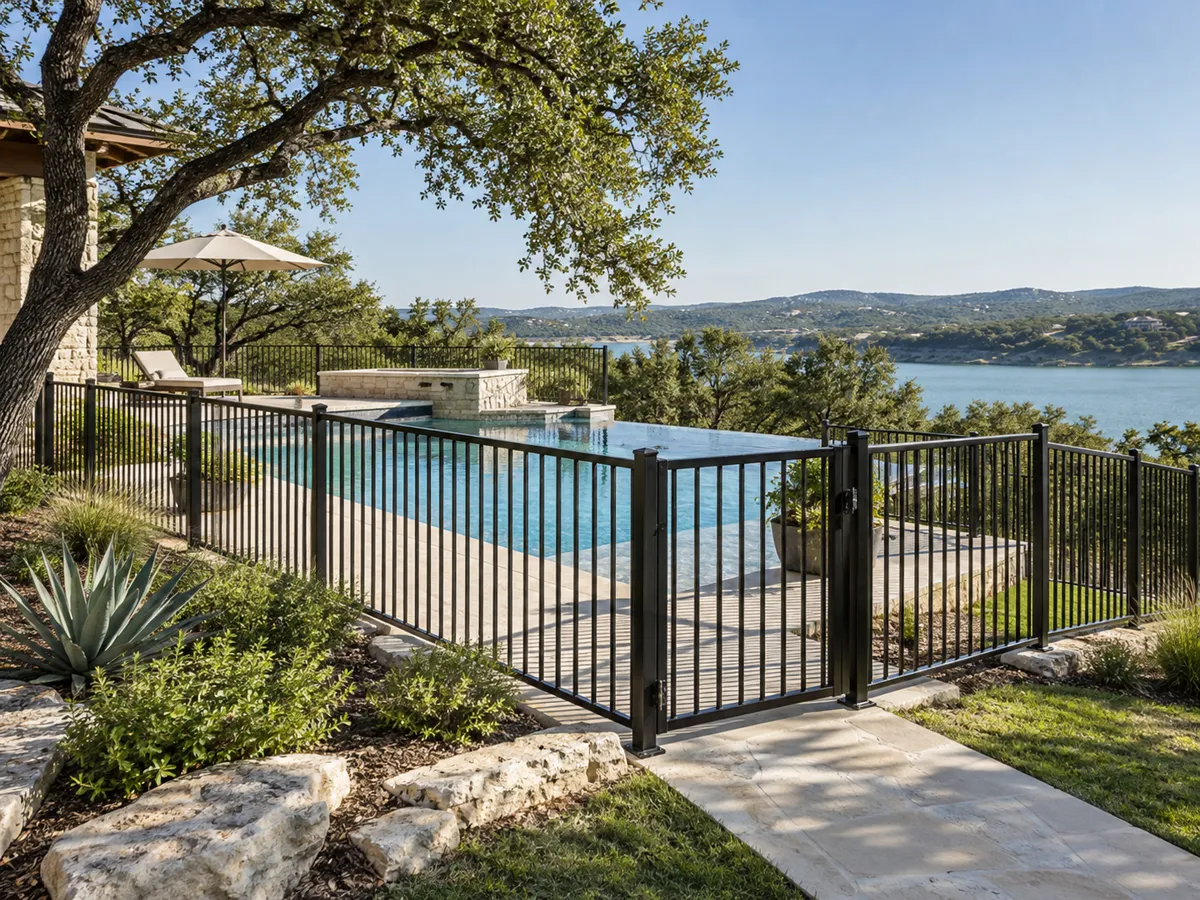
Black aluminum pool fence and self-closing gate around an infinity-edge pool overlooking a lake

The process

From Site Visit to a Gate That Runs

Four steps, and nothing is fabricated until you have signed off on the drawings and the price.

  1. Free site visit

    We measure the opening, the slope and where power can reach, and talk through style, automation and access.

  2. Drawings and a written price

    You get scaled drawings for your approval and for any HOA or city review, with one written price.

  3. Fabricated in our shop

    Steel is cut and welded to the approved drawings, then galvanized, powder coated or both.

  4. Installed and tested

    Columns and posts set, gate hung, operator set up to UL 325 and every safety device tested with you.

More of What We Build

Questions

Wrought Iron Fencing: Common Questions

What decides the price of an iron fence for my property?

Length, height, material and picket gauge come first, then the top style, the finish, the slope of the ground, footing conditions, any masonry columns or walk gates, and the approvals your city or HOA requires. We price it after a free site measure.

Is it real wrought iron?

No one is fabricating fences from true wrought iron anymore; commercial production ended in the 1970s. We build in mild steel or aluminum, which is what the industry sells as wrought iron, and we tell you exactly which one your quote uses.

My city bans spiked tops. Can I still get an ornamental look?

Yes. Lakeway, Sunset Valley, Rollingwood and West Lake Hills all restrict pointed tops in some form. A flat top rail over the pickets, or a scroll band between rails, keeps the fence decorative and legal.

Does my HOA have to approve the fence, and who files it?

In most Travis County subdivisions, yes. SB 711 means an HOA can no longer ban a perimeter fence outright, but it can still regulate type, material and front-yard placement. We supply the drawing and finish details for your application and can help you complete it.

Galvanized, powder coated, or both?

Both, for steel. Zinc protects the metal even where the coating is scratched, and powder coat gives the color and a thick outer film. Aluminum needs only the powder coat because it does not rust.

How long does fabrication take?

It depends on the length of the run, the finish and whether an HOA or city approval is pending. We give you a schedule with the drawing, and fabrication starts once the drawing and any approvals are signed.

Do you cover my area?

We work throughout Austin and Travis County, including West Lake Hills, Rollingwood, Barton Creek, Lost Creek, Steiner Ranch, Lakeway, The Hills, Volente, Sunset Valley and Shady Hollow.

What happens at the site visit?

We measure the run, check the grade and footing conditions, look for utilities and drainage, confirm the rules that apply to your lot and talk through materials and tops. The drawing and quote follow from that visit.

Is the fence covered after installation?

Yes. Every fence we build comes with a written warranty, and we walk the finished line with you before we leave.

Free site visit

Talk to us about wrought iron fencing

Free on-site measure across Austin and the west side. We call you back to set a time.

Call (512) 503-9203

Calls only, we do not receive text messages.

Call (512) 503-9203