Skip to content

Sliding Gates in Austin, Rolling Across the Drive on a Level Track

Austin Metal Gates builds sliding gates in Austin, TX, and is Travis County's trusted name in rolling driveway entries, specializing in V-groove wheel carriages, surface-mounted steel track and slide gate operators. We offer single-panel rolling builds and guide roller posts.

  • Free on-site measure
  • Shop drawings you approve
  • Operators set up to UL 325
  • One written price

Request a free site visit

Or call (512) 503-9203. Calls only, we do not receive text messages.

About our sliding & rolling gates

Our team provides a concrete track footing poured level across the opening, delivering an entrance that never sweeps the drive for homeowners and a compact, hard-working closure for both residential and commercial projects. We check the run-back room and the grade with our own crew before the shop drawings are made, and we fabricate each panel and its wheel boxes in our shop.

From setting the V-track dead level on its footing to the operator's stop point at full open, our team handles every detail. Serving Austin, Sunset Valley, Steiner Ranch and Lakeway, we fit rolling entries wherever there is a clear run along the fence.

Why Austin Metal Gates

How We Work

No stock panels cut down to fit, and no handoffs. The crew that measures your opening builds and installs the gate.

Measured on siteThe opening, the slope and the ground, measured where the gate will hang
Shop drawings firstYou approve the drawings and finish before any steel is cut
Welded in our own shopFrames fabricated and finished to your drawings, not ordered from a catalogue
Set up to UL 325Every operator installed with its safety devices tested before we leave

How a Rolling Gate Works on Its Track

A sliding gate, often called a rolling gate, is a single panel that travels sideways along the fence line to open. It rides on wheels that run on a track fixed to the ground across the opening.

The parts that carry it

  • The V-track. A steel rail with an inverted V profile, mounted on a concrete footing along the gate's path.
  • V-groove wheels. Wheels with a matching notch, mounted in wheel boxes welded or bolted to the bottom of the gate. They come in 4 and 6 inch sizes, and steel versions carry sealed bearings.
  • Guide rollers. Rollers on a post that hold the top of the panel upright as it moves, so the gate cannot lean.
  • The operator. A motor that drives the gate along the track, usually by chain or rack.

Because the wheels carry the weight on the ground, a rolling gate can be long and heavy without asking much of its posts. That is why sliding gates are so common on commercial properties, and why they work well on wide residential openings.

Side Clearance: Where the Gate Goes When It Opens

A rolling gate needs somewhere to go. When it opens, the whole panel moves beside the opening, so you need a clear run along the fence at least as long as the opening itself.

What we look for along the run

  • Trees, shrubs and irrigation heads in the path of the panel.
  • Air conditioning units, meters, mailboxes and utility boxes.
  • Landscape walls, steps or a change in grade along the fence line.
  • The neighbor's property line, if the run gets close to it.

The upside is that a slider takes up no room inside the drive. If your driveway is short, turns quickly, or climbs toward the house, the gate never has to sweep that ground. Where there is a clear stretch of fence and not much space behind the posts, a sliding gate often fits where a pair of swing leaves cannot.

If the run is there but the ground under it is uneven or gravel, a cantilever gate, which hangs from rollers instead of riding a track, is usually the better choice.

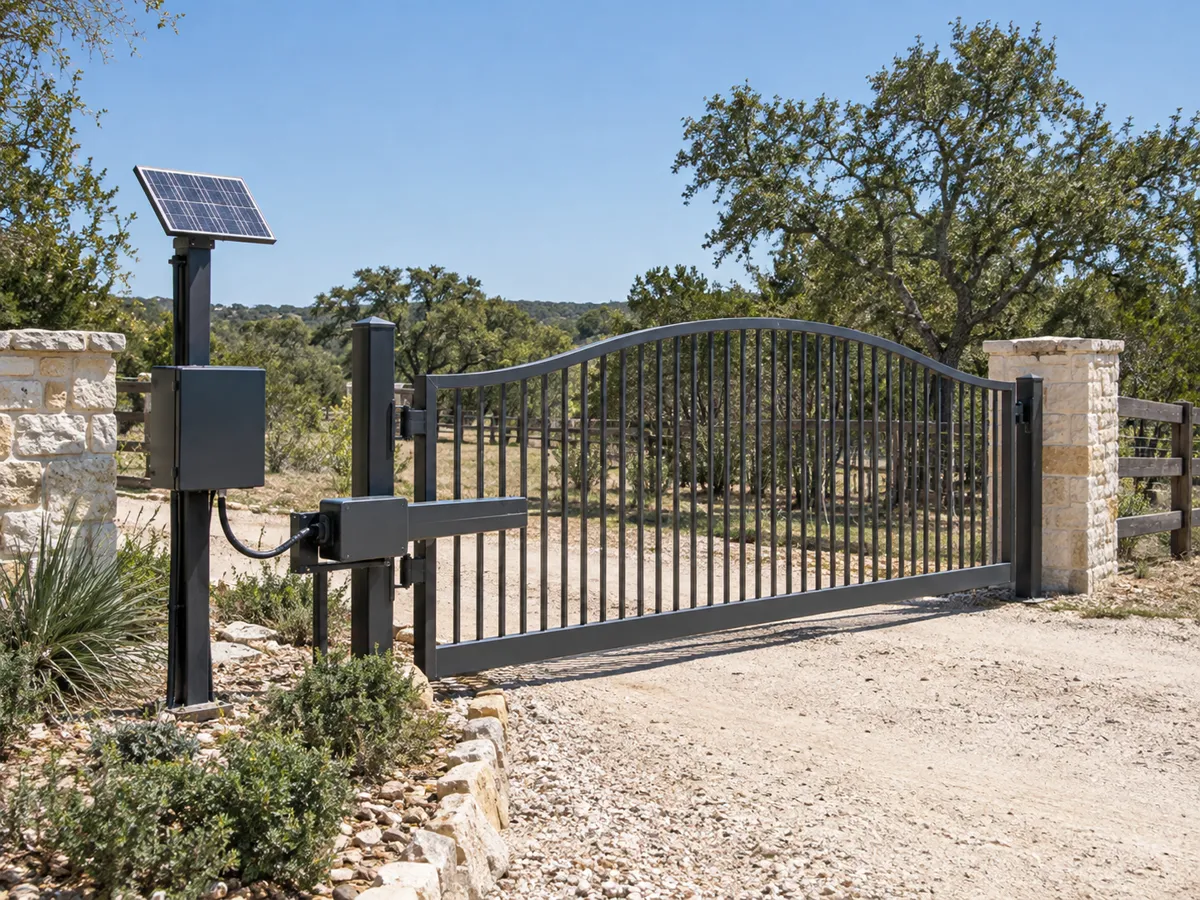
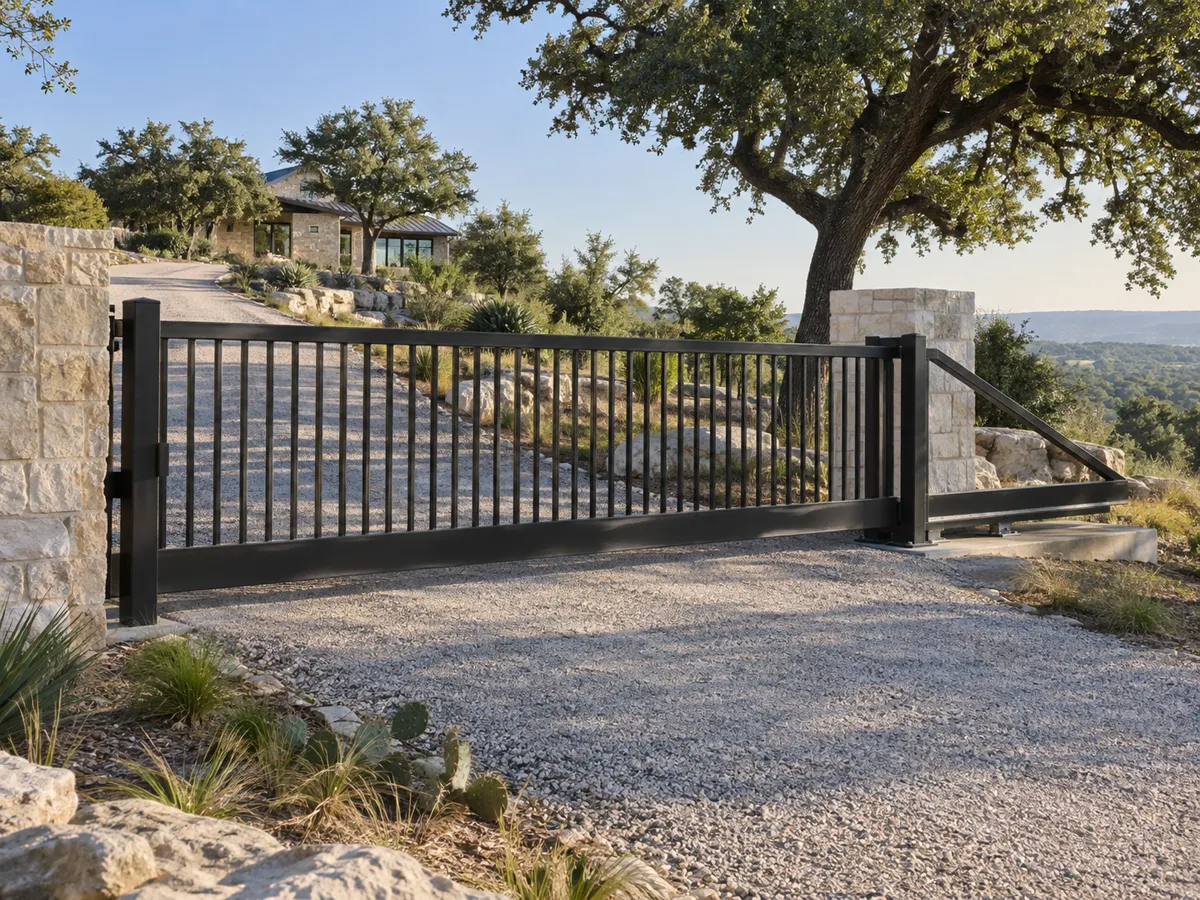
Black steel cantilever slide gate spanning a sloped gravel drive between limestone pillars, its counterbalance tail running along the fence line

Why the Track Needs a Level Drive

The track is the heart of a sliding gate, and it only works on level ground. A gate on a sloping track wants to roll downhill on its own, loads the operator unevenly and wears the wheels on one side.

Slope across the opening versus slope into the property

These are two different things. A drive that climbs from the street toward the house is not a problem for a slider, because the gate travels across the drive rather than into it. What matters is the grade along the line where the track sits. If that line is level, or can be made level with a small footing, a rolling gate works well.

How we set the track

We pour a concrete footing along the full path of the gate, from the far post to the end of its open position, and fix the V-track to it with a level on every section. On a paved drive that footing is cut in; on new work it is poured before the final surface goes down. When the grade along the opening is too steep or the surface is loose, we will recommend a cantilever gate instead rather than fight the ground.

Keeping the Track Clear of Debris

A ground track collects whatever washes or blows across the drive. Gravel, leaves, mud and small stones in the V can make a wheel ride up and jam the gate or trip the operator's obstruction sensing.

West Austin's hills are limestone under thin topsoil, and heavy thunderstorms send runoff and grit across driveways. We place the track so water drains off it rather than pooling, and we can add wheel covers to keep debris out of the wheel boxes.

Simple upkeep

Manufacturer guidance is to clean debris from the track, wheels, rollers and operator area every three to six months and to lubricate moving parts with an approved product. A quick sweep of the track does most of the work. If you would rather have no track to sweep at all, that is exactly what a cantilever gate is for.

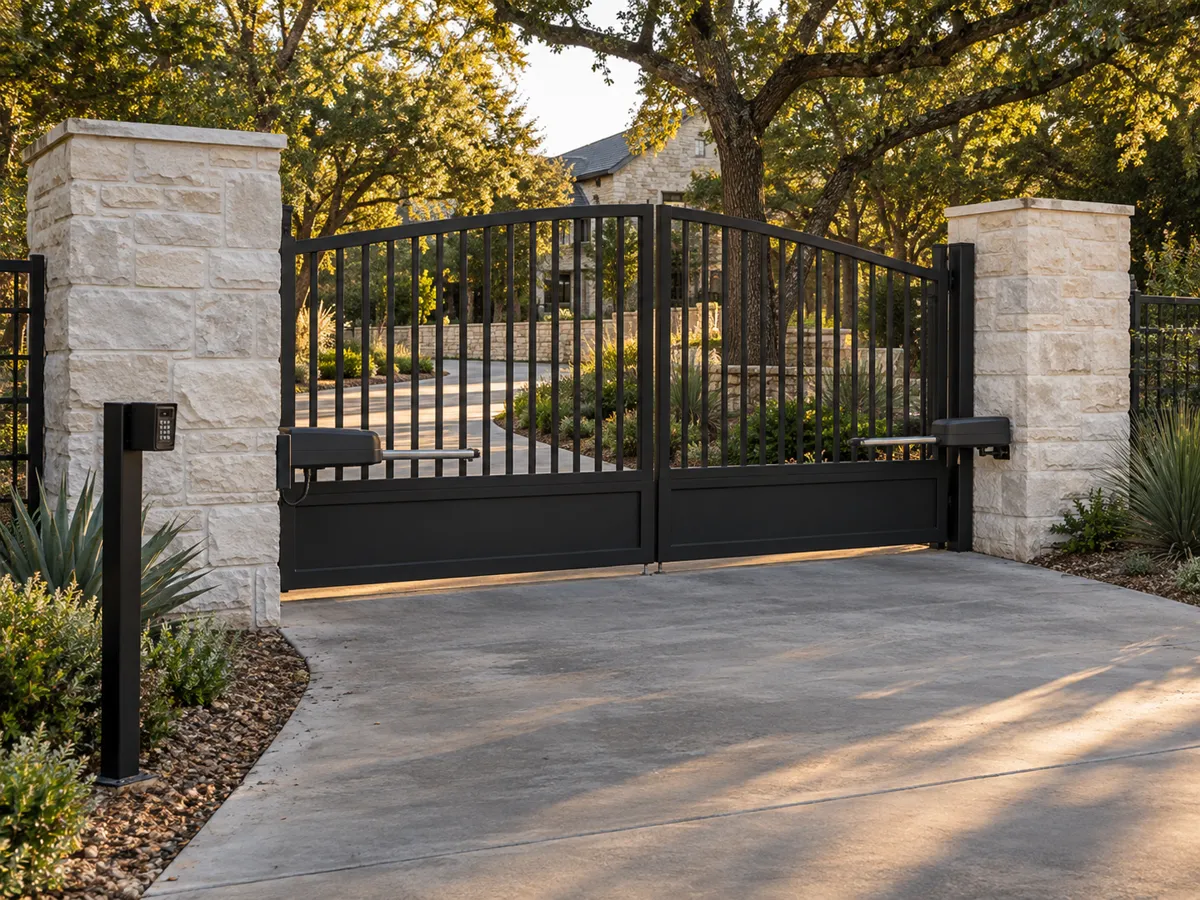
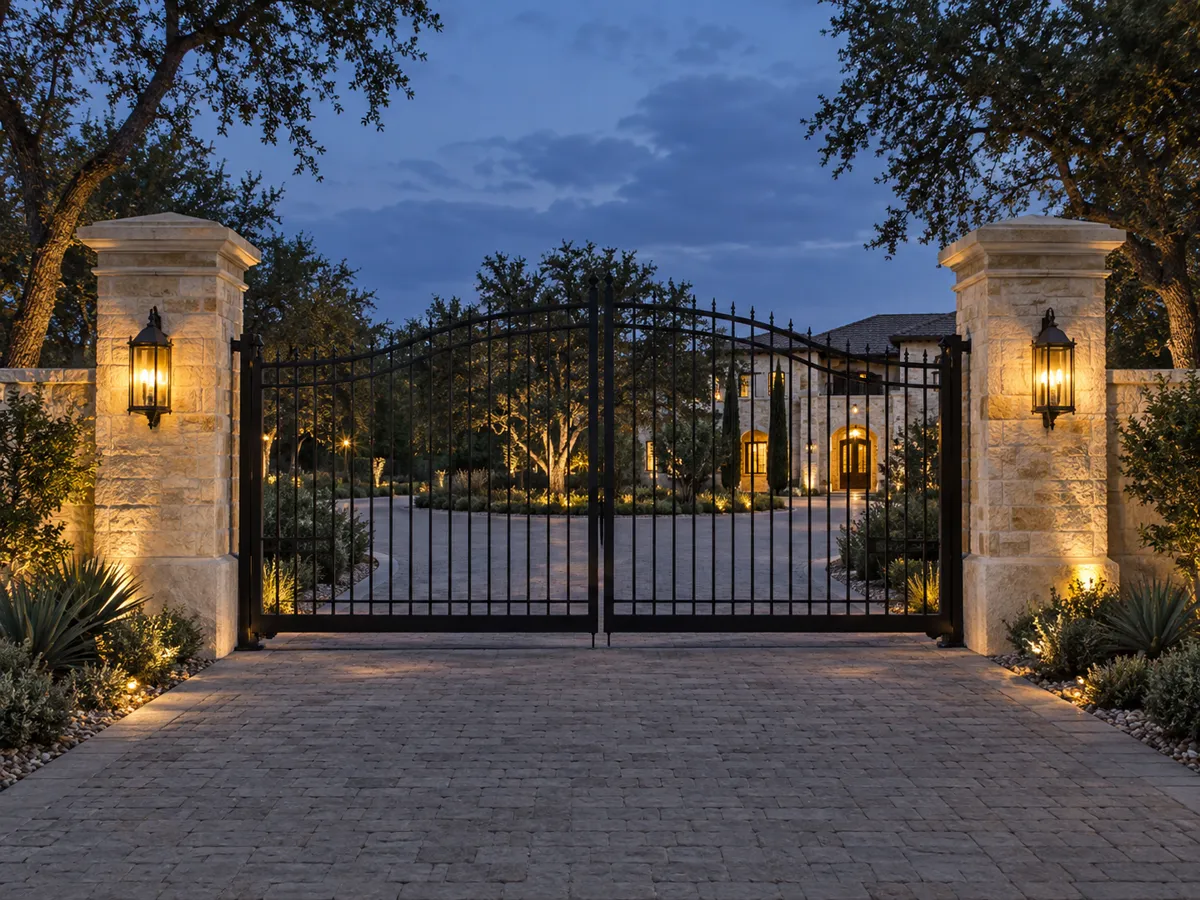
Black steel arched swing gate closed between limestone columns across a concrete drive, with a keypad post beside the drive at sunset

Sliding Gate Operators and UL 325 Safety

Automating a rolling gate is straightforward because the operator only has to push the panel along its track, not lift or swing it against the wind.

Operator choice

We size the operator to the finished panel weight and how often the gate will cycle. Hydraulic units deliver high torque for very heavy panels; electromechanical operators handle most residential rolling gates.

The safety standard

US gate installations must meet UL 325. For slide gate operators in the residential and commercial classes, the standard limits travel speed to one foot per second when the operator is pulling 75 pounds or more. It also requires at least two monitored entrapment protection devices for each entrapment area in each direction of travel.

Where the risks sit on a slider

The leading edge as it closes against the receiving post. The gap between the panel and the fence or post as it opens. The path across the drive, covered by photo eyes. We cover each zone with photo eyes or contact edges and screen the gap along the fence so hands cannot reach into the moving panel.

What Moves the Price of a Sliding Gate

We quote rolling gates from a measured drawing, never from a list. The drivers are:

  • Opening width, which sets panel length, weight and track length.
  • Metal and design: steel or aluminum, picket and frame gauge, and decorative detail.
  • Track footing, including cutting into an existing drive and any leveling work.
  • Run-back conditions, such as relocating landscaping or utilities in the gate's path.
  • Posts and guide rollers, set into the limestone under the drive.
  • Operator size and duty rating for the weight and daily use.
  • Power at the gate, trenched or solar.
  • Safety devices, including photo eyes, edges and screening.
  • Access control, intercom and any fire access key switch.
  • Finish, approvals and permits: galvanizing and powder coat, HOA or POA review, city permits.

Book the free on-site measure and we will check the run, the grade and the power before drawing your gate.

The process

From Site Visit to a Gate That Runs

Four steps, and nothing is fabricated until you have signed off on the drawings and the price.

  1. Free site visit

    We measure the opening, the slope and where power can reach, and talk through style, automation and access.

  2. Drawings and a written price

    You get scaled drawings for your approval and for any HOA or city review, with one written price.

  3. Fabricated in our shop

    Steel is cut and welded to the approved drawings, then galvanized, powder coated or both.

  4. Installed and tested

    Columns and posts set, gate hung, operator set up to UL 325 and every safety device tested with you.

More of What We Build

Questions

Sliding & Rolling Gates: Common Questions

Is a sliding gate or a swing gate right for my drive?

A slider suits drives with a clear run along the fence and little room behind the posts, including drives that climb toward the house. Swing leaves suit a level drive with room for the arcs.

How much room does a rolling gate need to the side?

At least the width of the opening, clear of trees, walls and utilities, plus a little extra for the gate's stop. We measure the run at the site visit.

Can you install a sliding gate on a gravel driveway?

A ground track needs a concrete footing and a level line. On gravel or uneven ground we usually recommend a cantilever gate, which has no track at all.

What happens to a sliding gate when the power goes out?

Battery backup keeps the operator running for a time after an outage, and every operator has a manual release so the panel can be rolled open by hand.

How do emergency vehicles get through?

We add the key switch or access box your fire district or city requires, such as the ESD 6 key switch Lakeway asks for on coded gates, and confirm it for your address at quote time.

Who files for HOA or POA approval?

The homeowner normally submits, and we provide the drawing, finish color and dimensions the committee needs. In Steiner Ranch, for example, the AC must approve fencing changes that differ from the standard.

Do you serve my part of Travis County?

Yes. We cover Austin, Sunset Valley, Steiner Ranch, Lakeway, Rollingwood, West Lake Hills, Shady Hollow, Barton Creek, Lost Creek, The Hills and Volente.

Does a sliding gate come with a warranty?

Yes, a written warranty, which we give you with the quote so you can read it before the job is booked.

Free site visit

Talk to us about sliding & rolling gates

Free on-site measure across Austin and the west side. We call you back to set a time.

Call (512) 503-9203

Calls only, we do not receive text messages.

Call (512) 503-9203