Skip to content

Commercial Security Fencing in Austin, Specified for the Site You Protect

Austin Metal Gates installs commercial security fencing in Austin, TX, and is a trusted Travis County specialist in perimeter protection, specializing in anti-climb mesh fencing, steel palisade fencing and ornamental security fence lines. We offer welded wire panels for equipment yards and vertical bar fencing for school and office campuses.

  • Free on-site measure
  • Shop drawings you approve
  • Operators set up to UL 325
  • One written price

Request a free site visit

Or call (512) 503-9203. Calls only, we do not receive text messages.

About our commercial security & perimeter fencing

Our team provides the gates, posts and footings that complete each run, delivering a boundary that slows an intruder and still looks deliberate from the street, for both residential and commercial projects. We measure every fence line and corner ourselves, send elevation drawings for sign-off, and weld the matching gates in our own shop so the fence and its openings finish as one system.

From the three-inch by half-inch aperture that leaves no finger or toe hold on an anti-climb panel to a full perimeter with vehicle and pedestrian gates, our team handles every detail. Serving Austin, West Lake Hills and Lost Creek, we check each line against the code that governs it before anything is ordered.

Why Austin Metal Gates

How We Work

No stock panels cut down to fit, and no handoffs. The crew that measures your opening builds and installs the gate.

Measured on siteThe opening, the slope and the ground, measured where the gate will hang
Shop drawings firstYou approve the drawings and finish before any steel is cut
Welded in our own shopFrames fabricated and finished to your drawings, not ordered from a catalogue
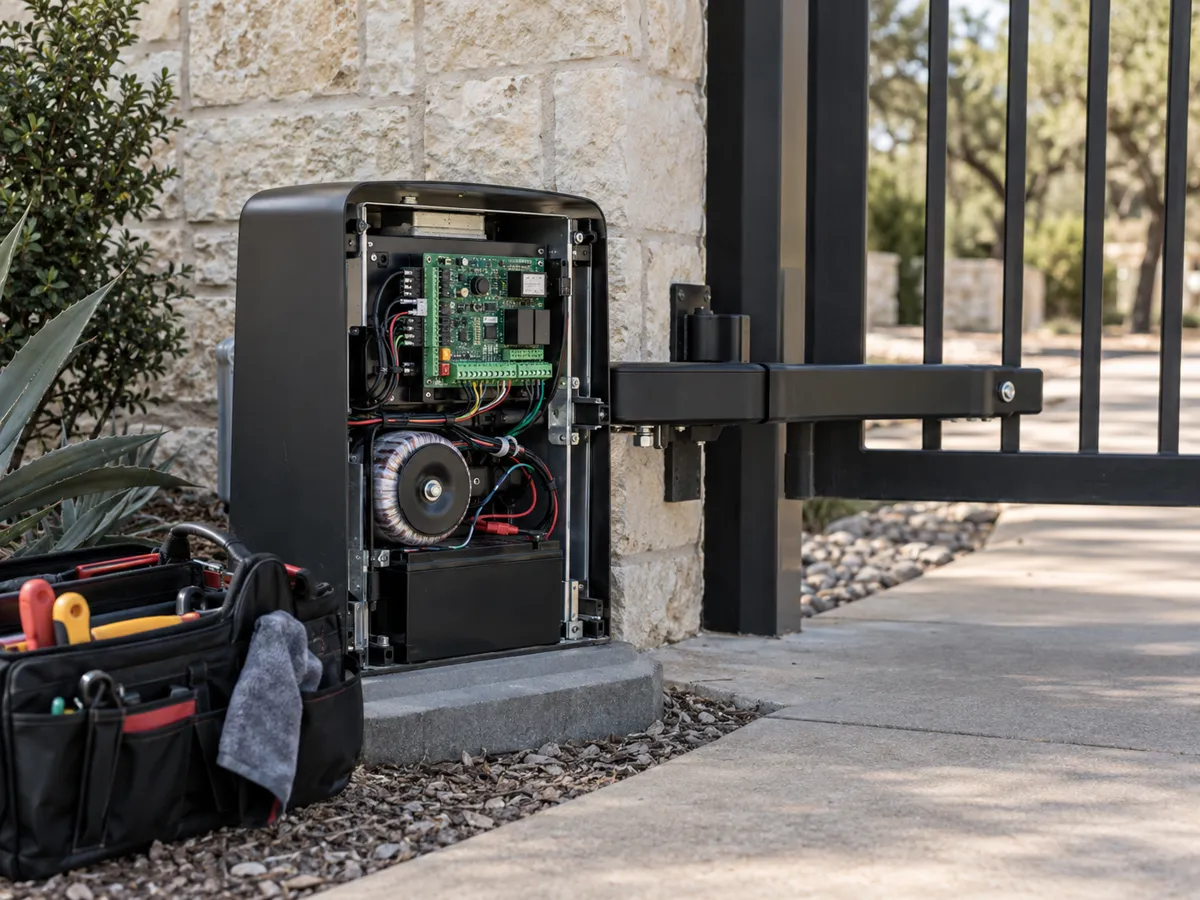
Set up to UL 325Every operator installed with its safety devices tested before we leave

Security Fencing for Yards, Utilities, Schools and Campuses

A perimeter fence marks the boundary and makes crossing it slow, visible and difficult. That extra time is what the fence is for: it gives cameras, alarms and staff a chance to respond. This page is written for facility managers, property managers, general contractors and developers who need a fence line specified to a threat rather than picked from a catalog.

  • Equipment and storage yards: anti-climb mesh or palisade around vehicles, materials and tools.
  • Utility and infrastructure compounds: tight-aperture mesh that resists climbing and cutting.
  • Schools and campuses: vertical bar fencing that secures the grounds without looking like a compound.
  • Office parks and retail backs of house: ornamental steel lines at the front, heavier mesh at service areas.
  • Construction and development sites: permanent perimeter lines built ahead of the buildings they will protect.

Every run ends at a gate, and gates are where fences are usually beaten. Vehicle openings and pedestrian gates are fabricated with the fence, not bought separately.

Anti-Climb Mesh, Palisade and Chain Link Compared

Anti-climb welded mesh

The high-security standard is often called 358 mesh, after its three-inch by half-inch apertures in roughly 8-gauge (about 4 mm) wire. The openings are too narrow for fingers or boot toes, which makes the panel hard to climb and hard to cut with hand tools, while the horizontal apertures keep sight lines through the fence. It is used at prisons, government buildings and high-risk sites, and it is normally galvanized after welding and then coated.

Steel palisade

Palisade is built from vertical steel pales bolted to horizontal rails, which are fixed to posts. Pales come in two main profiles. D-section pales suit low and medium security and decorative lines. W-section pales, folded for stiffness, suit higher security. Heads can be single point, triple point or rounded, and the top you choose is controlled by local code, covered below.

Vertical bar and ornamental steel

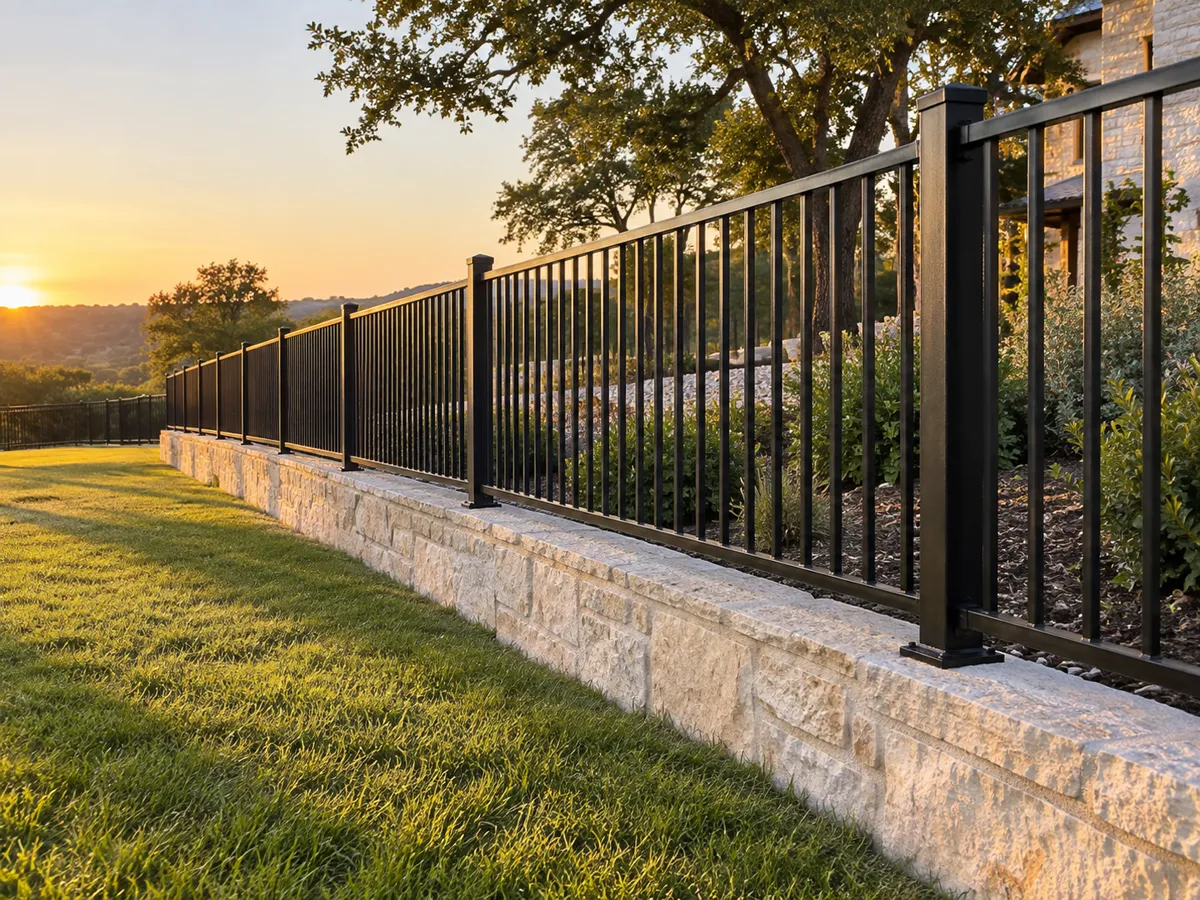
Vertical bar fencing has dominated commercial perimeter work since the 1980s. It reads as architecture rather than security, which is why schools, campuses and office fronts choose it, and it can be built with close bar spacing and a flat top.

Chain link with security toppings

Chain link is the lowest-cost option, galvanized or polymer-coated steel woven into a diamond mesh, commonly two inches. It is easy to climb and to cut, so on a security line it usually carries a topping, which several cities around Austin restrict. We recommend it for low-risk lines and interior separation, not for the boundary that matters most.

Fence Height, Tops and the Local Code

Security fencing is still fencing under a city code, and the codes around Austin say a good deal about what a fence may look like. We check the current text for your address at quote time because codes change, and we design to it rather than around it.

  • Lakeway: since a 2019 ordinance, all fences, including wrought iron and ornamental, must have a continuous flat top without spikes or sharp points. Yard fences run up to 6 feet administratively and 8 feet with the code official's approval, and any new fence needs a building permit.
  • West Lake Hills: barbed wire and sharp, pointed or penetrating materials are prohibited on new fences, and electrified fences are capped at 4 feet. A fence may reach 8 feet outside the setback if it is at least 80 percent transparent.
  • Rollingwood: chain link, barbed wire and electrified fences are prohibited, and no fence top may carry exposed sharp or pointed material.
  • Sunset Valley: spiked pickets above the top rail are banned, chain link must use knuckle selvage, and replacing more than half a fence brings the whole fence under the current rules.

A triple-point palisade head or a razor topping that is standard on an industrial site elsewhere may simply not be allowed here. Where the code rules out a sharp top, anti-climb mesh and close-spaced flat-top bar deliver the security through the panel itself.

Gates, Detection and the Rest of the Perimeter

A fence is the passive layer of a perimeter. The active layer is detection, and the strongest sites combine both.

Gates that match the fence

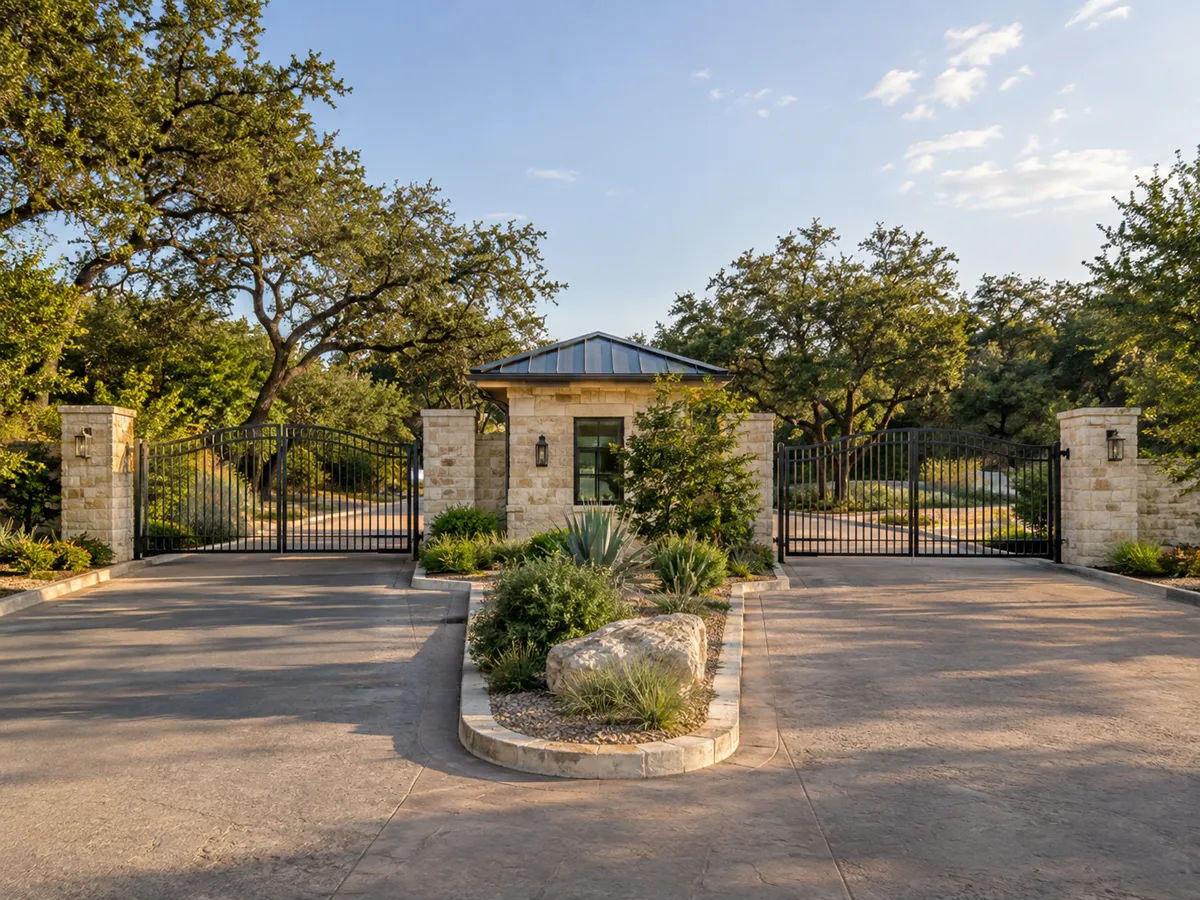
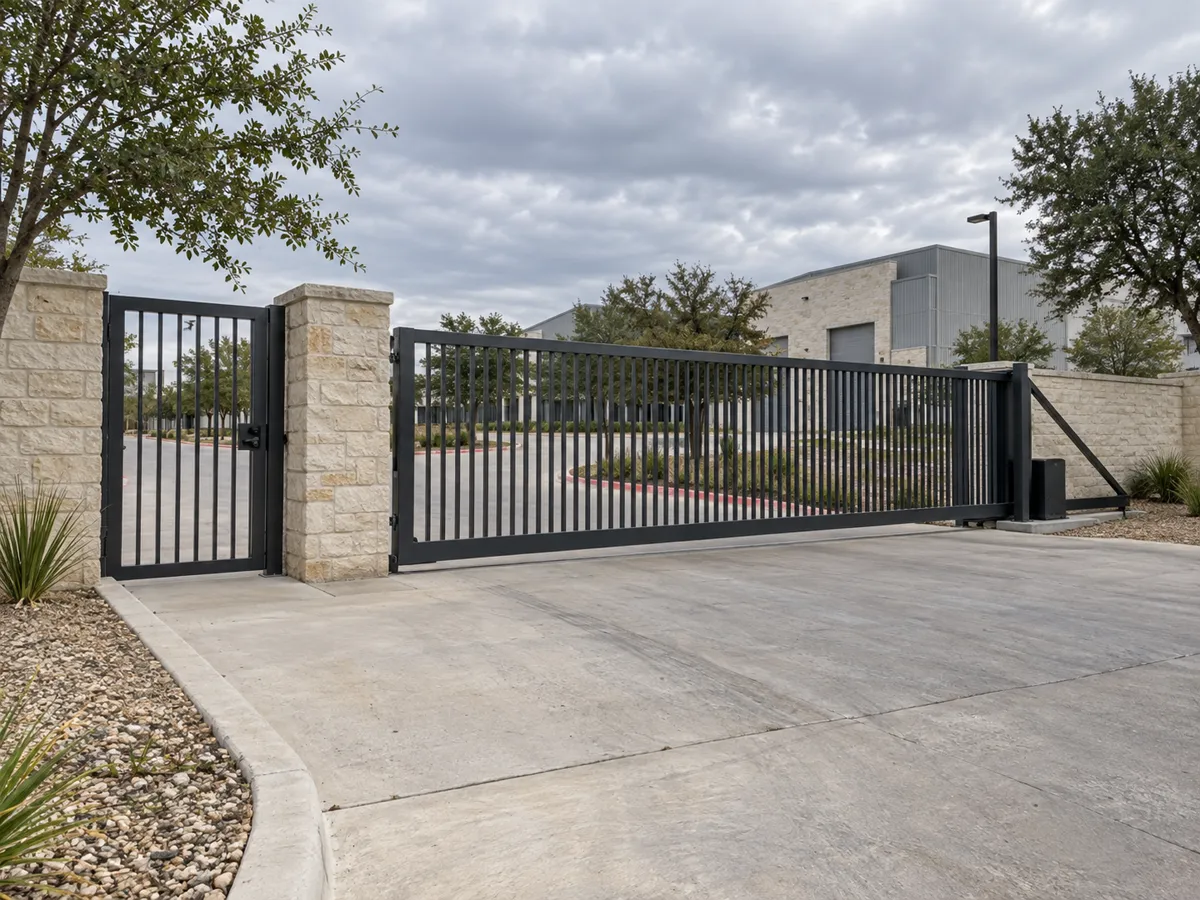
A mesh fence with a light gate is a mesh fence with a hole in it. We build vehicle gates, cantilever or swing, and pedestrian gates in the same infill as the line, with operators listed to UL 325 where the vehicle gate is automated and access control at every opening.

Fence-mounted sensors

Sensors fixed to the fence can detect cutting, climbing, lifting or an attempt to bypass the line, and raise an alarm for a monitoring operator. We leave conduit, mounting provisions and clear zones for your security integrator and coordinate the layout on the drawings.

Fire access at the perimeter

If a gate in the fence crosses a fire apparatus access road, it needs the fire code official's approval and a means for firefighters to open it. We show that device on the submittal.

Clear zones and grade

A fence line that crosses a ditch or runs above a gap at the bottom rail can be crawled under. We follow grade, close gaps at drainage crossings and keep landscaping from becoming a ladder.

From Site Survey to Closeout on a Perimeter Job

Survey and layout

We walk the line with you, locate corners, grade changes, drainage, utilities and every opening, and mark where the fence ties into buildings or neighboring walls.

Bid and submittals

You receive a written bid with clarifications, then shop drawings, panel and post details, footing sections and product data for review by you, your architect or engineer.

Fabrication and finish

Gates and custom panels are welded in our own shop. Steel is hot-dip galvanized, dipped in molten zinc so the zinc corrodes before the steel does, and powder coated where a color is specified.

Phased installation

On an operating site we sequence the line so the existing fence stays up until each new section is closed, keeping the perimeter secure every night of the job.

Closeout

Gates and operators are tested, as-built drawings are handed over, and the work is covered by our written warranty.

What Drives the Cost of Commercial Security Fencing

We do not publish a price for perimeter fencing. The bid comes from the drivers below.

  • Length of the line and number of corners: corners and ends take heavier terminal posts.
  • Fence type: anti-climb mesh, palisade, vertical bar or chain link.
  • Height: taller panels need heavier posts and deeper footings, and the code may cap height.
  • Panel and pale specification: wire gauge, aperture, pale profile and thickness.
  • Tops and toppings: flat tops, or a topping where the code allows one.
  • Finish: galvanized, or galvanized and powder coated.
  • Ground: limestone on the west side of Austin or clay to the east, grade changes and drainage crossings.
  • Gates: the number of vehicle and pedestrian openings, operators and access control.
  • Detection provisions: conduit and mounting for fence sensors and cameras.
  • Permits and approvals: city permits, association review and fire access approval.
  • Phasing: keeping an operating site secure through the work.

Call to set up a free walk of your fence line and a written bid.

The process

From Site Visit to a Gate That Runs

Four steps, and nothing is fabricated until you have signed off on the drawings and the price.

  1. Free site visit

    We measure the opening, the slope and where power can reach, and talk through style, automation and access.

  2. Drawings and a written price

    You get scaled drawings for your approval and for any HOA or city review, with one written price.

  3. Fabricated in our shop

    Steel is cut and welded to the approved drawings, then galvanized, powder coated or both.

  4. Installed and tested

    Columns and posts set, gate hung, operator set up to UL 325 and every safety device tested with you.

More of What We Build

Questions

Commercial Security & Perimeter Fencing: Common Questions

How is a security fence priced?

From a walk of the line. Length, corners, fence type, height, panel specification, finish, ground, gates and phasing all move the number, and you receive a written bid with clarifications.

Anti-climb mesh or palisade for our yard?

Anti-climb mesh gives the tightest resistance to climbing and cutting and keeps sight lines open. Palisade is heavy and visible, and the W-section profile suits higher security. Where local code bans pointed tops, mesh or flat-top palisade is the usual answer.

Can we put barbed or razor wire on top?

It depends on where the site is. Rollingwood and West Lake Hills prohibit barbed wire, and Lakeway requires a flat top on every fence. We check the current code for your address before we design the top.

How tall can a commercial security fence be?

The code for your address sets it. Lakeway allows 6 feet administratively and 8 feet with approval, and West Lake Hills allows 8 feet outside the setback on a fence at least 80 percent transparent. We confirm the limit at quote time.

Do you install the gates as well as the fence?

Yes. Vehicle and pedestrian gates are welded in our shop in the same infill as the fence, with operators and access control where the gate is automated.

What is the lead time for a perimeter job?

Fabrication is scheduled once shop drawings are approved and material is confirmed. We give you dates at that point and sequence the install so the site stays secure.

Do you work outside the Austin city limits?

Yes, across Travis County, including West Lake Hills, Lost Creek, Sunset Valley, Rollingwood and Lakeway, each checked against its own code.

What warranty comes with the fence?

A written warranty, handed over at closeout with the as-built drawings.

What happens at the site visit?

We walk the whole line, note corners, grade, drainage and utilities, count the openings, and talk through what you are protecting. A scope and bid follow.

Free site visit

Talk to us about commercial security & perimeter fencing

Free on-site measure across Austin and the west side. We call you back to set a time.

Call to Discuss Scope

Calls only, we do not receive text messages.

Call (512) 503-9203