Skip to content

Iron Railings in Austin for Stairs, Decks and Porches

Austin Metal Gates builds iron railings in Austin, TX, and is Travis County's trusted ironwork specialist, specializing in stair railings, deck railings and porch railings with graspable handrails. We offer interior balustrades and powder-coated exterior guards.

  • Free on-site measure
  • Shop drawings you approve
  • Operators set up to UL 325
  • One written price

Request a free site visit

Or call (512) 503-9203. Calls only, we do not receive text messages.

About our iron railings

Our team provides handrail fabrication shaped to the code's grip profile, delivering safe, handsome staircases for homes and durable guard lines for both residential and commercial projects. Every run is measured on site by the same crew that installs it, drawn up for your approval, and welded in our own shop before it reaches your steps.

From baluster spacing checked against a four-inch sphere to a finished stair run with returns at both ends, our team handles every detail. Serving Austin, Rollingwood, Shady Hollow and Steiner Ranch, we fit railings built to the code's numbers rather than to a guess.

Why Austin Metal Gates

How We Work

No stock panels cut down to fit, and no handoffs. The crew that measures your opening builds and installs the gate.

Measured on siteThe opening, the slope and the ground, measured where the gate will hang
Shop drawings firstYou approve the drawings and finish before any steel is cut
Welded in our own shopFrames fabricated and finished to your drawings, not ordered from a catalogue
Set up to UL 325Every operator installed with its safety devices tested before we leave

Iron Railings We Build for Austin Homes

A railing is two jobs in one piece of steel. The guard keeps a person from going over an open edge, and the handrail gives a hand something to hold on the way up or down. We design both together so they look like one line of ironwork rather than two parts bolted to each other.

Interior stair railings

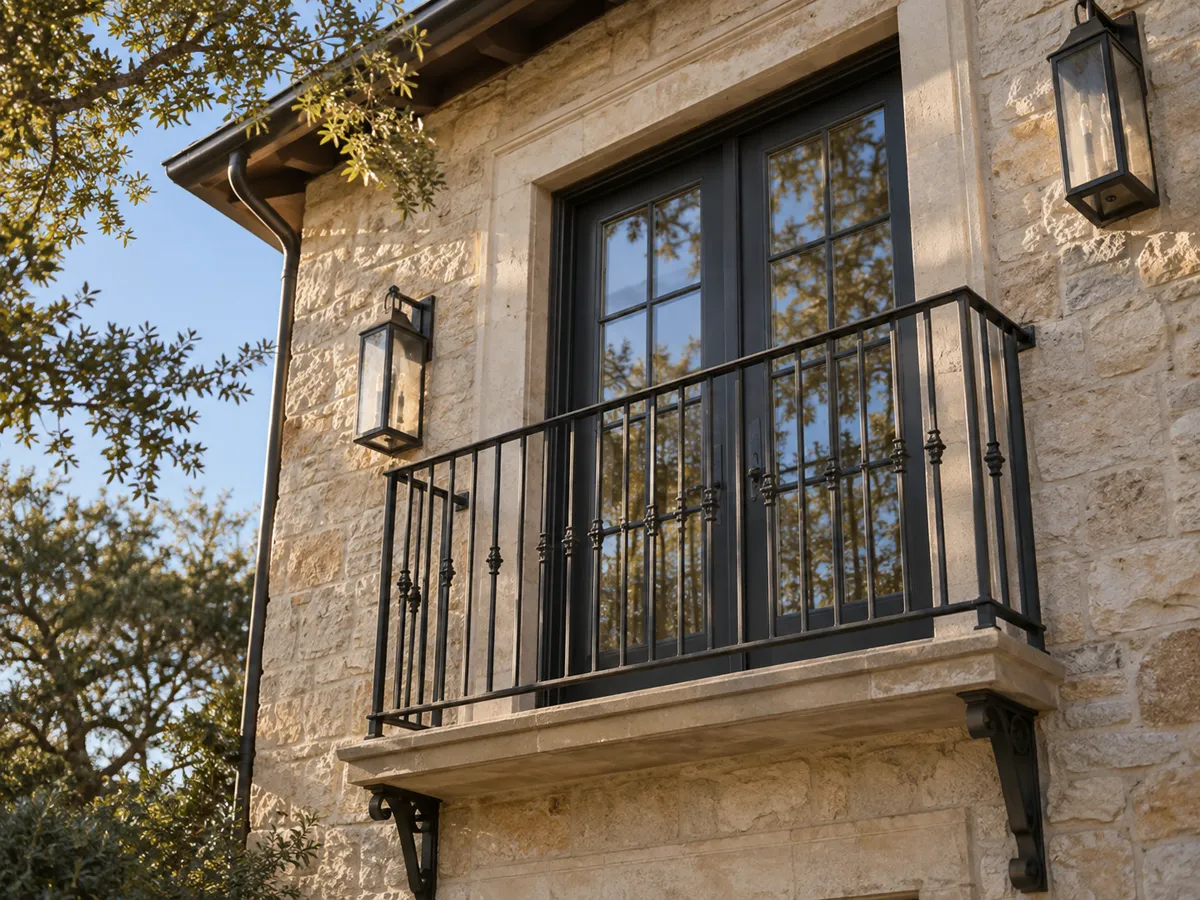
A balustrade is a row of balusters carrying a rail, and on an interior stair it is the first thing a guest sees from the entry. We build square bar, round bar, twisted and scrolled patterns, and we anchor the run at newel posts, the heavier posts that hold the handrail and tie back into the floor structure below.

Exterior stair and porch railings

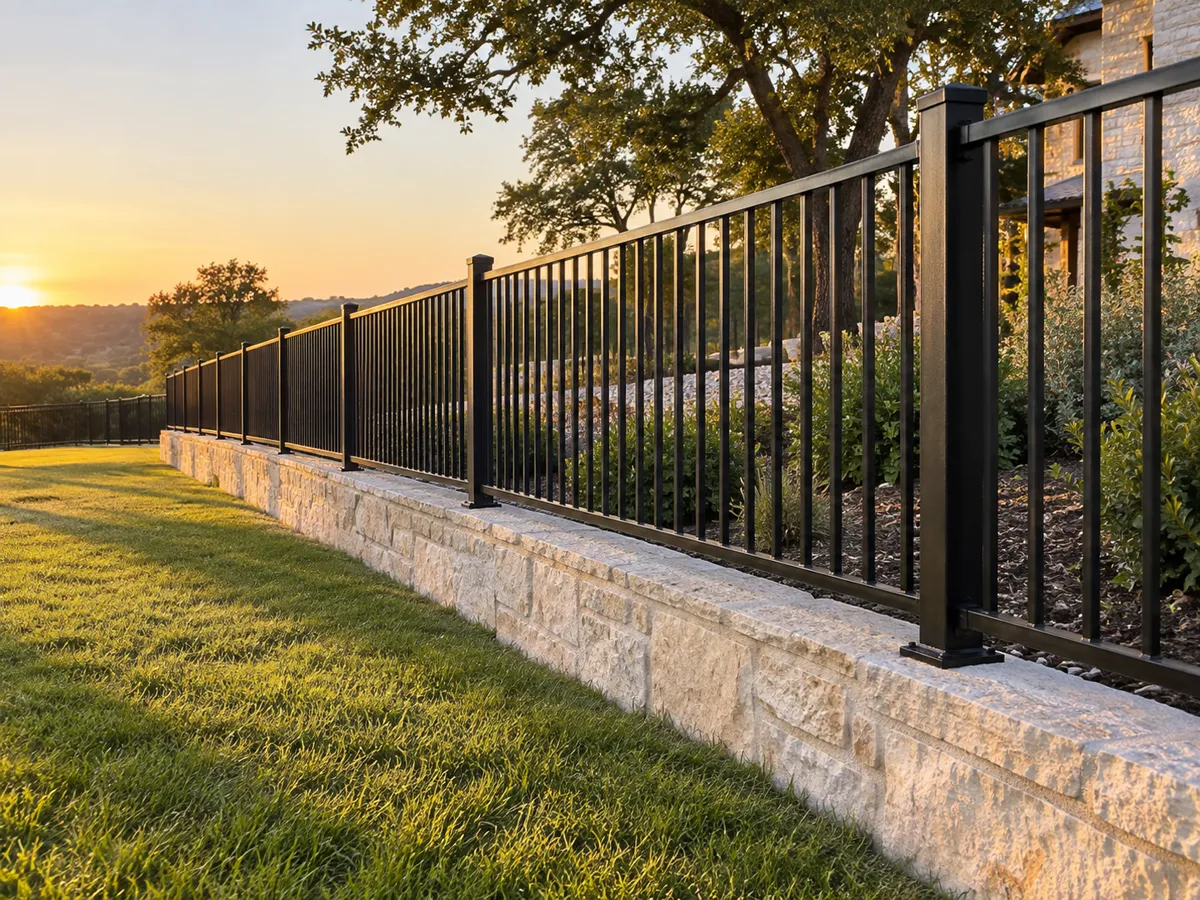
Front steps, porch edges and walkout stairs take sun, rain and hands every day. These runs get a galvanized or exterior-grade powder-coated finish and are fastened into the concrete, stone or framing that is actually there, which we confirm at the measure.

Deck railings

A raised deck edge is a guard location under the code, so the rail height and the gaps between pickets are set by rule, not by taste. We work to those numbers first and then to the look you want.

Wall-mounted handrails

Where a stair runs between two walls there is no guard to build, only a handrail. We make these in steel or with a wood cap on a steel core, mounted on brackets that hold the rail off the wall.

Guard Height and Baluster Spacing Under the Residential Code

The International Residential Code sets the numbers every guard has to meet. The figures below are from the 2015 edition as published in a building inspection firm's stair guide; the edition and local amendments Austin enforces are confirmed against the current code when we quote your job.

  • Where a guard is required: along any open side of a walking surface, stair, ramp or landing that sits more than 30 inches above the floor or grade below, measured at any point within 36 inches of the edge.
  • Guard height: at least 36 inches above a porch, balcony, landing or other walking surface.
  • Guards on the open side of a stair: at least 34 inches, measured from a line connecting the leading edges of the treads. Where that guard top also serves as the handrail, it must land between 34 and 38 inches.
  • Openings in a level guard: no gap may let a 4 inch sphere pass.
  • Openings in a stair guard: no gap may pass a sphere of 4 and 3/8 inches, and the triangle formed by the riser, tread and bottom rail must stop a 6 inch sphere.

Those three sphere sizes decide your baluster layout. On a sloped stair the spacing between bars changes as the rail climbs, so we lay the pickets out on the drawing at the real rake of your stair instead of copying a flat spacing onto it. Insect screening, the code notes, never counts as a guard, which matters on screened porches.

Floating white oak staircase with a matte black flat-bar iron railing and landing guard beside a limestone wall in a bright entry hall

A Handrail You Can Actually Grip

A handrail is designed to be grasped, and the code measures that literally. A flat bar laid across the top of a guard looks tidy and fails the test, because a hand cannot close around it.

Grip profiles

A Type I handrail is round, between 1 and 1/4 and 2 inches across, or a non-round shape with a perimeter of 4 to 6 and 1/4 inches and no cross section wider than 2 and 1/4 inches. A larger rail can still pass as Type II, but only with a finger recess on both sides of the profile. We draw your rail profile on the shop drawing so you can see which type you are getting.

Height, continuity and ends

A handrail is required on at least one side of any flight with four or more risers. It sits 34 to 38 inches above the tread nosings, runs the full length of the flight, and ends in a return or a newel post so a sleeve or a bag strap cannot catch on an open end. Against a wall it needs at least 1 and 1/2 inches of clear space for knuckles.

Strength

Handrails are commonly designed to carry a continuous load of 50 pounds per foot or a concentrated 200 pound load at the top. That is why post spacing and the anchor into the stair structure get as much attention on our drawings as the pattern does.

Interior vs Exterior Railing Finishes

Almost nothing sold as wrought iron today is true wrought iron. The last commercial wrought iron works closed in 1973, and modern railings, gates and guard rails described that way are made of mild steel. Steel rusts when the finish fails, so the finish is where an outdoor railing lives or dies.

Powder coating

Powder coating is a dry powder sprayed with an electrostatic charge onto grounded steel, then baked so it flows into a hard film thicker than liquid paint without running or sagging. Polyester powders suit exterior work; epoxy powders suit interiors. Steel is cleaned first, by degreasing and chemical pretreatment or by sandblasting, because powder only holds as well as the surface under it.

Hot-dip galvanizing

For porch, deck and pool-side runs we can hot-dip galvanize before coating. The steel is dipped in molten zinc at around 450 degrees Celsius, and the zinc weathers to a dull grey carbonate layer that protects the metal beneath. Handrails are one of the listed everyday uses for galvanized steel.

Why Austin weather matters

Austin sees 90 degree highs on about 123 days a year and averages roughly 34 inches of rain, with spring and fall the wettest. A south-facing porch rail cycles hot and wet all year, so we specify its finish differently from an interior stair that never sees a raindrop.

What Drives the Cost of an Iron Railing

We do not publish a figure, because two railings of the same length can be very different jobs. These are the things that move the number on your quote:

  • Run length and turns. Every landing, corner and rake change is another cut, another fitting and another weld.
  • Stair versus level. A raked stair section takes more layout and fitting than a straight porch guard.
  • Baluster pattern. Plain square bar is the simplest; twisted bar, scrolls, collars and custom panels add shop hours.
  • Handrail profile. An all-steel rail, a wood cap on steel and a shaped Type II profile each fabricate differently.
  • Mounting. Top-mounted posts on concrete, side-mounted posts on a stair stringer and posts cored into stone each need their own anchors.
  • Finish. Powder coat alone, galvanizing plus powder coat, and custom colors each change the finishing step.
  • Removal. Taking out an old wood or iron railing and patching the mounting points adds labor.
  • Approvals. HOA or ACC submittals and any permit the job needs take drawing time.

The way to a real number is a free on-site measure. We look at your stair, porch or deck, measure every run, and price it from the drawing.

How a Railing Job Runs, and Where We Work

We measure your stair or deck at the house, including the rise of each tread and the condition of whatever we will anchor into. We then send shop drawings showing the elevation, picket layout, handrail profile and finish, and nothing is cut until you approve them. The steel is welded and finished in our shop, and the same crew that measured sets it on site.

We serve Austin and the Travis County communities around it: Rollingwood, West Lake Hills, Sunset Valley, Shady Hollow, Barton Creek, Lost Creek, Steiner Ranch, The Hills, Lakeway and Volente. An exterior railing is usually visible from the street, and several of these places review that kind of change. In Shady Hollow, no exterior change may be made without the section's Architectural Control Committee approving it first, and The Hills POA asks for an architectural modification request before any exterior improvement. Recorded design guidelines for one Barton Creek neighborhood list excessively formal or ornate ironwork as undesirable, so a restrained pattern is the safer submittal there. We prepare the drawings those committees ask for and check the current rules for your address when we quote.

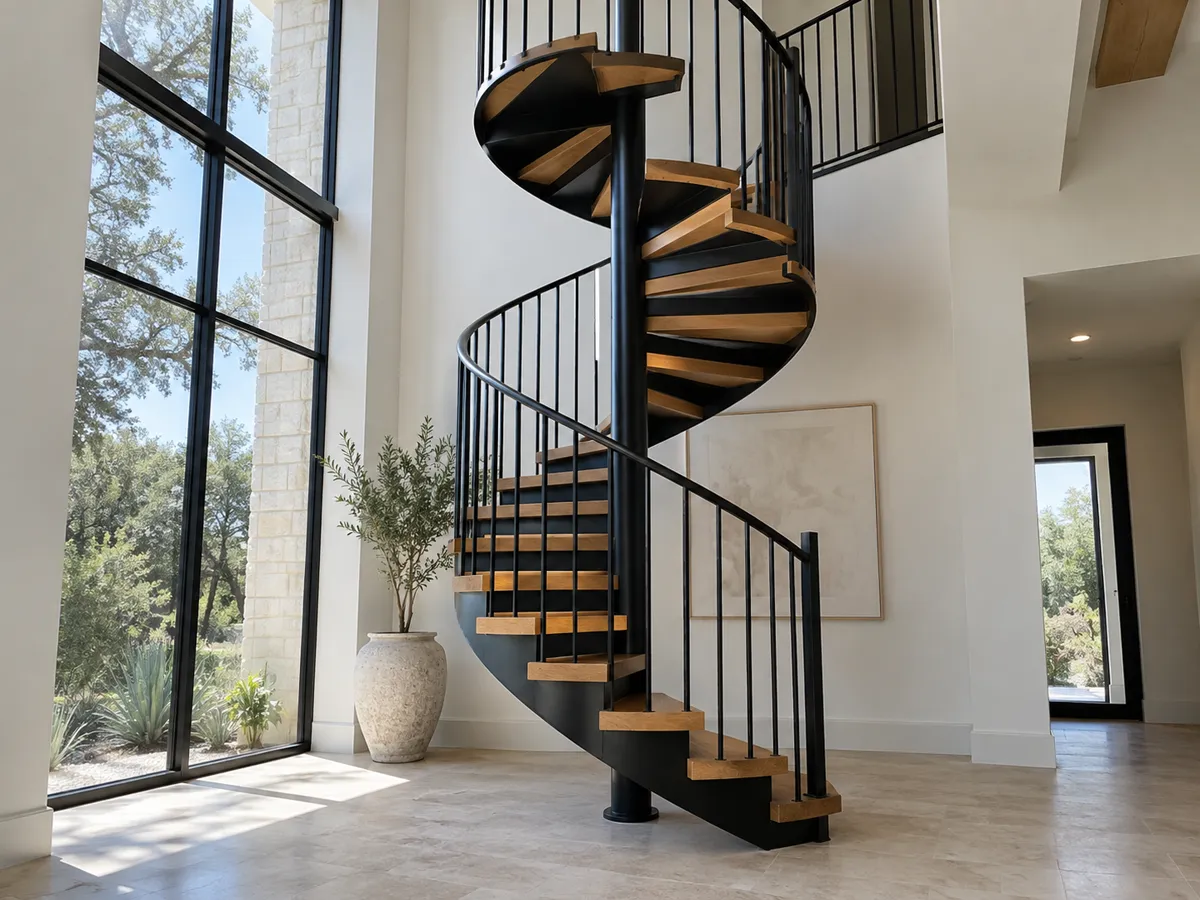
Black steel spiral staircase with oak treads rising beside a tall window in a white double-height room

The process

From Site Visit to a Gate That Runs

Four steps, and nothing is fabricated until you have signed off on the drawings and the price.

  1. Free site visit

    We measure the opening, the slope and where power can reach, and talk through style, automation and access.

  2. Drawings and a written price

    You get scaled drawings for your approval and for any HOA or city review, with one written price.

  3. Fabricated in our shop

    Steel is cut and welded to the approved drawings, then galvanized, powder coated or both.

  4. Installed and tested

    Columns and posts set, gate hung, operator set up to UL 325 and every safety device tested with you.

More of What We Build

Questions

Iron Railings: Common Questions

How much does an iron railing cost?

It depends on the run length, the number of turns, whether it climbs a stair, the baluster pattern, the handrail profile, how it mounts and the finish. We price every railing from a free on-site measure and a drawing, so you see the real number for your stair rather than an average.

How tall does my railing need to be?

Under the 2015 residential code, a guard on a porch, deck or landing is at least 36 inches tall, and a guard on the open side of a stair is at least 34 inches measured from the tread nosings. We confirm the edition Austin currently enforces when we quote.

How far apart can the balusters be?

The gap is tested with spheres: 4 inches on level guards, 4 and 3/8 inches along a stair, and 6 inches for the triangle under the bottom rail. We lay out your pickets on the drawing to pass those tests at the actual slope of your stair.

Can you build a railing for both inside and outside the house?

Yes. Interior stair railings and exterior porch, deck and stair railings are the same trade with different finishes. Inside, an epoxy or polyester powder coat is typical; outside, we recommend polyester powder coat and often galvanizing underneath.

Can you put a wood handrail on an iron railing?

Yes. A wood cap on a steel core is a common interior choice. We size the profile so it still meets the code's grip dimensions and show it on the shop drawing before anything is built.

How long does fabrication take?

It depends on the size of the run, the pattern and the finish, plus any HOA review. We give you a schedule with the quote once the drawing is settled, and fabrication starts after you approve the shop drawings.

Do I need HOA approval for a new exterior railing?

Often, yes. Shady Hollow sections, The Hills POA and the Lost Creek ACC all review exterior changes. We supply drawings and finish details for the submittal, and we check the current rules for your address at quote time.

Is there a warranty?

Yes, every railing we build and install comes with a written warranty. We go through it with you when you approve the quote.

What happens at the site visit?

We measure every run, check the rise and nosing line of the stair, look at what the posts will anchor into, and talk through patterns and finishes. You get a drawing and a quote afterward, and the visit is free.

Free site visit

Talk to us about iron railings

Free on-site measure across Austin and the west side. We call you back to set a time.

Call (512) 503-9203

Calls only, we do not receive text messages.

Call (512) 503-9203