Skip to content

Solar Gate Openers in Austin, Sized for the Gate and the Sky Above It

Austin Metal Gates supplies and installs solar gate openers in Austin, TX, and is Travis County's trusted specialist in off-grid gate power, specializing in solar panel sizing, battery banks and low-draw operators. We offer south-facing panel mounts and charge control.

  • Free on-site measure
  • Shop drawings you approve
  • Operators set up to UL 325
  • One written price

Request a free site visit

Or call (512) 503-9203. Calls only, we do not receive text messages.

About our solar gate operators

Our team provides a written daily power budget built from your cycles and accessories, delivering an entry that runs without a trench for homes and independent, grid-free access for both residential and commercial projects. Our own crew measures sun and shade at the site across the day, sets the operator up to UL 325, and backs the installation with a written warranty.

From angling the panel toward the southern sky to sizing the battery for a string of gray days, our team handles every detail. Serving Austin, Volente, Steiner Ranch and Rollingwood, we set each system up to keep opening after dark and through overcast weeks.

Why Austin Metal Gates

How We Work

No stock panels cut down to fit, and no handoffs. The crew that measures your opening builds and installs the gate.

Measured on siteThe opening, the slope and the ground, measured where the gate will hang
Shop drawings firstYou approve the drawings and finish before any steel is cut
Welded in our own shopFrames fabricated and finished to your drawings, not ordered from a catalogue
Set up to UL 325Every operator installed with its safety devices tested before we leave

When a Solar Gate Opener Beats Trenching Power

Every automatic gate needs power at the post. On a short drive that usually means a trench from the house. On acreage, a long approach, or a lot where limestone sits just under the soil, as it does across much of western Austin, cutting a trench out to the gate can be slow, disruptive and hard on established landscaping. A solar opener removes the trench: a panel near the gate charges a battery, and the operator runs from that battery.

Solar also suits entries that must keep working when the grid does not. West Lake Hills requires electric driveway gates to carry an emergency power source as an integral part of the system, and a battery-based solar operator has that storage built in from the start.

It is not the right answer for every entry. A post under dense tree canopy, a very heavy leaf or an entry that cycles all day may be better served by wired power, and we tell you plainly which side of that line your gate sits on. If the gate is new as well, the full build is covered on our automatic driveway gates page; if you have a working gate and a wired operator you want to replace, see gate operator installation.

How the System Works: Panel, Controller, Battery, Operator

  • Solar panel. Mounted on its own pole or on a column, facing south, clear of shade for the whole day.
  • Charge control. Regulates charging so the battery is not damaged. Controllers use pulse-width modulation or maximum power point tracking to get the most from the panel.
  • Battery. Stores the day's harvest for night and for dull weather. Lead acid remains the common choice in fixed installations for its cost and its tolerance of rough use, and capacity is chosen in amp hours.
  • Low-draw operator. Solar-ready operators manage power so it flows freely while the gate moves and consumption stays minimal the rest of the time.

Because the operator runs from the battery rather than straight from the panel, a cloudy afternoon does not stop the gate. What matters is whether the panel puts back, over days and weeks, what the gate and its accessories take out. That balance is the whole design problem, and it is worked out on paper before anything is ordered.

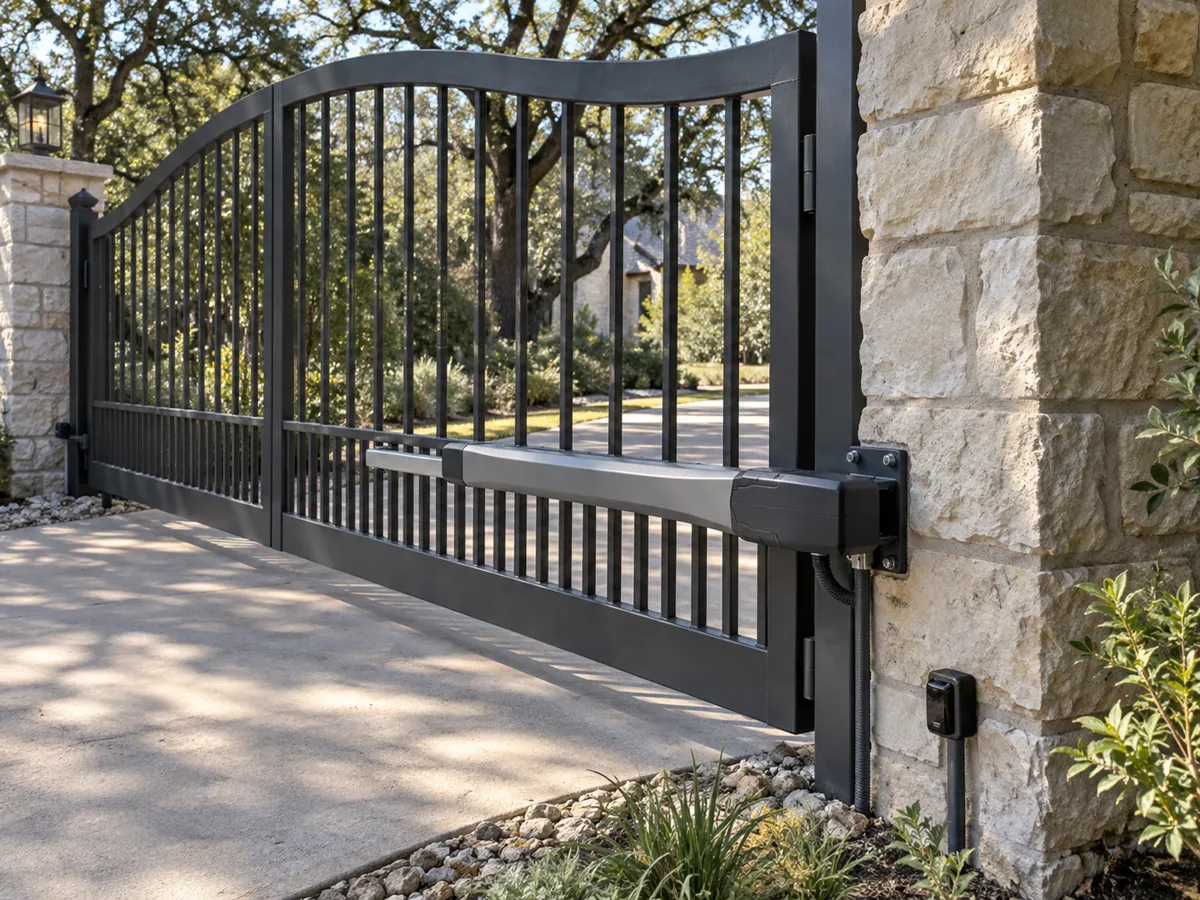
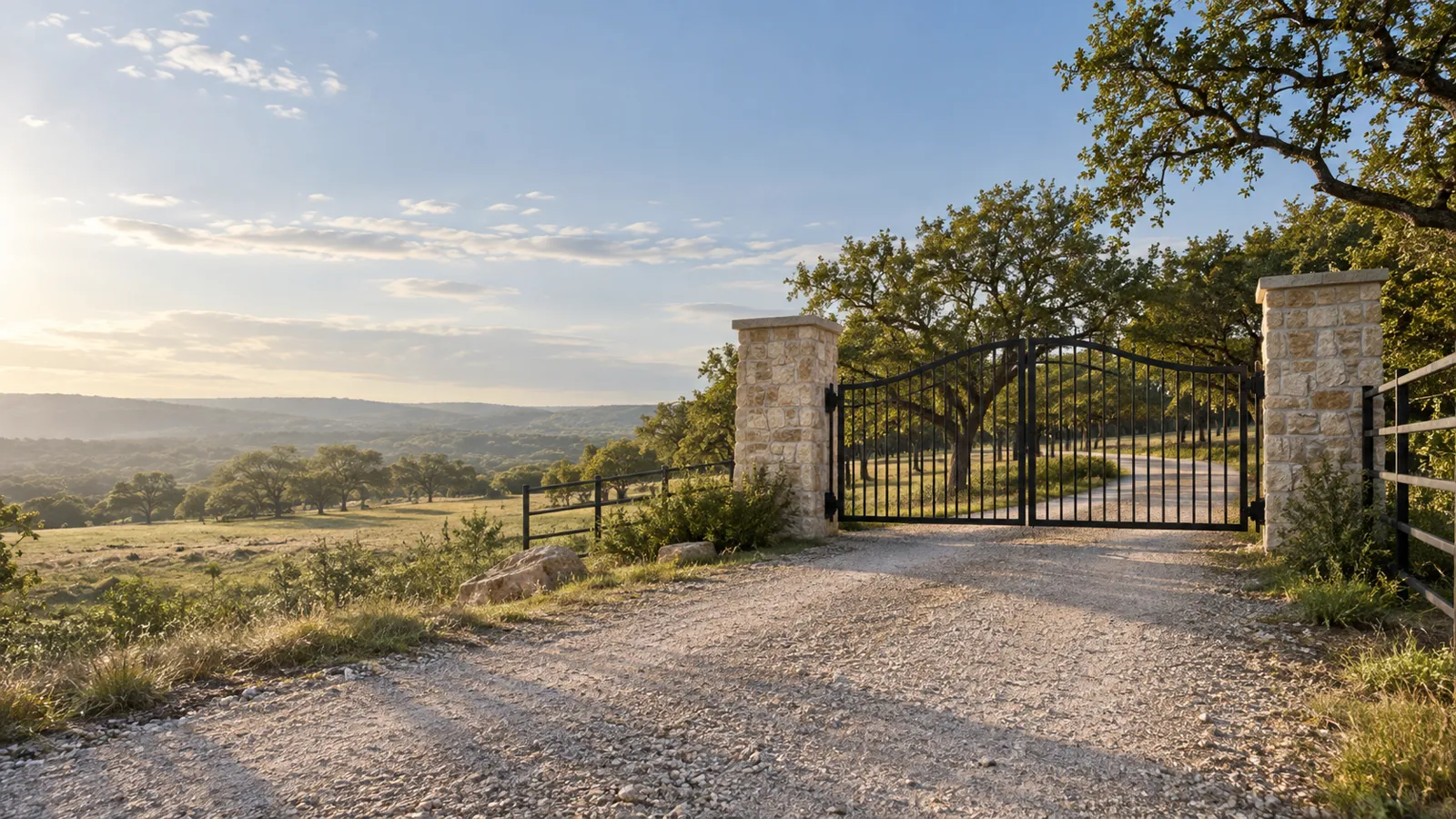
Arched black steel double swing gate between rough limestone pillars on a gravel ranch road, with iron wing fencing and rolling Hill Country pasture

Sizing the Panel and Battery for Your Gate

Operator makers size solar systems on four inputs: a single leaf or a pair, the daily cycle rate, the current the control board and every accessory draw, and the region of the country. Their charts group sites into zones by hours of usable sunlight per day, six, four or two, and publish how many cycles each panel and battery pairing supports in each zone.

Panel wattage

One manufacturer's residential charts run from 10 watt panels up to 60 watts, reached by pairing smaller panels, and larger 24 volt kits in the hundreds of watts exist for busier entries. More wattage buys faster recovery after a dull spell.

Battery capacity

The same charts compare standard 7 amp hour batteries with 33 amp hour units. A bigger bank carries the gate further through a run of gray days before the panel has to catch up.

Standby draw

This is where most of the budget quietly goes. On one 24 volt operator, the main board with no radios learned draws 2.7 milliamps, each plug-in loop detector adds 3.8, and an expansion board adds about 11, which is why the maker suggests unplugging that board when its features are not used. Small numbers, but they run every hour of every night. We put all of it in a written budget: expected cycles, the draw of each device, the sunlight zone for your site, then the panel wattage and battery capacity with margin, since the makers themselves warn that local geography and weather may need extra panels.

Central Texas Sun, Summer Heat and Cloudy Stretches

Austin is a good place for a solar opener, with caveats worth planning around. The city logs about 2,650 hours of sunshine a year, roughly 60 percent of what is possible, and sunshine is common in every season.

The caveats:

  • Wet seasons. Spring and fall bring the most rain, with measurable rain on around 86 days a year. Heavy rain and fog cut a panel's charge rate, so the battery has to bridge those spells.
  • Heat. The city sees 90 degree days well over a hundred times a year. Panel output falls as module temperature climbs, so we mount with open air behind the panel rather than flat against a solid surface.
  • Hard freezes. Winter Storm Uri in February 2021 left 6.4 inches of snow on Austin. Snow on the panel stops charging, and cold weather reduces what a battery can deliver, which is one more reason to carry reserve capacity.
  • Dust and debris. Soiling reduces the light reaching the cells, so the panel should be cleaned regularly.

Shade on Hill Country lots

Photovoltaic cells are very sensitive to shade: one shaded cell drags down the output of many others. On wooded lots in Steiner Ranch, Volente or the hills west of downtown, we walk the site to find a spot that stays clear of shadow for the whole day, and if that spot sits away from the post we run a protected cable to it.

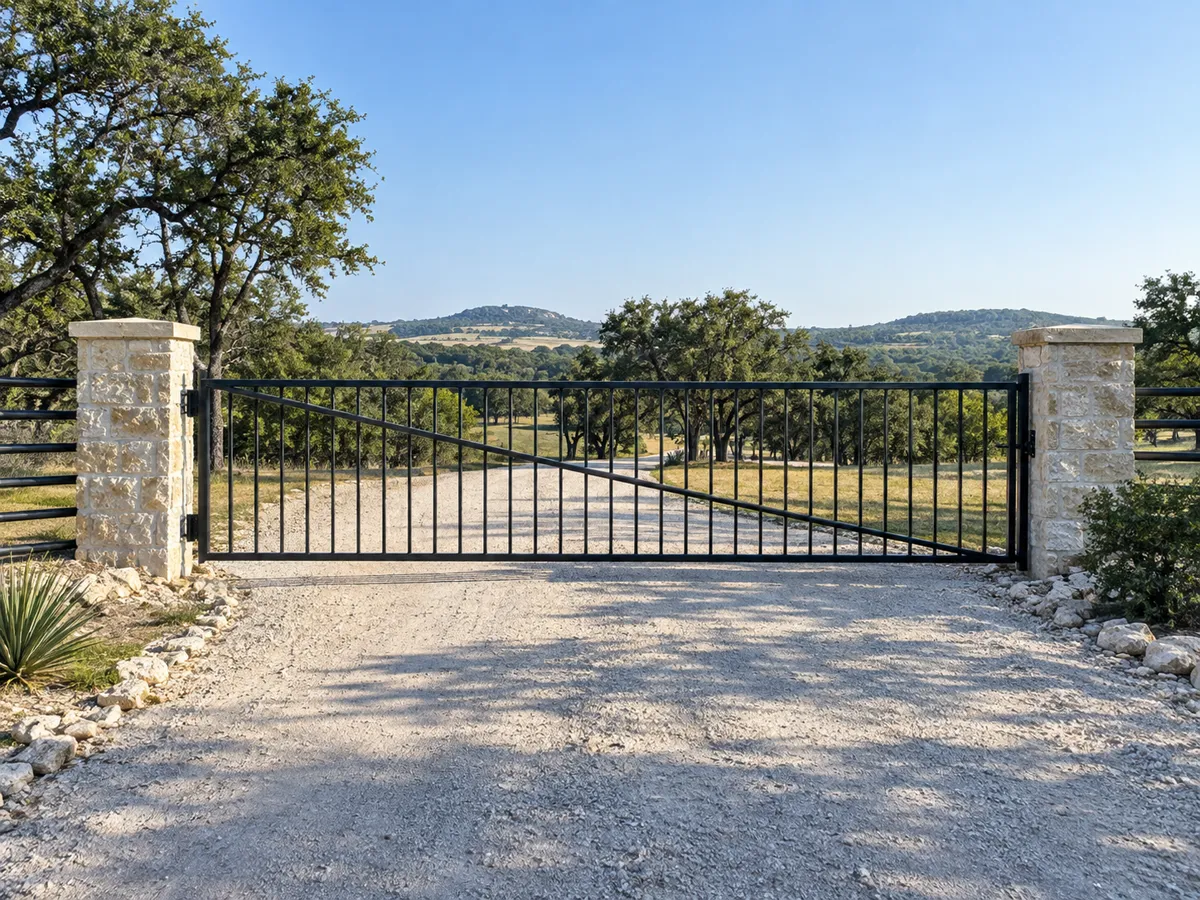
Wide black steel ranch gate with diagonal bracing between limestone pillars across a caliche road, with pasture and hills beyond

Duty Cycle, Accessories and Safety on Solar Power

Duty cycle is the fraction of time a device is actually running. A gate motor runs only a small share of the day, but on solar every run, and every idle hour of the electronics around it, is paid for out of the battery. That is why the accessory list matters so much.

  • Keypads, receivers and intercoms each add standby draw. Makers recommend solar-optimized or wireless accessories to keep it down.
  • Exit loops add a detector each, and each one draws current around the clock.
  • Lighting at the gate draws far more than any sensor and is planned separately, or left on wired power.

What is never trimmed to save power is safety. A solar operator is still a UL 325 operator: at least two independent entrapment protection means in each direction of travel where there is an entrapment zone, every external photo eye or edge monitored, controls at least 6 feet from the gate and warning signs on both sides. The budget is built around those devices, not the other way round.

Fire access stays too. A key switch or access box accepted by your fire district is wired in, and the battery keeps it working when the panel has not seen sun for a while.

What Shapes the Cost of a Solar Gate Opener

We quote solar systems after seeing the site, never before, because the sky over your gate is part of the design. The drivers:

  • Single or dual leaf. Two leaves mean more motor work per cycle.
  • Gate weight and style. Swing, slide or cantilever, and how heavy the leaf is.
  • Cycles per day. A household entry and a shared drive need very different budgets.
  • Accessories. Keypad, intercom, receivers and loops, each with its own draw.
  • Panel wattage and count. Set by the budget and the sunlight zone.
  • Battery capacity. Standard or extended, sized for reserve.
  • Panel placement. A mount at the post, or a separate pole in open sky with a cable run back.
  • Safety devices. The photo eyes and edges every entrapment zone needs.
  • The gate itself. A new leaf built to ASTM F2200, or upgrades to an existing one.
  • Approvals. HOA or POA review of a visible panel or post, and any city permit.

On the other side of the ledger is the trench you are not digging. The free site visit shows you both options, and the written quote lists the solar parts line by line.

The process

From Site Visit to a Gate That Runs

Four steps, and nothing is fabricated until you have signed off on the drawings and the price.

  1. Free site visit

    We measure the opening, the slope and where power can reach, and talk through style, automation and access.

  2. Drawings and a written price

    You get scaled drawings for your approval and for any HOA or city review, with one written price.

  3. Fabricated in our shop

    Steel is cut and welded to the approved drawings, then galvanized, powder coated or both.

  4. Installed and tested

    Columns and posts set, gate hung, operator set up to UL 325 and every safety device tested with you.

More of What We Build

Questions

Solar Gate Operators: Common Questions

Will a solar gate opener work through a cloudy week?

Yes, if the battery is sized for it. The operator runs from stored charge, so the question is reserve. We size panel and battery with margin for the wet spring and fall spells Central Texas gets.

How many times a day can a solar gate open?

That depends on the panel, the battery, the sunlight at your site and how much the accessories draw. We work out your expected daily cycles first and size the system to cover them with room to spare.

What happens at night?

Nothing changes for you. The gate runs from the battery, which the panel recharges the next day.

What drives the cost of a solar opener?

Leaf count and weight, daily cycles, the accessories, panel wattage and placement, battery capacity, safety devices and any work the gate itself needs. It is itemized in the written quote after the free site visit.

Can you add solar to my existing operator?

Some operators accept a solar kit and some do not, depending on the model and its voltage. Where yours cannot, we fit a solar-ready operator and bring the installation up to UL 325 at the same time.

Does the panel need HOA or POA approval?

Often, because it is visible. In Shady Hollow no exterior change may be made without the section's Architectural Control Committee, and The Hills POA reviews exterior improvements before they start. We prepare the drawings and panel placement for the application.

How does the fire department open a solar-powered gate?

The same way as a wired one: a key switch or access box your fire district accepts, powered from the battery. West Lake Hills requires an ESD 9 approved access box on lockable gates.

Is there a warranty?

Yes. Every solar installation comes with a written warranty, and you keep the manufacturer documentation for the operator, panel and battery.

What happens at the site visit?

We look at the gate, count how often it will cycle, list the accessories you want, and check sun and shade where a panel could go. It is free, and the power budget follows with the quote.

Free site visit

Talk to us about solar gate operators

Free on-site measure across Austin and the west side. We call you back to set a time.

Call (512) 503-9203

Calls only, we do not receive text messages.

Call (512) 503-9203