
Ranch Entry Gates in Austin for Wide Openings on Acreage
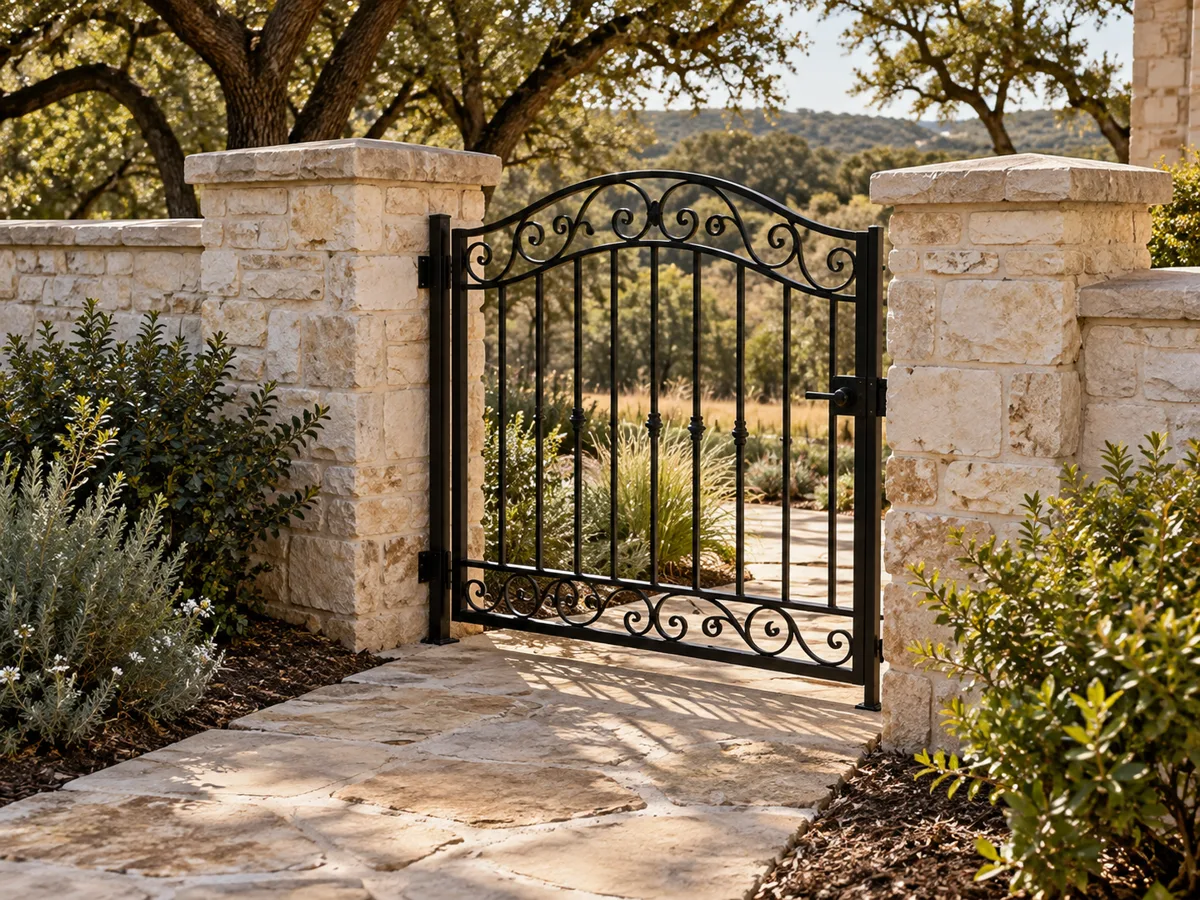
Austin Metal Gates fabricates ranch entry gates in Austin, TX, and is Travis County's leading specialist in acreage entrances, specializing in long-span steel gates, arched ranch gates with a raised top rail and wing fencing that flares out from the posts. We offer solar-powered operators and pipe-frame walk gates.
- Free on-site measure
- Shop drawings you approve
- Operators set up to UL 325
- One written price
About our ranch & acreage entry gates
Our team provides entry layouts for caliche and gravel drives, delivering a working entrance that lasts for homes and a wide, trailer-ready opening for both residential and commercial projects. We weld every span in our own shop, but only after the opening, the crown of the road and the swing path have been measured on site and drawn up for your sign-off.
From the post spacing that keeps a long leaf from sagging to a complete entrance with wing fencing and a solar panel on its own pole, our team handles every detail. Serving Austin, Volente and Lakeway, we build entries for land where the house may sit well out of sight of the road.
Why Austin Metal Gates
How We Work
No stock panels cut down to fit, and no handoffs. The crew that measures your opening builds and installs the gate.
What Makes a Ranch Entry Different From a Driveway Gate
A driveway gate on a suburban lot opens for cars. A ranch entry opens for everything that has to reach the land: pickups towing trailers, a hay delivery, a well rig, a horse trailer backing in at an angle. The opening is wider, the leaves are longer and the design has to work at a distance, because the entrance is often the only part of the property anyone sees from the road.
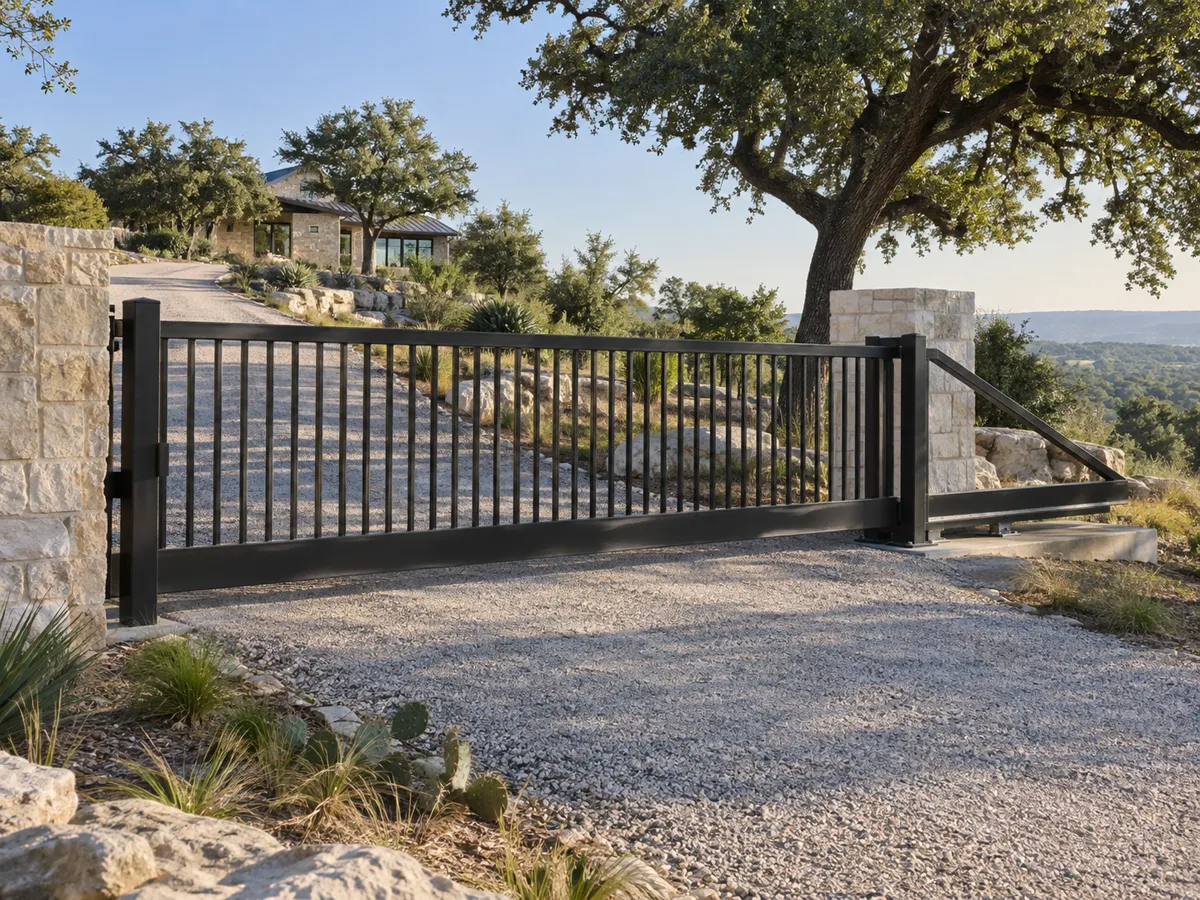
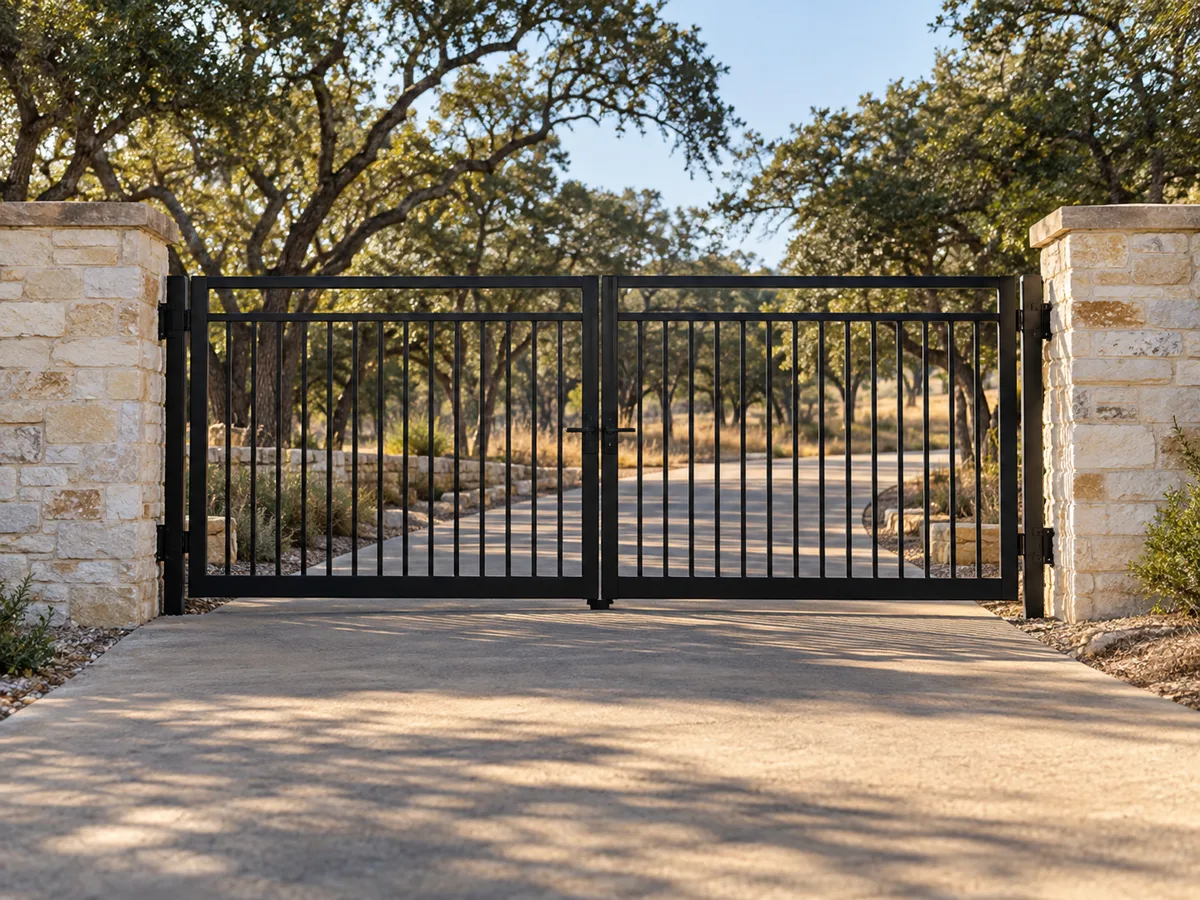
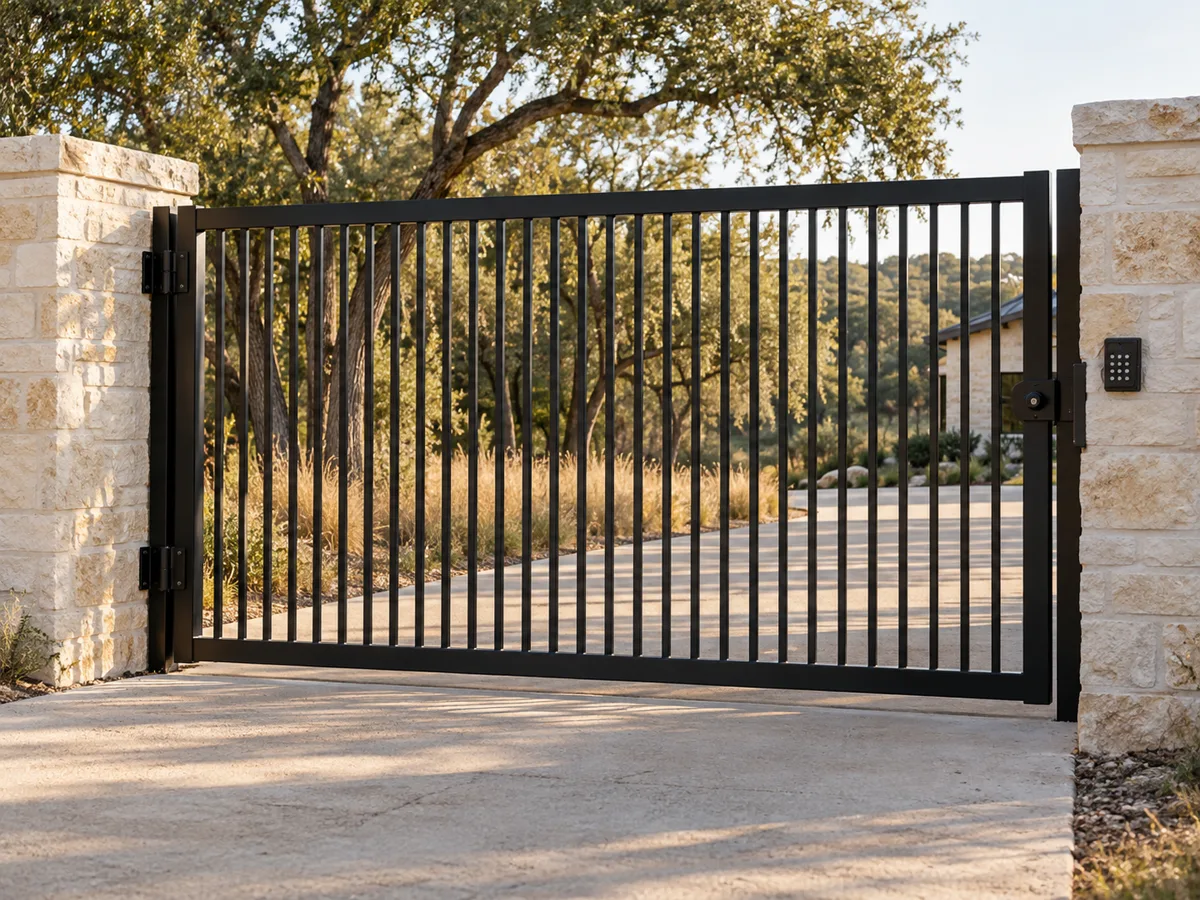
That changes the layout. A wide opening can be closed by one long swing leaf, a pair of leaves meeting in the middle, or a slide gate running along the fence line where the ground allows it. The choice comes from the opening width, the slope across it and how much clear ground sits behind the posts.
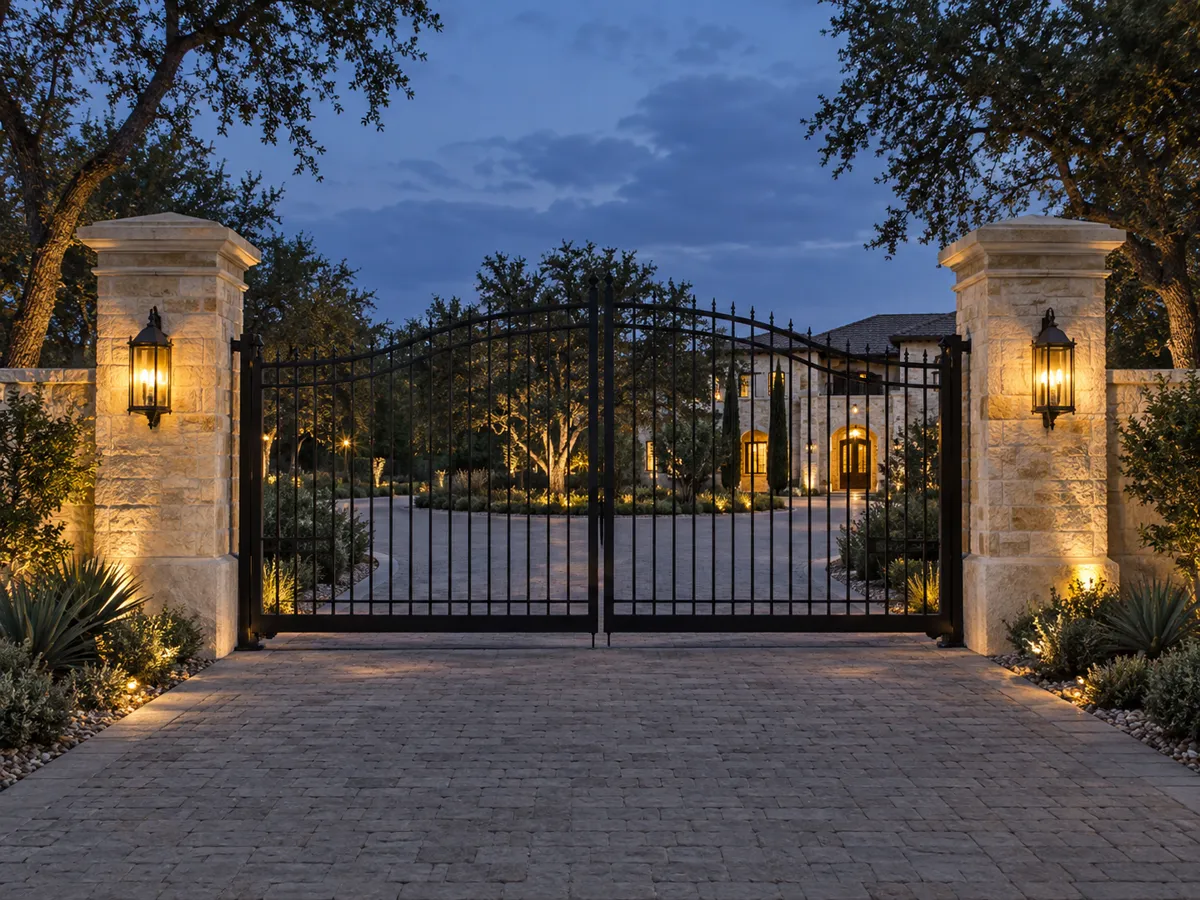
It also changes the look. Many owners want an arched top rail rising across the span, sometimes with a ranch name worked into a panel above the drive, set between heavy steel posts rather than masonry columns. The entry reads as a landmark, and it is drawn to the scale of the land around it rather than the scale of a house front.
Finally, the house may be a long way back. That single fact decides how the entry is powered, how guests call up to the house and how a delivery driver gets through, and it is the reason ranch entries are planned as a whole system rather than a gate first and the rest later.
Long Spans, Arched Rails and Keeping a Leaf From Sagging
Length is the enemy of a swing leaf. The longer the leaf, the more leverage its own weight has on the hinge post, and a poorly braced leaf drops at the latch end until it drags across the drive. Everything about a long span is designed around that.
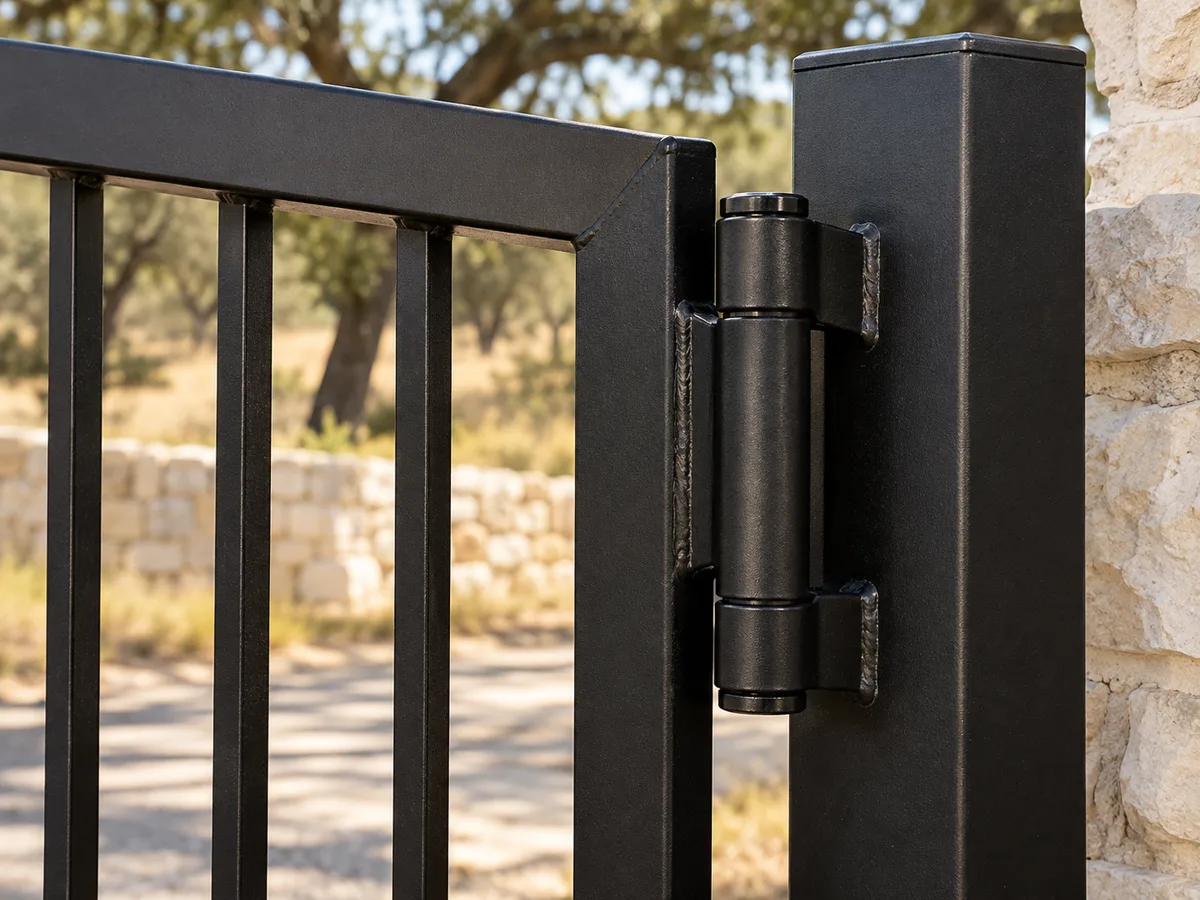
We size the frame tube to the span, add diagonal or arched bracing that carries the load back toward the hinges, and set the hinge post deep in concrete. On the limestone that covers much of western Travis County under a thin layer of soil, setting that post often means drilling or breaking rock, which is planned from the measure rather than found on the day.
An arched top rail is not only decoration. Rising toward the center, it adds depth to the frame exactly where a long leaf needs stiffness, which is why it suits wide ranch openings so well. A straight top rail with a truss below it does the same job with a plainer look.
The steel is hot-dip galvanized, then powder coated. Galvanizing puts a zinc layer on the steel that protects it where the finish is scratched, which matters on an entrance that trailers, mowers and cattle will brush against for years. Powder coating goes on as a dry powder, is cured under heat, and holds up far better than brushed paint.
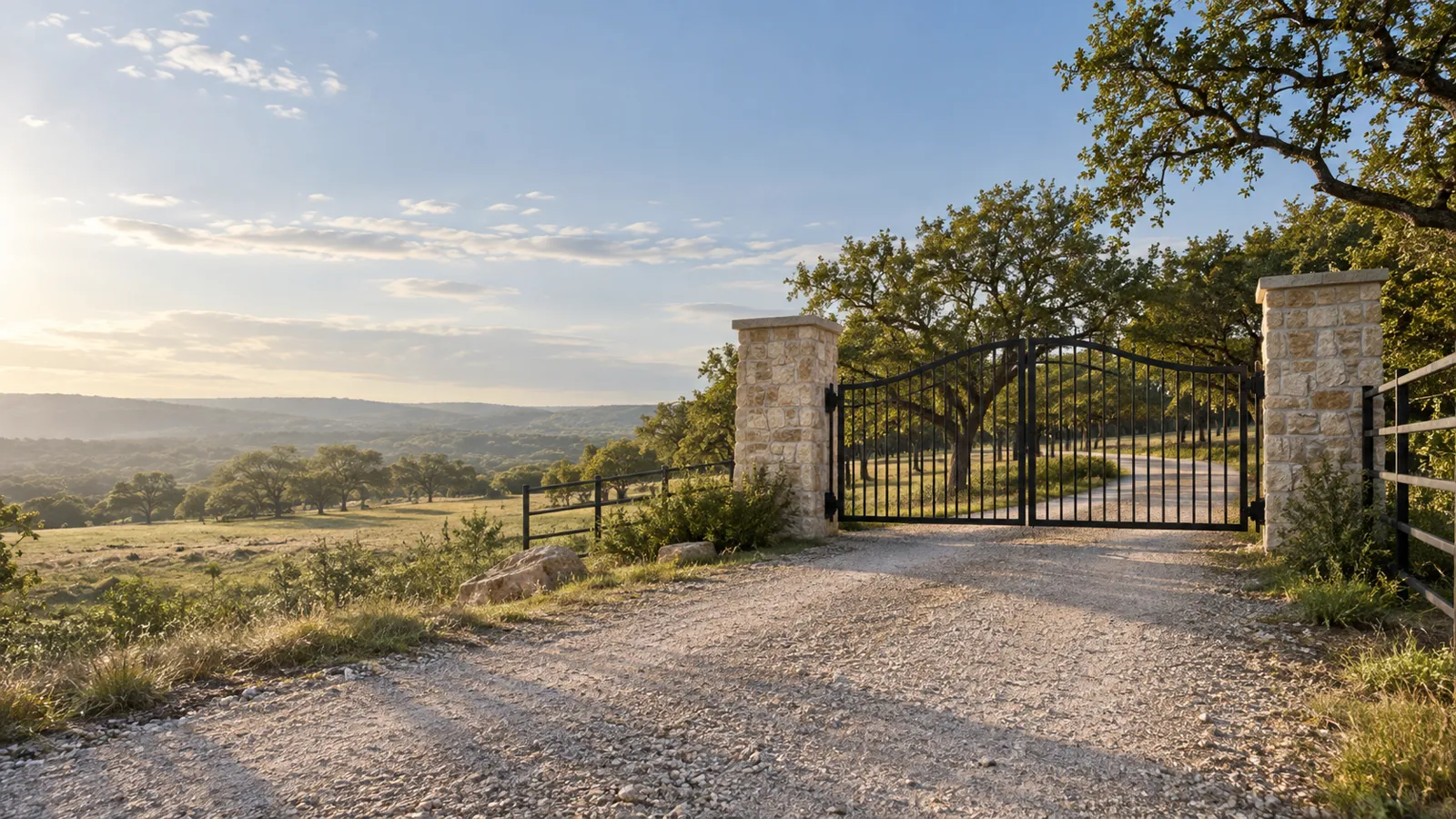
Wing Fencing, Cattle and Deer
Wing fencing is the short run of fence that flares out from each post and ties the entrance into the perimeter fence. It frames the opening, guides vehicles in, and stops livestock walking around the end of a closed gate. We build the wings to match the entry, whether that means pipe rail, steel panels or ornamental pickets.
Where cattle run on the land, some owners pair the entrance with a cattle guard, a grid of bars or pipes over a shallow pit that livestock will not cross while vehicles drive straight over it. A guard is an alternative to opening and closing a gate for every vehicle, so it suits a working ranch with frequent traffic. It has limits worth knowing: deer can cross a grid with flat bars, sheep find their way over, and horses can trap a hoof. On a property with horses, a gate stays the safer answer.
Deer are part of every Hill Country job. Texas holds the largest white-tailed deer population in North America, the Edwards Plateau carries high numbers, and a whitetail can clear about 9 feet. An entry gate is not a deer barrier by height alone, so the goal is to avoid hurting them. Lakeway banned new spiked and open-picket tops in 2019 after deer were impaled leaping ornamental metal fences, and we recommend a continuous flat top rail on ranch entries everywhere for the same reason.
Caliche, Gravel and Water at the Entrance
Few ranch drives are paved all the way in. Many run on caliche or gravel, and both affect how an entrance is built and how it holds up.
Caliche is soil cemented by calcium carbonate. Where it is hard, it digs like rock, which slows post holes and trenching. As a drive surface it has a known weakness: it does not hold up well to moisture, so the drive can rut and soften at the entrance, exactly where vehicles slow, turn and stop. Gravel shifts under braking and builds up against the bottom of a leaf.
So the entrance gets its own footing work. We set a concrete pad for the operator, plan the ground clearance under each leaf so gravel does not jam the swing, and look at where water will run when it rains.
Water deserves real attention here. The Hill Country is known as Flash Flood Alley, and many rural entrances sit near a low point where the drive meets the road. At the measure we note where runoff crosses the entry, keep the operator and its electronics off the lowest ground, and lay out the gate so a storm does not push debris against a closed leaf.
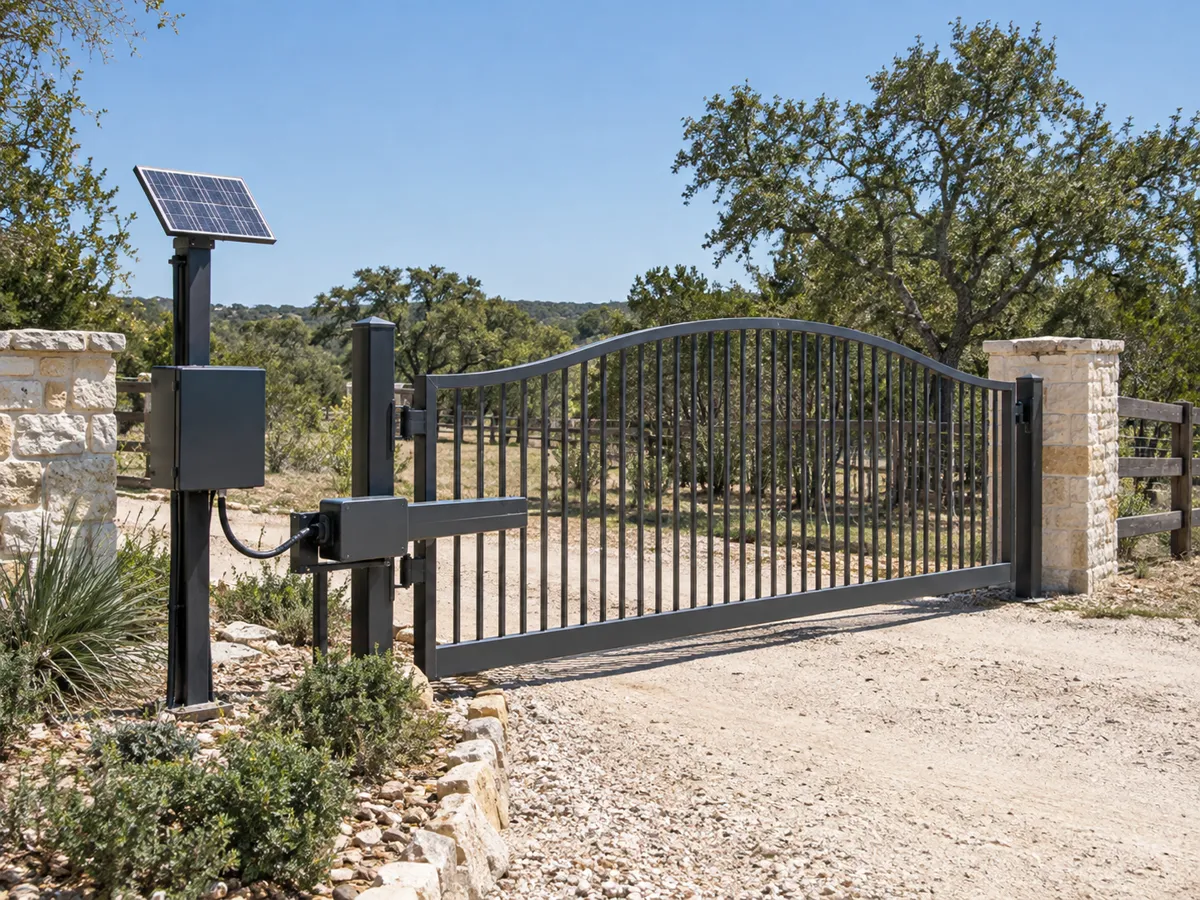
Solar Power When the House Is Far From the Road
Running utility power to an entrance a long way from the house means a long trench, often through rock. On acreage the usual answer is a stand-alone solar system at the gate: panels, a battery bank and a charge controller that protects the batteries, with no wire back to the house at all.
The battery is what makes it work. A panel wired straight to a load only runs in daylight, so the operator draws from the battery and the panel refills it. The sizing starts with the question of how many times the gate opens on a busy day, then allows for cloudy stretches, and the panel and battery are matched to that use rather than to a guess.
Placement matters as much as size. The panel needs open sky, and Hill Country entrances are often shaded by live oak and Ashe juniper, so the panel may stand on its own pole a short distance from the posts where it sees the sun all day. We choose that spot at the measure.
Where power is already near the road, or the gate carries a heavy daily load, a trenched supply can still be the better choice. We lay out both options and explain the trade before you decide.
Permits and Rules Outside the City Limits
Acreage near Austin sits under a patchwork of rules, and a ranch entry is checked against the current requirements for the address at quote time.
- Volente issues its own fence permits, including a separate replacement fence permit, plus a driveway permit and a right-of-way permit, and application fees there are paid by check only.
- Steiner Ranch sends every fence change through its master association's design review, and bans chain link and wire fences.
- Lakeway requires a permit for any new fence and, on a gate with keyed or coded access, codes for the police and a key switch for the ESD 6 fire department.
- Unincorporated land may fall under county rules instead of a city code, and neighborhood deed restrictions can apply on top of either.
We find out what applies before the drawing is final, so the entrance is designed once and approved once.
What Drives the Cost of a Ranch Entry Gate
A ranch entry is priced from a drawing, and the drawing comes from walking the site. The factors that move it:
- Opening width and whether it closes with one leaf, a pair, or a slide gate.
- The top rail design, arched or straight, and any name panel.
- Steel frame and picket sizes, and the bracing a long span needs.
- Galvanizing and powder coat.
- Posts or columns, and how much rock or hard caliche the footings cut through.
- Wing fencing length and style.
- The operator and its duty cycle, plus the monitored photo eyes and edges the safety standard requires.
- Solar panel and battery sizing, or a trench from the nearest power.
- Keypad, intercom or phone entry for guests and deliveries.
- A cattle guard alongside the entrance, if the land needs one.
- Permits, POA review or deed restriction approval.
It ends at the free on-site measure: we walk the entrance with you, measure the span and the slope, check the ground, the drainage and the sun, and send a drawing with a written quote.
The process
From Site Visit to a Gate That Runs
Four steps, and nothing is fabricated until you have signed off on the drawings and the price.
Free site visit
We measure the opening, the slope and where power can reach, and talk through style, automation and access.
Drawings and a written price
You get scaled drawings for your approval and for any HOA or city review, with one written price.
Fabricated in our shop
Steel is cut and welded to the approved drawings, then galvanized, powder coated or both.
Installed and tested
Columns and posts set, gate hung, operator set up to UL 325 and every safety device tested with you.
More of What We Build
Questions
Ranch & Acreage Entry Gates: Common Questions
How much does a ranch entry gate cost?
It depends on the span, leaf count, top rail design, steel sizes and finish, the posts and how much rock they go through, wing fencing, the operator and its power, and access control. We quote from a drawing made after a free walk of your entrance.
Can a gate that wide be automated?
Yes, as long as the operator is matched to the leaf. Operator makers rate their units for a maximum gate size and weight, so we choose the operator from the finished leaf design, not the other way around, and set it up to UL 325.
Do I need a cattle guard as well as a gate?
Not always. A cattle guard saves stopping to open and close a gate on a busy working ranch, but deer can cross flat bars and horses can trap a hoof. Many owners keep the automatic gate and add a guard only where livestock and traffic call for it.
Will the gate keep deer out?
Not by height alone, since a whitetail can clear about 9 feet. What we can do is make the entrance safe for them, with a continuous flat top rail and no spikes, which is also what Lakeway's fence code now requires.
My drive is caliche. Is that a problem?
No, but it shapes the work. Hard caliche digs slowly, and it softens and ruts when wet, so we pour a concrete pad for the operator, set clearance under the leaves and plan drainage at the entrance rather than trusting the drive surface.
What happens with a solar gate on a run of cloudy days?
The operator runs from the battery, not the panel, so the battery is sized for your daily use with a margin for poor weather. If it ever runs low, the manual release lets you open the gate by hand.
How does a fire truck get through my ranch gate?
It depends on your fire district and city. Lakeway requires a key switch for its fire department on coded gates, and other districts set their own rules. We confirm what your address needs and mount the hardware beside the keypad.
Do you build ranch entries in my area?
We work across Travis County, including acreage around Austin, Volente, Lakeway, Steiner Ranch and Barton Creek. The rules change from one place to the next, so each design starts with the code and deed restrictions for your land.
What does the warranty cover?
Your entrance comes with a written warranty on our fabrication and installation, and we go over it with you at handover.
Talk to us about ranch & acreage entry gates
Free on-site measure across Austin and the west side. We call you back to set a time.
Calls only, we do not receive text messages.