Skip to content

Automatic Driveway Gates in Austin, Built and Automated as One System

Austin Metal Gates designs and installs automatic driveway gates in Austin, TX, and is Travis County's trusted specialist in complete gate automation, specializing in swing and slide operators, monitored photo eyes and vehicle exit loops. We offer keypad entry and battery backup power.

  • Free on-site measure
  • Shop drawings you approve
  • Operators set up to UL 325
  • One written price

Request a free site visit

Or call (512) 503-9203. Calls only, we do not receive text messages.

About our automatic driveway gates

Our team provides the whole entry under one contract, delivering a drive that opens at the press of a remote for homes and dependable, well-planned access for both residential and commercial projects. We measure the opening and the slope of your drive ourselves, build the leaf in our own shop to drawings you approve, and set the operator up to UL 325 before handing you the remotes.

From placing the hinge posts where the operator arm needs them to wiring the eyes, loops and keypad, our team handles every detail. Serving Austin, West Lake Hills, Lost Creek and Lakeway, we finish every job with a walk-through so you know each way the entry opens.

Why Austin Metal Gates

How We Work

No stock panels cut down to fit, and no handoffs. The crew that measures your opening builds and installs the gate.

Measured on siteThe opening, the slope and the ground, measured where the gate will hang
Shop drawings firstYou approve the drawings and finish before any steel is cut
Welded in our own shopFrames fabricated and finished to your drawings, not ordered from a catalogue
Set up to UL 325Every operator installed with its safety devices tested before we leave

What a Complete Automatic Driveway Gate Includes

Most owners who call us have an open drive and a clear picture of the result: a gate that opens as the car arrives and closes behind it. Getting there takes five parts that have to be planned together, and buying them from separate trades is where gaps between them appear.

  • The leaf. Fabricated in steel or aluminum to the opening we measure, with its openings, gaps and hardware laid out to ASTM F2200, the construction standard for automated vehicular gates.
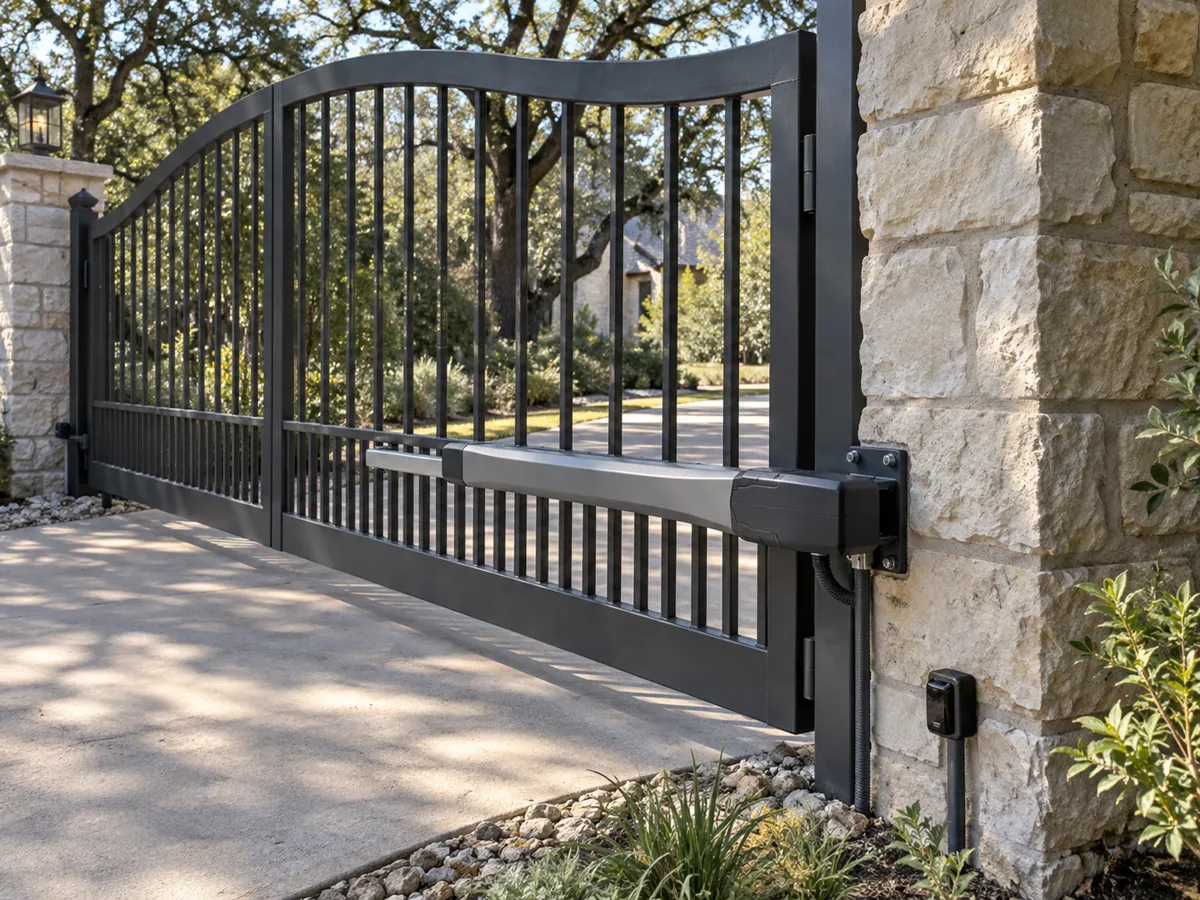
  • The operator. The motor and control board, chosen for the leaf weight, the style of gate and how often it will run, and listed to UL 325.
  • Entrapment protection. Monitored photo eyes, contact edges or both, placed wherever the moving leaf could trap a person or a car.
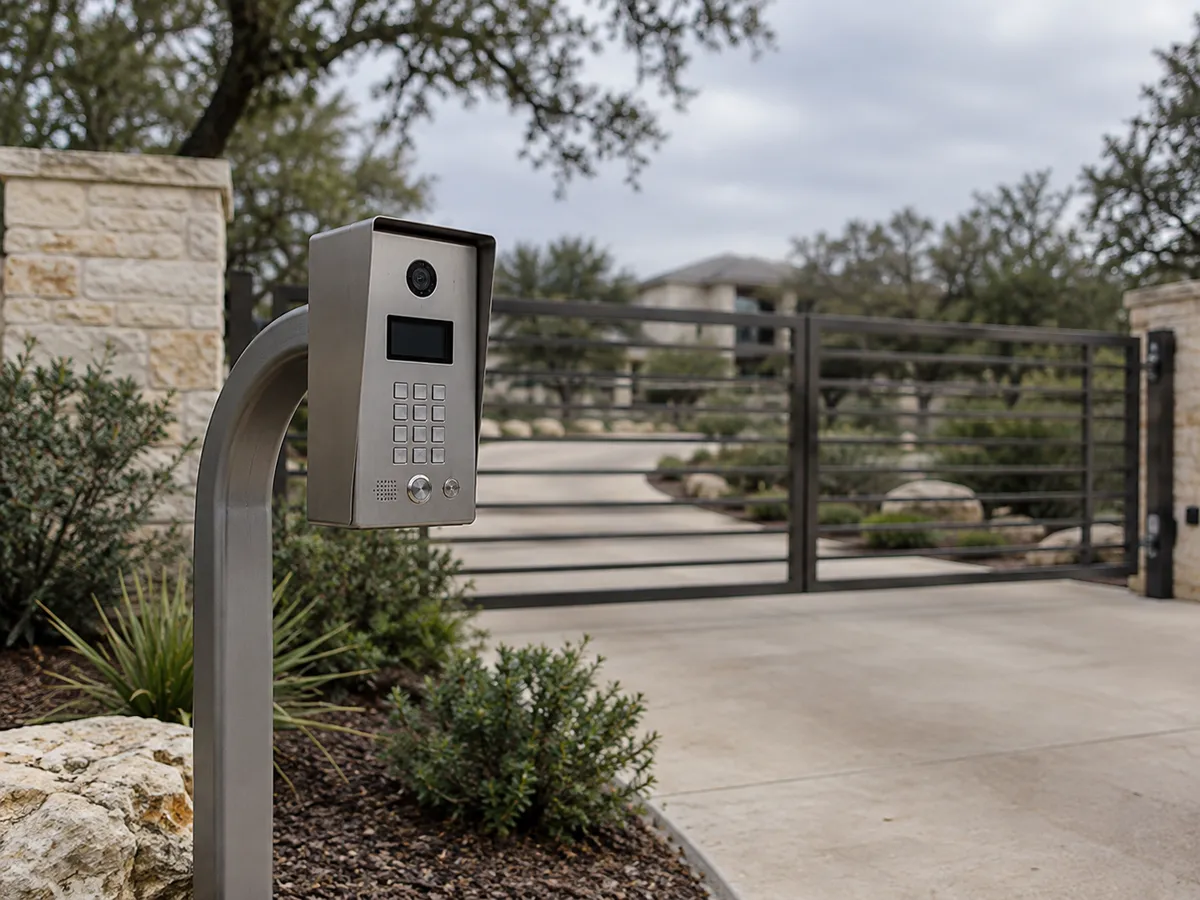
  • Entry and exit. Remotes, a keypad or intercom post at the approach, and a vehicle loop in the drive so the gate opens for cars leaving.
  • Power. A run of electrical service out to the post, or a solar panel and battery where trenching is not practical.

Because one crew plans all five, the hinge posts go where the operator needs them, conduit is in the ground before concrete is poured, and the safety devices are on the drawing rather than bolted on afterwards. If you already own a gate and only want it motorized, our gate operator installation service is the better fit for that job.

Swing, Slide or Cantilever: Matching the Gate to Your Drive

The shape of the drive usually chooses the style before taste does. On the site visit we look at three things: how much room sits beside and behind the opening, how the grade runs, and what is near the leaf when it moves.

Swing gates

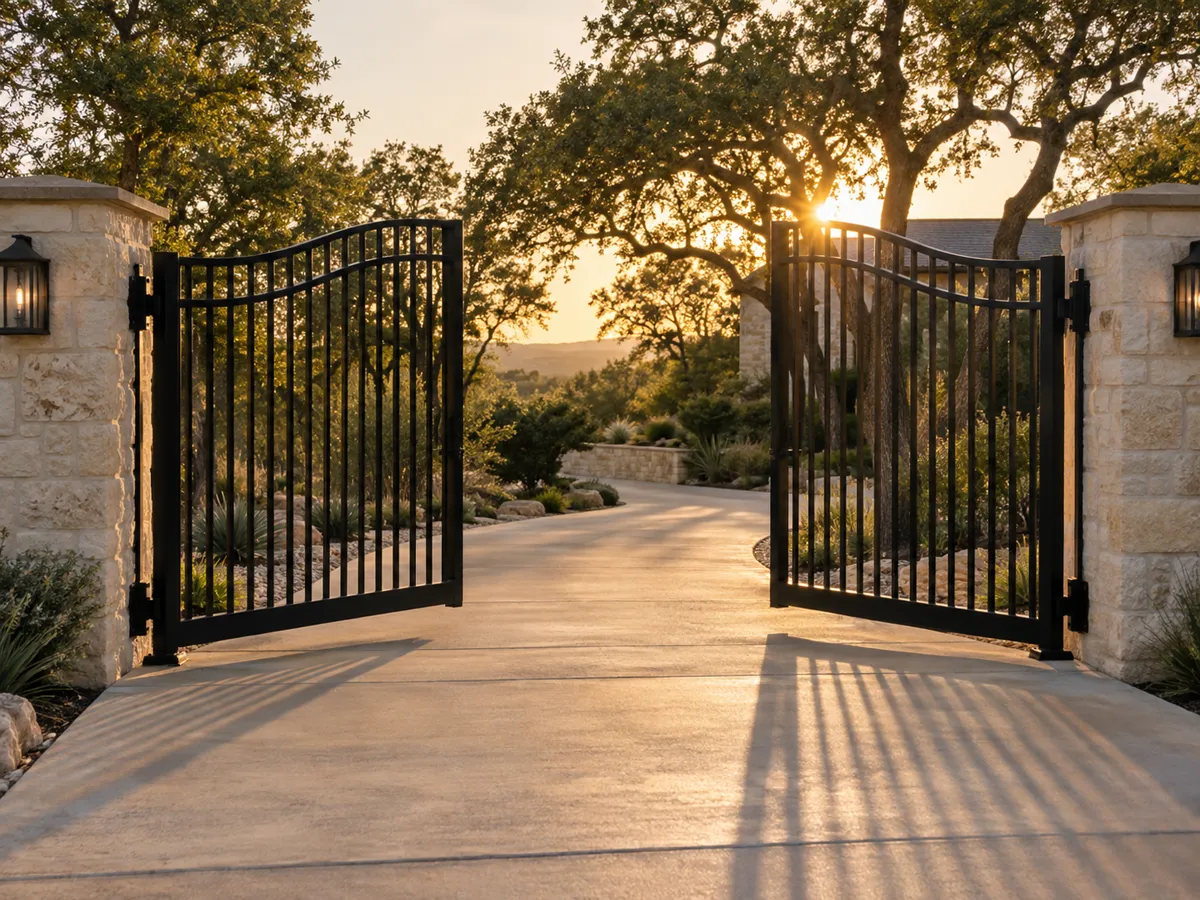
A single or double leaf on hinges is the classic look and suits a fairly level approach with room for the leaves to travel. The construction standard calls for at least 16 inches between a swinging leaf and a fixed object such as a wall or column, or else added entrapment protection in that zone. A drive that climbs away from the street can stop an inward swing short, so we check the rise across the full arc with a level before anything is drawn.

Sliding and cantilever gates

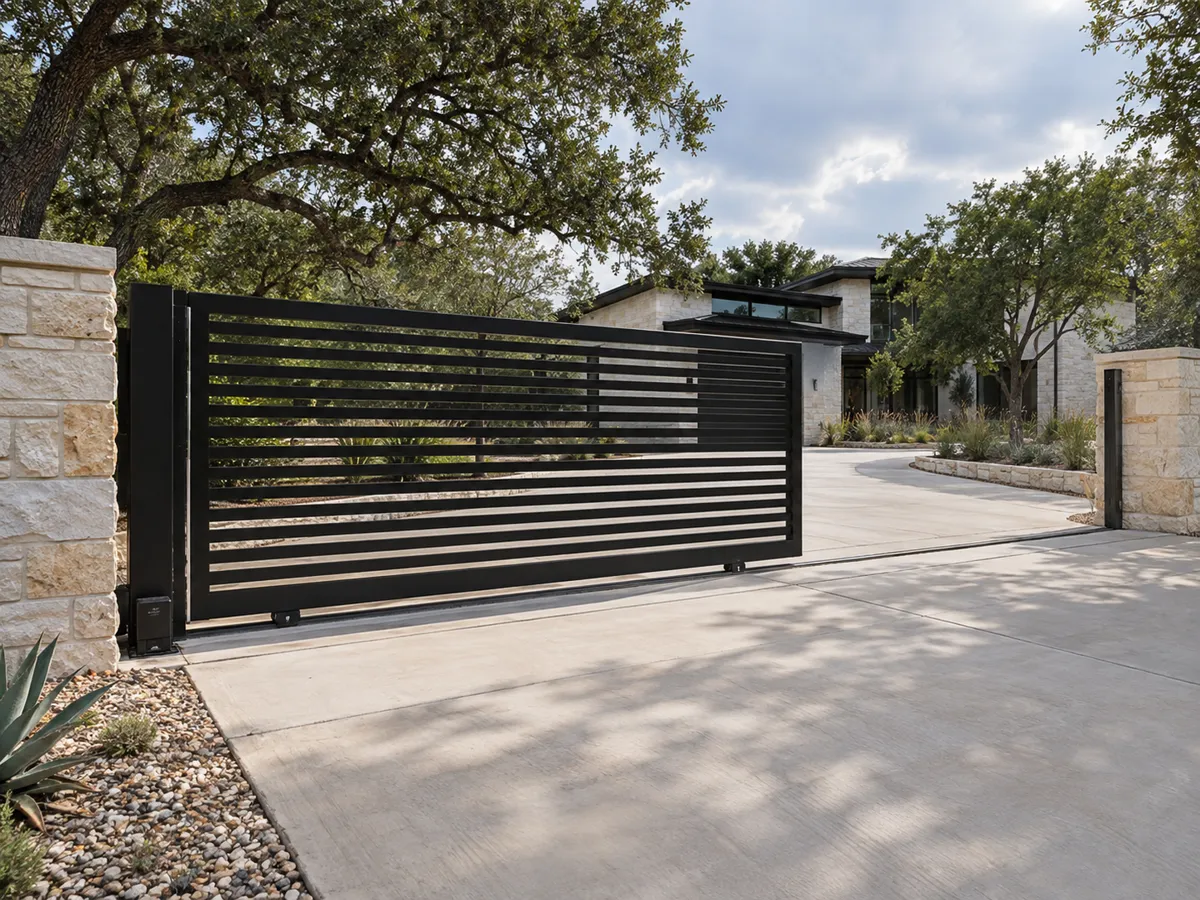
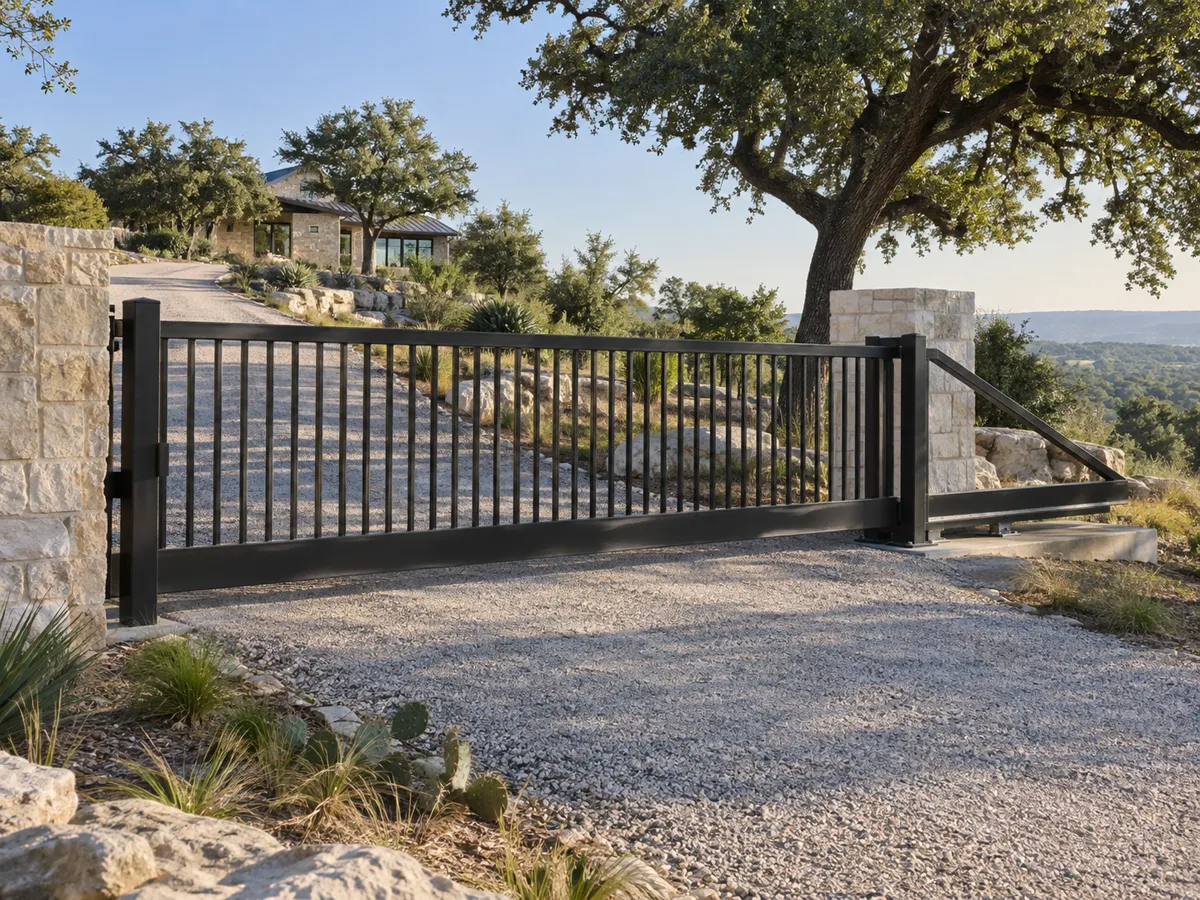
A sliding leaf travels along the fence line instead of into the drive, which is why it is the usual answer where space is tight or the driveway is steep. A cantilever version rides on rollers set beside the opening with no track across the pavement. Both have their own pages on this site; on an automated system the choice changes the operator type, the device layout and the footing plan. Whatever the style, a sliding leaf has to roll smoothly by hand in both directions before any operator is attached, and a swinging leaf has to hang true on its hinges. We build to that first, then automate.

UL 325 Safety Designed Into the Entry

UL 325 is the safety standard that gate operators are listed to, and ASTM F2200 governs how the gate itself is built. Every automated entry we design is drawn against both from the start.

  • Two independent protections. For most installations the standard requires at least two independent means of protecting against entrapment in each direction of travel, and every external device has to be monitored by the operator.
  • Photo eyes and edges. Non-contact photoelectric sensors watch across the path of the leaf; contact edges on its face stop and reverse it if touched.
  • Reversal timing. After sensing an obstruction the operator must begin reversing within two seconds.
  • Controls out of reach. Activation controls sit at least 6 feet from the gate so nobody can reach through the pickets to use them.
  • Warning signs. At least two, visible from both sides of the opening.
  • A separate walk gate. Vehicular operators are meant for vehicular gates only, so where people will come and go on foot we plan a pedestrian gate beside the drive.

On the leaf, openings in the lower 48 inches are screened so a 2.25 inch sphere cannot pass through, weight-bearing rollers are covered, and positive stops end travel at fully open and fully closed.

Entry, Exit and Fire Access in Travis County Neighborhoods

How the gate is told to open matters as much as how it moves. A typical system combines handheld remotes for the household, a keypad or intercom post at the approach for guests and deliveries, and an induction loop saw-cut into the drive on the inside, which senses the metal of a departing car and opens without anyone reaching for a button. Intercoms and code systems have their own page here; on this job they are specified as part of the whole.

Local rules shape the layout, and several cities we serve write them down:

  • West Lake Hills requires gated driveways to let cars stop completely off the street, gates to open parallel to or away from the street, an emergency power source built into any electric gate, and a security access box approved by Travis County ESD No. 9.
  • Lakeway asks owners of keyed or coded gates to give codes to the city police department and a key switch to the ESD 6 fire department.
  • Rollingwood requires an entering car to be fully off the street while it waits, with the gate opening parallel to or away from the street.
  • In HOA neighborhoods, Texas SB 711, in force since September 1, 2025, lets an association require a driveway gate to sit at least 10 feet back from the right-of-way.

Codes change, so every layout is checked against the current city code and any HOA or POA guidelines at the time we quote.

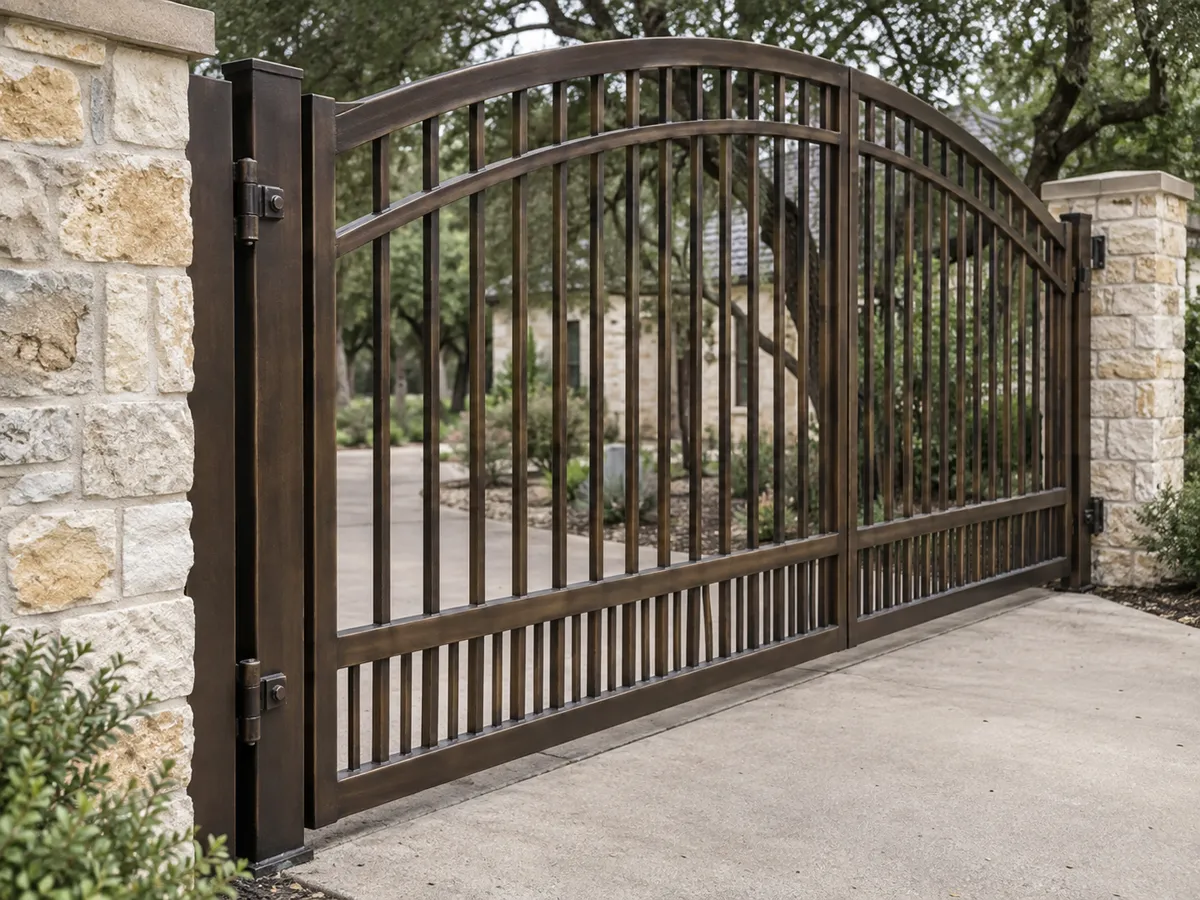
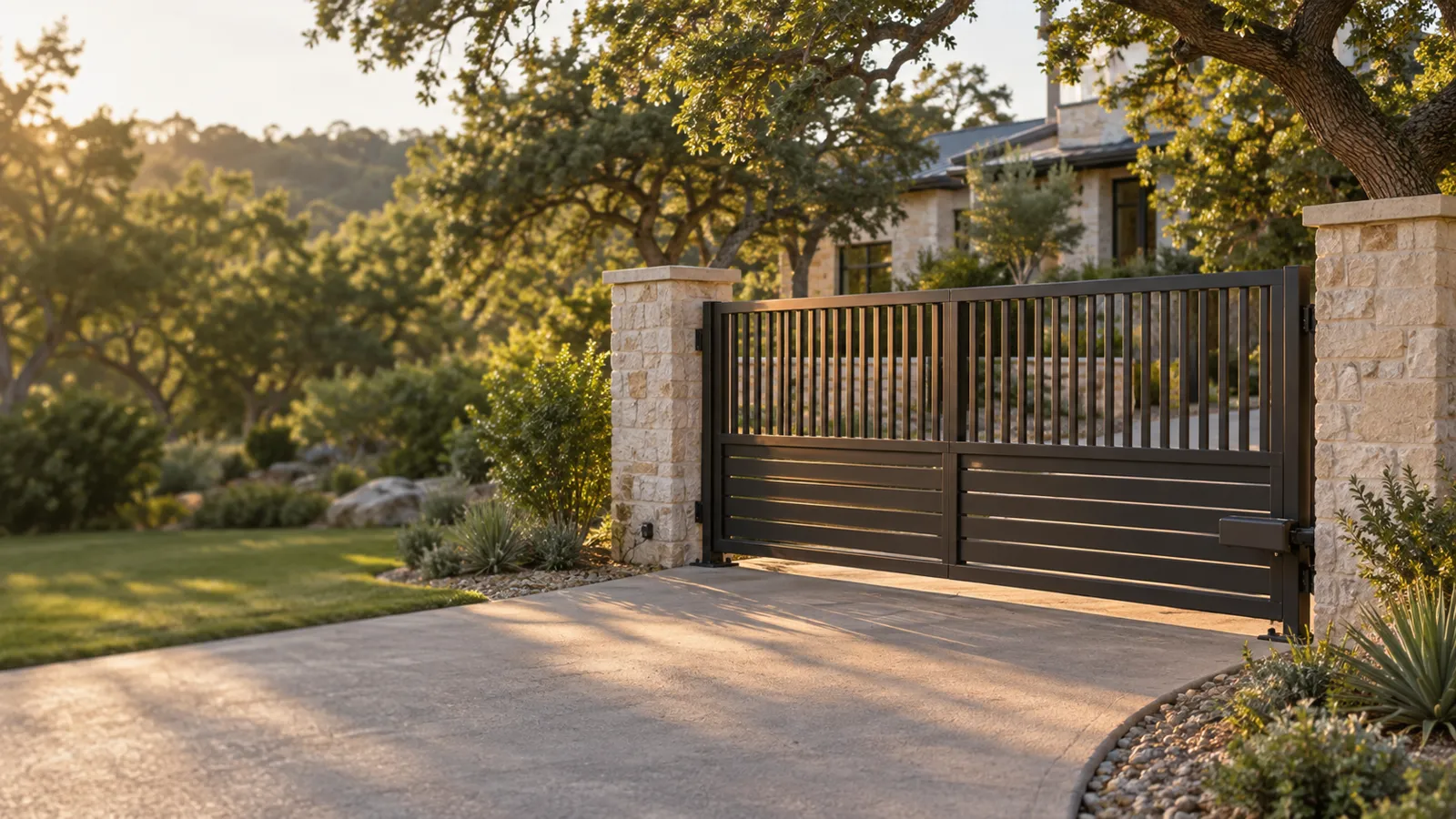
Bronze-finish steel driveway gate, vertical pickets over horizontal slats, closed between cut limestone columns at golden hour with a stone house behind live oaks

What Drives the Cost of an Automatic Driveway Gate

We do not publish a figure for an automated entry, because two drives on the same street can need very different systems. These are the factors that decide where yours lands:

  • Opening width and leaf count. A wide drive split into two swing leaves needs two operators; a single sliding leaf needs one larger unit.
  • Gate style. Swing, slide and cantilever each call for different hardware, footings and safety layouts.
  • Slope and grade. A drive that rises or falls across the opening may need a stepped leaf, a different swing direction or a sliding design.
  • Material and frame. Steel, aluminum or a wrought iron look, the picket and frame gauge, and how much ornament the design carries.
  • Finish. Hot-dip galvanizing under a powder coat protects steel longer than paint alone and adds a step to fabrication.
  • Operator and duty. A Class I residential operator for one household differs from one listed for a busier shared entry, and very heavy leaves may call for hydraulic drive.
  • Power at the gate. Trenching service from the house versus a solar panel and battery.
  • Entry devices. Remotes, keypad, intercom, exit loop and any fire access hardware.
  • Safety devices. How many photo eyes and edges the layout needs to cover every entrapment zone.
  • Columns and footings. Masonry or steel columns, and footings cut into the limestone that sits under much of western Austin.
  • Approvals. HOA or POA architectural review and any city permit.

The honest way to put a number on all of that is to stand at the opening. The on-site measure is free, and the written quote that follows lists each part of the system on its own line.

From Site Visit to Handover

1. Site visit and measure

We measure the opening, shoot the grade across the drive, mark where power can reach, and note what sits in the swing or slide path. Photos and dimensions go back to the shop.

2. Drawings and approval

You receive shop drawings of the leaf, columns and device layout. If your neighborhood has an architectural committee, those drawings are what goes into the application, and no steel is cut until you sign off.

3. Fabrication and finish

The leaf is cut, fitted and welded in our shop, then finished. Posts, conduit and footings go in on site while fabrication runs.

4. Installation and setup

We hang or set the leaf, mount the operator, wire the eyes, edges and loop, program the remotes and keypad, and adjust force and travel limits.

5. Testing and walk-through

Every safety device is tested in both directions of travel with you watching. We show you how to release the operator and move the gate by hand, where the warning signs are, and how the backup power behaves. You keep the operator manual and a written warranty. Call us to book the free site visit and see what an automated entry looks like on your own drive.

The process

From Site Visit to a Gate That Runs

Four steps, and nothing is fabricated until you have signed off on the drawings and the price.

  1. Free site visit

    We measure the opening, the slope and where power can reach, and talk through style, automation and access.

  2. Drawings and a written price

    You get scaled drawings for your approval and for any HOA or city review, with one written price.

  3. Fabricated in our shop

    Steel is cut and welded to the approved drawings, then galvanized, powder coated or both.

  4. Installed and tested

    Columns and posts set, gate hung, operator set up to UL 325 and every safety device tested with you.

More of What We Build

Questions

Automatic Driveway Gates: Common Questions

What decides the cost of an automatic driveway gate?

The width of the opening, the gate style, the slope of the drive, the material and finish, the operator, how power reaches the post and which entry and safety devices go with it. We walk through each one on the free site visit and itemize them in the written quote.

How long does fabrication take after I approve the drawings?

It depends on the design, the finish and the operator, and you get a schedule with the quote. Site work such as footings and conduit runs while the leaf is in the shop, so installation is short once fabrication is done.

Should my drive have a swing gate or a sliding gate?

A fairly level drive with room for the leaves suits a swing gate. A steep drive, a short run between the street and the garage, or a wall close to the opening usually points to a sliding or cantilever design. We settle it with you on site rather than from a photo.

Who handles HOA or POA approval?

You are the applicant, because the approval is tied to your lot, but we prepare the drawings, finish details and device layout the committee asks for and help put the submission together. Nothing is fabricated until it is approved.

How do fire trucks get through an automatic gate?

Fire access is part of the layout, usually a key switch or an access box accepted by the local fire district. West Lake Hills requires an ESD 9 approved access box and Lakeway asks for an ESD 6 key switch on coded gates. We confirm what your district expects when we quote.

What happens when the power goes out?

The systems we design carry a battery that keeps the operator working after mains power drops, and West Lake Hills makes an integral emergency power source mandatory. If the battery runs down, the operator can be released so the leaf moves by hand.

Do you cover my area?

We work across Travis County, including Austin, Rollingwood, West Lake Hills, Sunset Valley, Shady Hollow, Barton Creek, Lost Creek, Steiner Ranch, The Hills, Lakeway and Volente. Call with your address and we will confirm.

Is the installation covered by a warranty?

Yes. Every automated entry we install comes with a written warranty, and the operator documentation is handed over at the walk-through.

What happens at the site visit?

We measure the opening and the grade, look at where power can come from, check the swing or slide path, and talk through how you and your guests will get in and out. It is free and carries no obligation.

Free site visit

Talk to us about automatic driveway gates

Free on-site measure across Austin and the west side. We call you back to set a time.

Call (512) 503-9203

Calls only, we do not receive text messages.

Call (512) 503-9203