Skip to content

Custom Driveway Gates in Austin, Drawn First and Built to Fit

Austin Metal Gates designs and builds custom driveway gates in Austin, TX, and is Travis County's trusted specialist in driveway gate fabrication, specializing in shop-drawn entry designs, welded steel frames and hand-laid picket patterns. We offer lightweight aluminum builds and forged-look wrought iron styling.

  • Free on-site measure
  • Shop drawings you approve
  • Operators set up to UL 325
  • One written price

Request a free site visit

Or call (512) 503-9203. Calls only, we do not receive text messages.

About our custom driveway gate fabrication

Our team provides galvanizing and powder coat finishing, delivering a one-of-a-kind entrance for homeowners and durable, low-upkeep ironwork for both residential and commercial projects. Every opening is measured on site by the same crew that installs it, and no steel is cut in our own shop until you have approved the drawings.

From picket spacing and top rail profile on the drawing to a finished leaf hung square on its posts, our team handles every detail. Serving Austin along with Rollingwood, Sunset Valley and Lost Creek, we design each entry around the lot it guards and the rules that govern it.

Why Austin Metal Gates

How We Work

No stock panels cut down to fit, and no handoffs. The crew that measures your opening builds and installs the gate.

Measured on siteThe opening, the slope and the ground, measured where the gate will hang
Shop drawings firstYou approve the drawings and finish before any steel is cut
Welded in our own shopFrames fabricated and finished to your drawings, not ordered from a catalogue
Set up to UL 325Every operator installed with its safety devices tested before we leave

From Sketch to Shop Drawing: How a Custom Driveway Gate Is Designed

A custom gate is not picked from a catalog. It is drawn for one opening, and the drawing is the contract between what you pictured and what we build.

The site measure

We start at the driveway. The crew measures the clear width between the posts or columns, the height you want, the grade under the leaves and the distance back from the street. Those numbers go straight onto the drawing, so nothing is guessed at the welding table.

The shop drawing

In construction, a shop drawing is the detailed set a fabricator prepares so a crew can build a component exactly, with dimensions, materials and fabrication notes spelled out. Ours show the frame, every picket, the rail layout, the hinge points and the finish color. Any dimension that still has to be confirmed at the site is flagged on the sheet rather than assumed.

Your approval

You review the drawing before anything is cut. Change the picket rhythm, lower the top rail, add a scroll panel: it is a pencil change now and a costly one later. When you sign, that sheet goes to the shop floor.

Steel, Aluminum or Wrought Iron: Choosing the Metal

The metal you choose sets the weight of the gate, how it holds up outdoors, and how hard any future operator has to work.

  • Steel. Mild steel carries roughly 0.05 to 0.30 percent carbon, which is why it welds cleanly and bends without cracking. It is strong and it rusts if it is left bare, so it is never left bare here.
  • Aluminum. Its density is about one third that of steel, and it forms a protective oxide layer on its own surface. A lighter leaf puts less strain on hinges and posts, which matters on a wide opening.
  • Wrought iron. True wrought iron is an almost carbon-free iron with fibrous slag running through it, and commercial production of it ended in 1973. Most gates sold as wrought iron today are mild steel shaped to look hand-forged. We will tell you plainly which you are getting.

For most estate entries we recommend steel for its rigidity and presence, and aluminum where the span is wide or the leaves will be automated. The drawing notes the metal and the tube and picket sizes, so you can compare options side by side.

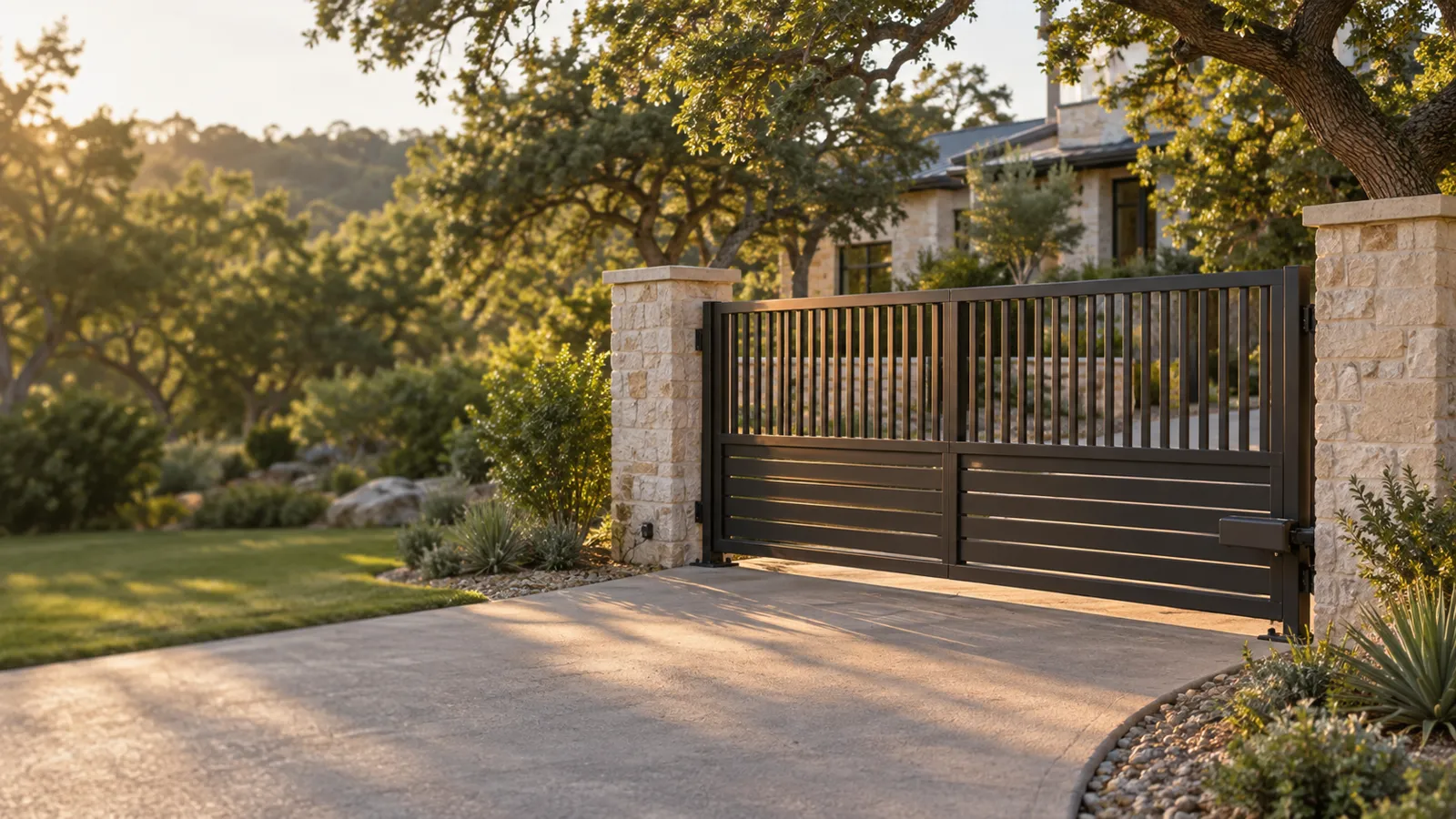
Bronze-finish steel driveway gate, vertical pickets over horizontal slats, closed between cut limestone columns at golden hour with a stone house behind live oaks

Picket Styles, Top Rails and Solid Panels

The picket is the vertical bar that gives a gate its character, set at an even spacing between horizontal rails. The choices you make here are mostly about looks, but in several nearby cities they are also about code.

Flat tops versus pointed tops

Pointed pickets trace back to sharpened stakes, and many buyers love the classic spear or finial profile. Some places will not allow it. Lakeway banned new spiked and open-picket fencing in 2019 and now requires a continuous flat top, because deer leaping ornamental fences were being impaled. Sunset Valley's code bars spiked elements above the top rail and pickets spaced more than two and less than nine inches apart above it.

Color and pattern rules in POA communities

Some associations specify the look outright. One set of recorded Barton Creek Southwest guidelines calls for brown or bronze wrought iron style pickets. We draw to whatever your association's current document says, and we check it again at quote time, because these rules change.

Solid and privacy panels

A solid face gives full privacy and catches wind like a sail. If you want the screen, we can draw louvers or offset slats that let wind spill through while still blocking the view.

Galvanizing and Powder Coat: The Finish That Protects the Steel

Bare steel will rust in a Central Texas spring. The finish is what keeps a custom gate looking the way it did on the drawing.

Hot-dip galvanizing

In hot-dip galvanizing, the fabricated steel is lowered into molten zinc at roughly 450 degrees Celsius. The zinc bonds to the surface and weathers into a zinc carbonate layer that shields the steel beneath it. Because the whole piece is dipped, the inside of hollow tube is coated as well as the face you see.

Powder coat

Powder coating is applied as a dry powder, charged electrostatically so it clings to the metal, then cured under heat. It builds a thicker, tougher film than liquid paint without running or sagging, and it looks the same on horizontal rails as on vertical pickets.

How we use them together

On steel gates we galvanize first and powder coat over the zinc, so the color is the visible layer and the zinc is the backstop. Aluminum does not need the zinc and goes straight to powder coat. You pick the color from physical samples at the site visit, not from a screen.

What Drives the Cost of a Custom Driveway Gate

We do not publish a set figure, because two custom gates of the same width can differ widely in what they take to build. These are the factors that move the number:

  • Opening width and leaf count. A single wide leaf and a matched pair of leaves use different frames and hardware.
  • Swing, slide or cantilever. The way the gate moves changes the frame, posts and footings behind it.
  • Metal and gauge. Steel, aluminum or a hand-forged look, and the size of the tube and pickets.
  • Design detail. Scrollwork, arched top rails, monograms and cast elements all add shop hours.
  • Finish. Galvanizing plus powder coat, and whether the color is a stock shade.
  • Slope and grade. A drive that rises under the leaves needs a different hinge plan or a different gate type.
  • Columns and footings. Masonry columns or steel posts, set in the limestone that sits under a thin layer of topsoil on the west side of Austin.
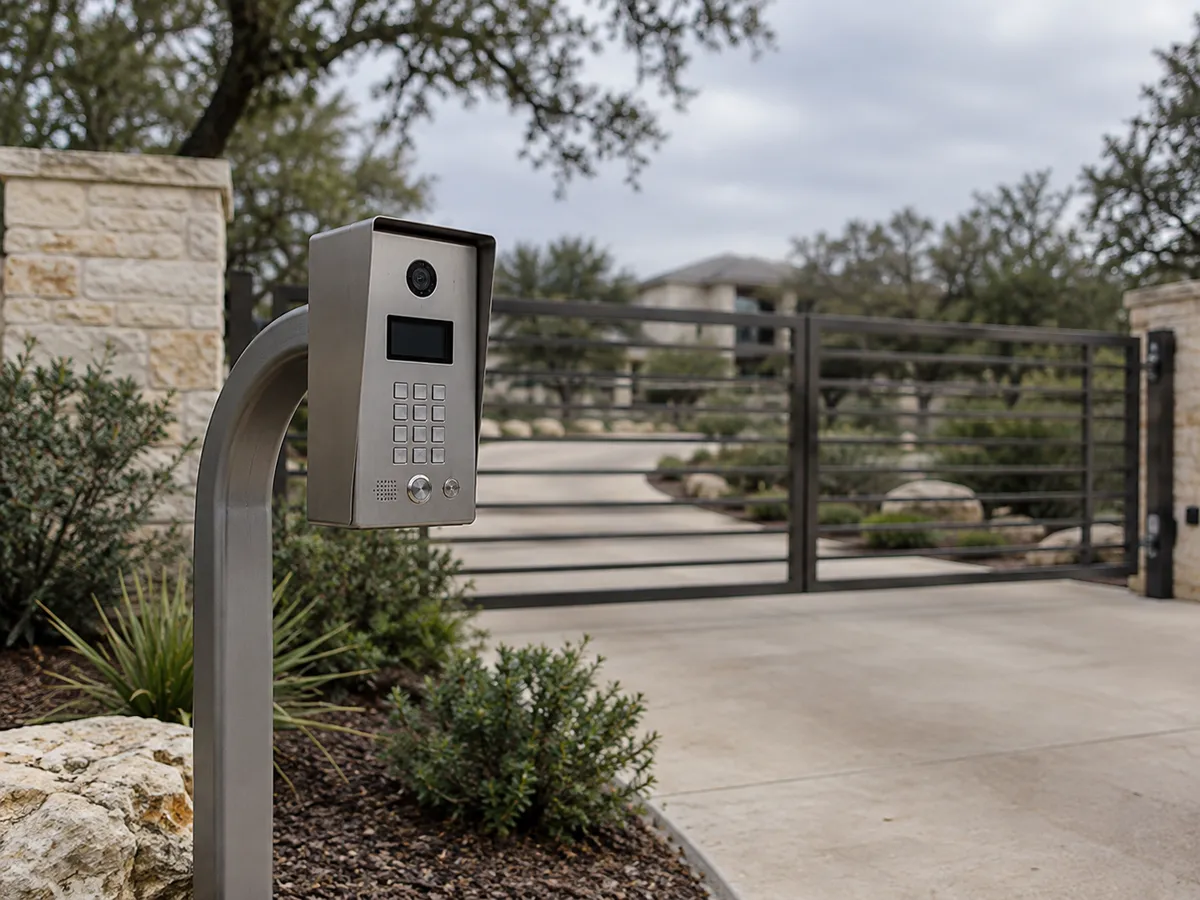
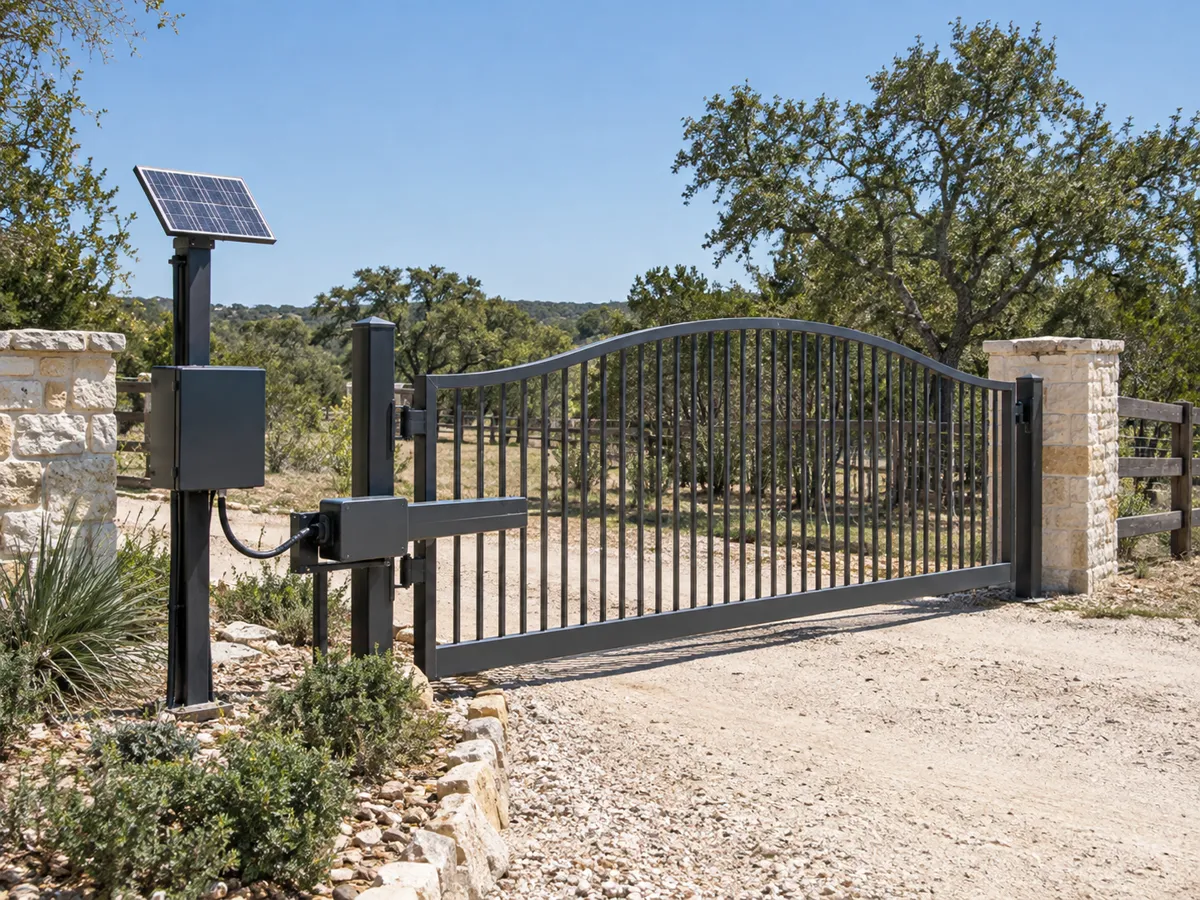
  • Automation now or later. Operator type, power at the gate by trenching or solar, access control and intercom, and safety devices such as photo eyes and edges.
  • Approvals. HOA or POA review, and any city permit the location requires.

The way to a real number is the free on-site measure, after which you get a drawing and a written quote for that gate.

Posts, Setbacks and Planning for an Operator

A gate is only as straight as the posts it hangs on. We size posts or columns and their footings for the finished weight of the leaves, not a generic default.

Setbacks and swing direction

Where the gate sits on the lot is often decided for you. Rollingwood's code requires a driveway gate to let a car stop completely off the street and to open parallel to or away from it. Under Texas SB 711, in force since September 1, 2025, an HOA may require a driveway gate to be set back at least 10 feet from the right-of-way where the drive meets a laned road. We mark the setback on the drawing.

Ready for automation

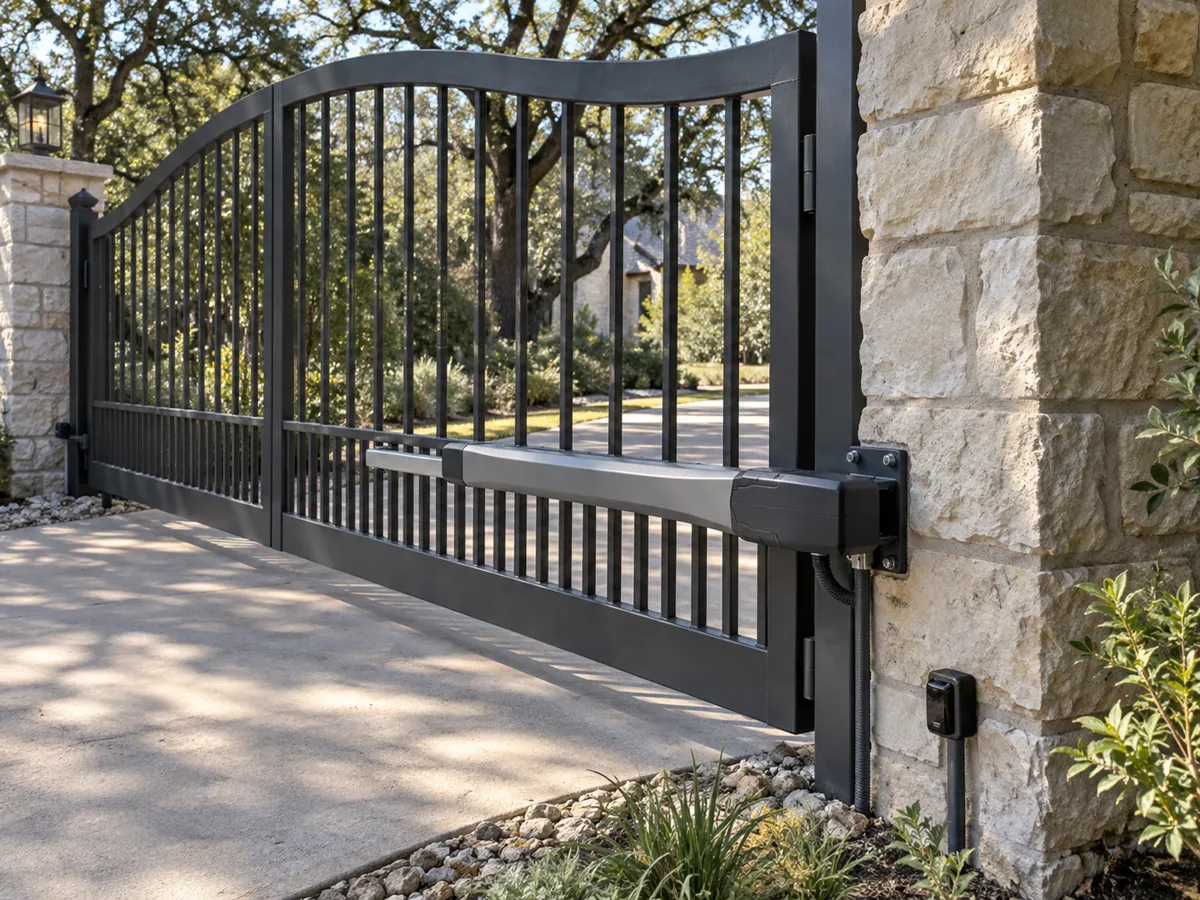
Even if you are not automating yet, we can build hinge points, operator mounting plates and a conduit path into the first install so an operator can be added later without cutting the finish.

The process

From Site Visit to a Gate That Runs

Four steps, and nothing is fabricated until you have signed off on the drawings and the price.

  1. Free site visit

    We measure the opening, the slope and where power can reach, and talk through style, automation and access.

  2. Drawings and a written price

    You get scaled drawings for your approval and for any HOA or city review, with one written price.

  3. Fabricated in our shop

    Steel is cut and welded to the approved drawings, then galvanized, powder coated or both.

  4. Installed and tested

    Columns and posts set, gate hung, operator set up to UL 325 and every safety device tested with you.

More of What We Build

Questions

Custom Driveway Gate Fabrication: Common Questions

What affects the price of a custom driveway gate the most?

Width, the metal, the amount of decorative detail and whether it will be automated usually matter most. Grade, columns and approvals come next. We price from the drawing after measuring your opening, at no charge.

How long does fabrication take once I approve the drawing?

It depends on the design, the finish and the galvanizer's schedule, so we give you a date with the written quote rather than a general promise. Nothing is cut until your signed drawing is in the shop.

Can you match my existing fence or the ironwork on my house?

Yes. We photograph and measure the existing pickets, rails and scroll details at the site visit and draw the new gate to match their spacing, profile and color.

Who handles HOA or POA approval?

The owner is usually the applicant, but we supply the drawing, the finish color and the dimensions the committee asks for, and we revise the drawing if they request changes.

Should I choose steel or aluminum?

Steel gives a heavier, more rigid leaf with a classic presence. Aluminum weighs about a third as much, which suits very wide openings and automated gates. We can draw both so you can compare.

Do you cover my area?

We work across Travis County, including Austin, Rollingwood, West Lake Hills, Sunset Valley, Shady Hollow, Barton Creek, Lost Creek, Steiner Ranch, The Hills, Lakeway and Volente.

Is the gate covered by a warranty?

Yes. Every custom gate we build comes with a written warranty, and you receive it with the quote so you can read it before you commit.

What happens at the site visit?

We measure the opening, the grade and the setback, talk through style and metal, show finish samples, and note any HOA or city rules that apply. You then receive a drawing and a written quote.

Free site visit

Talk to us about custom driveway gate fabrication

Free on-site measure across Austin and the west side. We call you back to set a time.

Call (512) 503-9203

Calls only, we do not receive text messages.

Call (512) 503-9203