Skip to content

Cantilever Gates in Austin, With No Track in the Drive

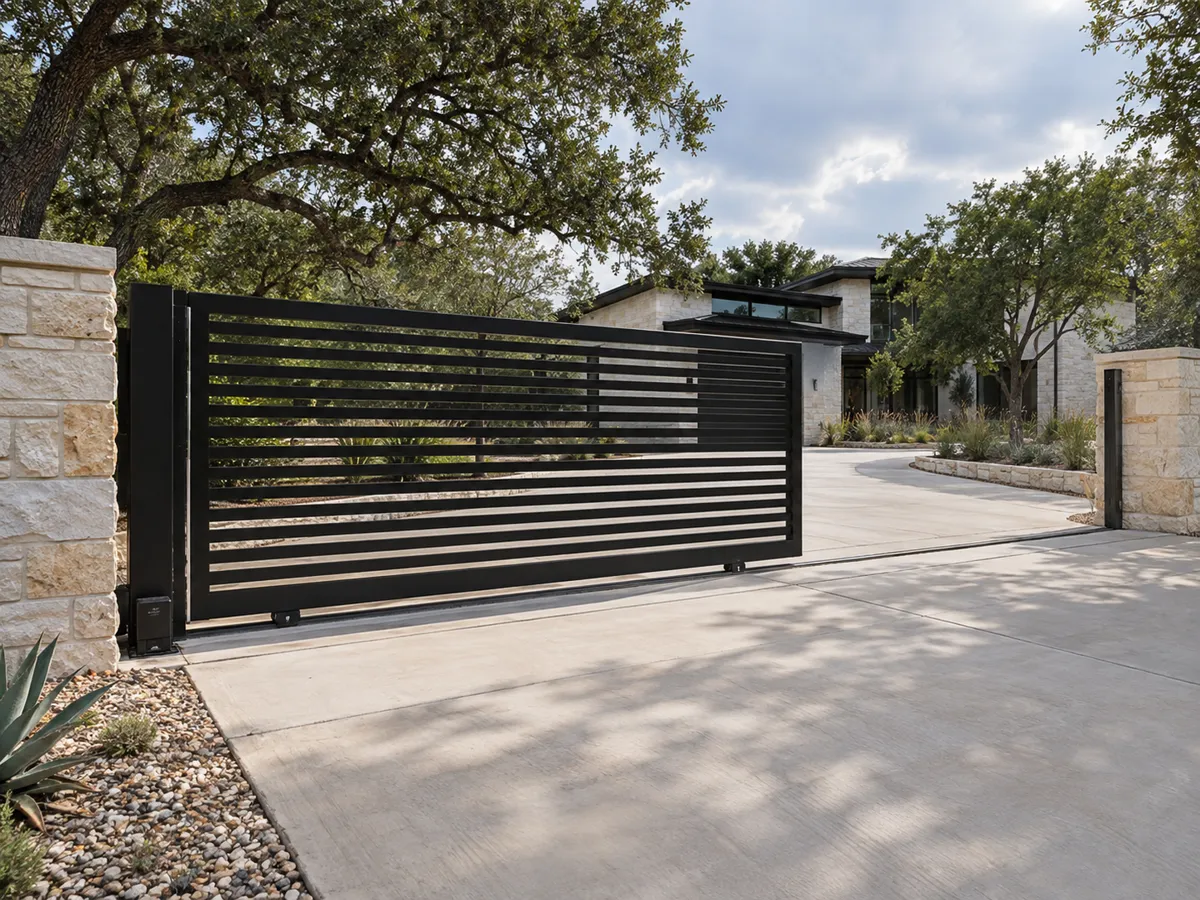
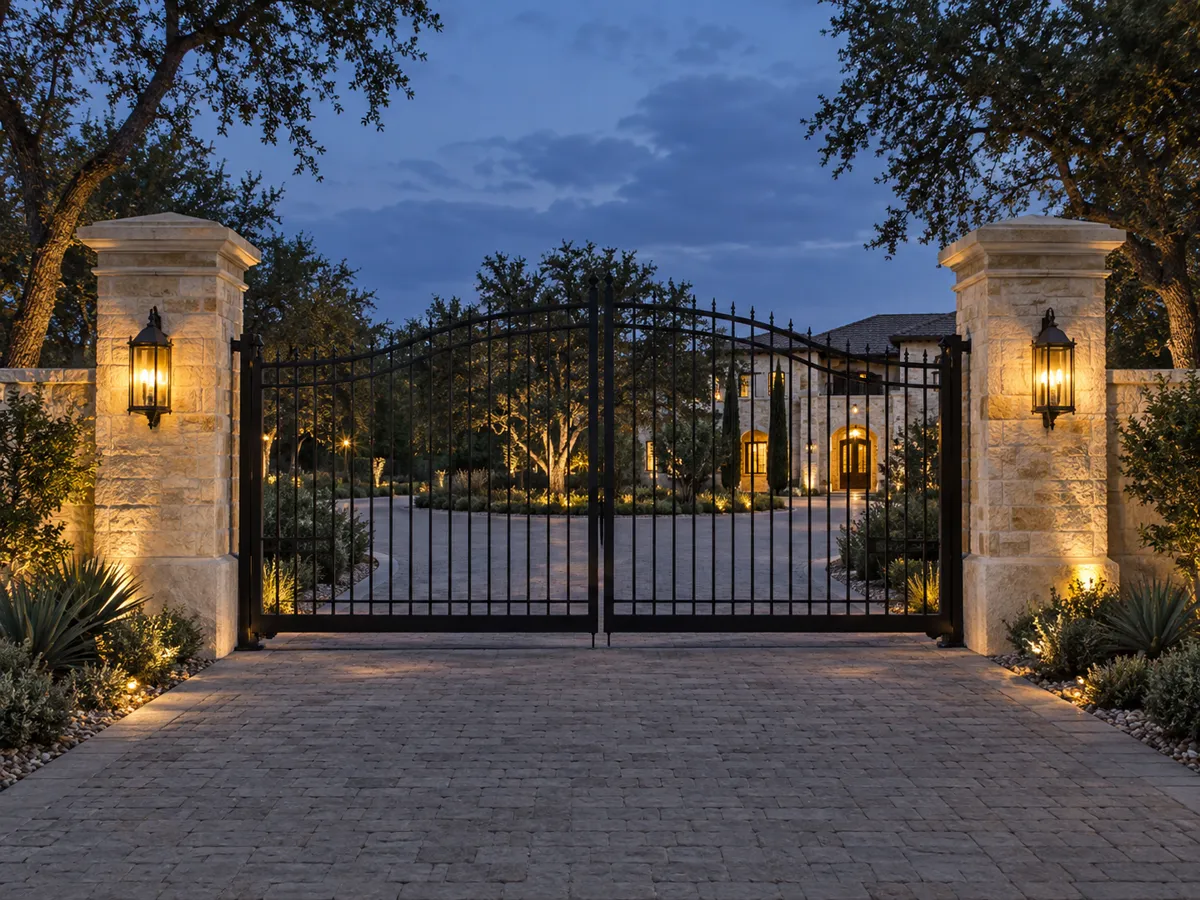
Austin Metal Gates fabricates cantilever gates in Austin, TX, and is Travis County's specialist in trackless slide gate systems, specializing in counterbalanced frames, roller truck assemblies and post-mounted carriage hardware. We offer rigid steel frames and lighter aluminum builds.

  • Free on-site measure
  • Shop drawings you approve
  • Operators set up to UL 325
  • One written price

Request a free site visit

Or call (512) 503-9203. Calls only, we do not receive text messages.

About our cantilever gates

Our team provides a full counterbalance layout for each opening, delivering a clean entry over gravel and grade for homeowners and a low-maintenance, track-free slide for both residential and commercial projects. The same crew that walks the grade with you sets the posts, and we weld the frame and its counterbalance tail in our shop to the drawings you sign.

From squaring the roller trucks on each support post to hanging a panel that floats clear of the drive, our team handles every detail. Serving Austin, Volente, The Hills and Lost Creek, we build for drives where a ground track would never stay level.

Why Austin Metal Gates

How We Work

No stock panels cut down to fit, and no handoffs. The crew that measures your opening builds and installs the gate.

Measured on siteThe opening, the slope and the ground, measured where the gate will hang
Shop drawings firstYou approve the drawings and finish before any steel is cut
Welded in our own shopFrames fabricated and finished to your drawings, not ordered from a catalogue
Set up to UL 325Every operator installed with its safety devices tested before we leave

How a Cantilever Gate Carries Itself

In engineering, a cantilever is a member fixed at one end and unsupported at the other, carrying its load back to the support. A cantilever gate uses the same principle. The panel hangs from rollers on posts at one side of the opening and reaches across the drive with nothing underneath it.

Roller trucks on the posts

The gate frame runs through sets of rollers, called trucks, mounted on two support posts beside the opening. As the gate opens and closes, its frame rolls through those trucks. The posts carry the whole weight; the drive carries none of it.

No track to fail

Because the gate floats above the ground, there is no rail across the drive to clean, crack, heave or replace. Nothing on the ground catches a tire, a mower or a heel. That is why cantilever systems are the standard on commercial sites, and why they suit estates where the drive surface is anything but flat and hard.

The Counterbalance Tail and the Room It Needs

A panel that reaches across an opening with no support at the far end has to be balanced. The balance comes from a counterbalance section, a tail of frame that extends back past the support posts.

How long the tail runs

Manufacturers size the counterbalance at roughly 40 to 50 percent of the clear opening, and the support posts are usually spaced about half the opening width apart. The practical result is that a cantilever gate needs a clear run beside the opening of about one and a half times the opening width to slide fully open.

Planning the run

The run sits along the fence line, on the inside of the property. It has to be clear of trees, walls, utilities and steps along its length. The ground under the run does not need to be level or paved, because the gate never touches it. That last point is the reason to choose a cantilever. A tracked slider needs a flat, poured line the full length of its travel. A cantilever only needs the gate to clear the ground.

The Answer for Sloped Hill Country Drives and Gravel

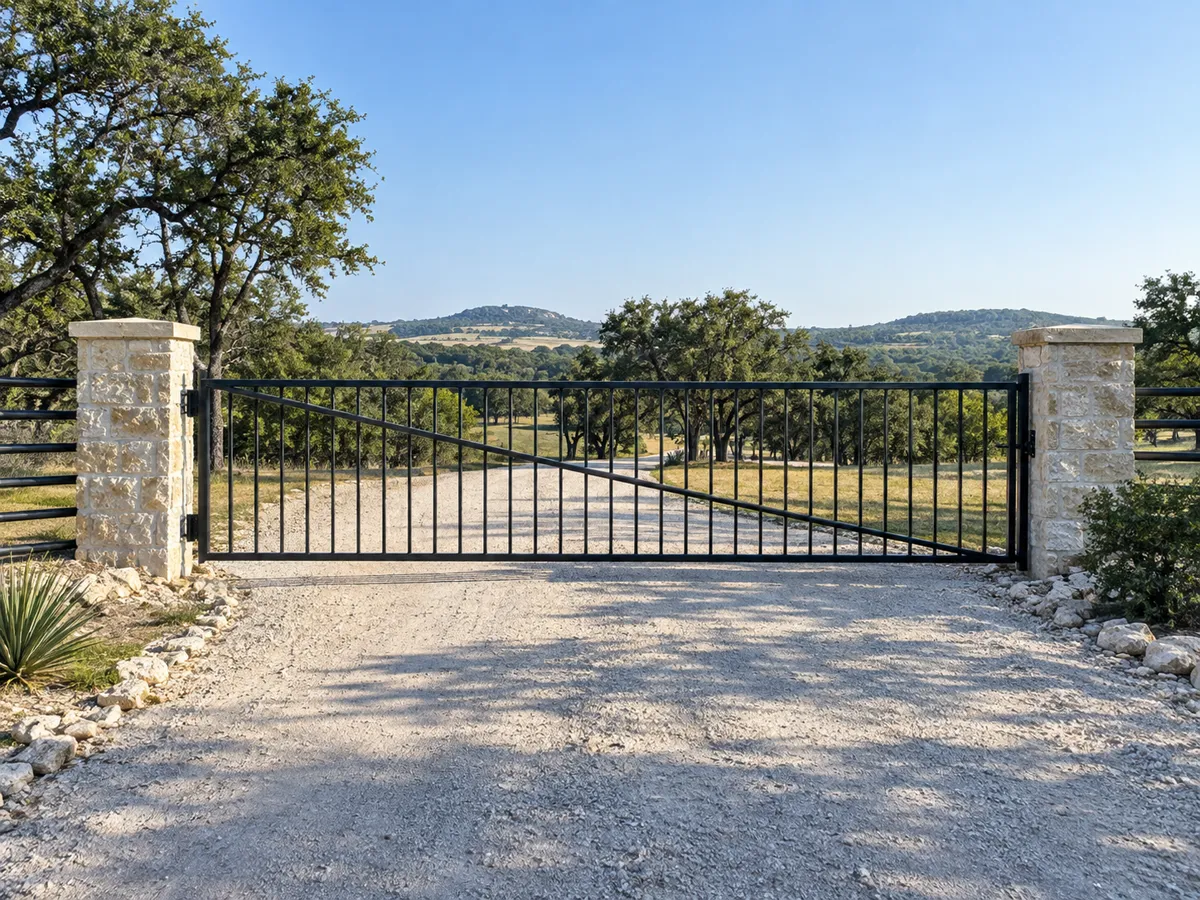
West of the Balcones Escarpment, Austin climbs into the edge of the Texas Hill Country, a landscape of karst, limestone hills, thin topsoil and exposed rock. Driveways here twist, pitch and change grade quickly, and many are gravel or crushed stone rather than concrete.

Why a track struggles here

A tracked sliding gate needs a level line across the opening. On a drive that pitches across the entry, that line has to be built, and on gravel there is nothing solid to fix it to. Swing leaves have their own problem when the drive rises toward the house, because they meet the grade as they open.

Why a cantilever does not

A cantilever gate travels across the drive in the air. We set its height so the bottom rail clears the highest point of ground along its path, and the gate slides above the slope rather than fighting it. Gravel stays where it is, and the grit that storm runoff leaves across a drive has no track to jam. For a sloped drive with gravel or uneven ground, gate suppliers point to cantilever as the recommended answer, and it is usually our first suggestion on Hill Country lots.

Rollers, Posts and Footings

Everything a cantilever gate does depends on its two support posts staying plumb. They carry the full weight of the panel and its tail, plus the leverage of a frame reaching across open air.

Footings in limestone

Western Travis County ground is limestone close to the surface. Once reached, it gives a solid base for a support post footing, but it has to be drilled to depth. We size those footings for the finished panel weight, not for a generic post.

Steel or aluminum

Aluminum has about one third the density of steel, so an aluminum cantilever of the same size puts far less weight on its rollers and posts. Steel gives a heavier, more rigid panel and a more imposing look. We draw both on wide openings so you can compare.

Roller alignment

The trucks are set dead in line on both posts so the frame rolls through them without binding. Once the gate is hung, it should glide by hand before an operator is ever connected.

Operators, Safety and Fire Access

Cantilever gates automate with a slide operator, which drives the frame along its rollers. With no track friction, the operator works against the panel's rolling resistance and little else.

UL 325 on a cantilever

US gate installations must meet UL 325. For residential and commercial slide gate operators it caps travel speed at one foot per second when pulling 75 pounds or more, and it requires at least two monitored entrapment protection devices for each entrapment area in each direction of travel. On a cantilever those areas include the closing edge, the rollers and the counterbalance tail moving back along the fence, so we fit photo eyes and contact edges and screen the roller area.

Fire access and power

Lakeway asks for a key switch for the ESD 6 fire department on coded gates. West Lake Hills requires electric driveway gates to include an integral emergency power source and an ESD 9 approved access box. We confirm your city's requirement at quote time, and battery backup is available on every operator.

What Shapes the Cost of a Cantilever Gate

Cantilever gates are quoted from a measured drawing, because the counterbalance tail and the ground under the run change every job. What moves the number:

  • Clear opening width, which sets the panel and a tail of up to half that length again.
  • Metal and frame: steel or aluminum, frame depth and picket gauge.
  • Design and face: open pickets, privacy slats, decorative detail.
  • Roller trucks and posts, sized to the finished weight.
  • Footings drilled into limestone.
  • Grade and clearance along the run, which sets the hang height.
  • Operator and duty rating, plus power at the gate by trenching or solar.
  • Safety devices, including photo eyes, edges and roller guards.
  • Access control, intercom and fire access hardware.
  • Finish, approvals and permits, from galvanizing and powder coat to HOA, POA or village review.

Start with the free on-site measure, where we walk the opening and the run with you.

The process

From Site Visit to a Gate That Runs

Four steps, and nothing is fabricated until you have signed off on the drawings and the price.

  1. Free site visit

    We measure the opening, the slope and where power can reach, and talk through style, automation and access.

  2. Drawings and a written price

    You get scaled drawings for your approval and for any HOA or city review, with one written price.

  3. Fabricated in our shop

    Steel is cut and welded to the approved drawings, then galvanized, powder coated or both.

  4. Installed and tested

    Columns and posts set, gate hung, operator set up to UL 325 and every safety device tested with you.

More of What We Build

Questions

Cantilever Gates: Common Questions

Is a cantilever gate worth it over a tracked sliding gate?

On a level concrete drive either works. On a slope, on gravel or anywhere debris washes across the entry, a cantilever avoids the track problems entirely.

How much room does a cantilever gate need beside the drive?

Plan on a clear run of about one and a half times the opening width, because the counterbalance tail travels with the gate. We measure it on site.

Can a cantilever gate work on a steep driveway?

Often, yes. The gate slides above the ground, so we set its height to clear the high point along its path. Very steep grades change the layout, which we check at the site visit.

What happens if the power goes out?

With battery backup the operator keeps working for a time, and a manual release lets you roll the gate open by hand.

Does my HOA or village need to approve it?

Usually. Volente, for example, issues its own fence permits, and many associations review gates and fences. We supply the drawings and details the reviewer asks for.

How does the fire department open it?

We install the key switch or access box your fire district or city requires and confirm the requirement for your address when we quote.

Do you work in my area?

Yes, throughout Travis County: Austin, Volente, The Hills, Lost Creek, Lakeway, Steiner Ranch, West Lake Hills, Rollingwood, Barton Creek, Sunset Valley and Shady Hollow.

Is there a warranty on a cantilever gate?

Yes, a written warranty, which comes with your quote so you can read it first.

Free site visit

Talk to us about cantilever gates

Free on-site measure across Austin and the west side. We call you back to set a time.

Call (512) 503-9203

Calls only, we do not receive text messages.

Call (512) 503-9203