
Gate Access Control and Intercoms in Austin, Planned Around Who Comes In
Austin Metal Gates installs gate access control in Austin, TX, and is Travis County's trusted specialist in entry systems for automatic gates, specializing in keypad entry, cellular and smartphone app access and video intercoms at the drive. We offer proximity fobs and vehicle detection loops that open the gate for cars on the way out.
- Free on-site measure
- Shop drawings you approve
- Operators set up to UL 325
- One written price
About our gate access control & intercoms
Our team provides fire department access hardware, delivering an easy arrival for the family and controlled, recorded entry for both residential and commercial projects. Our own crew surveys the drive before anything is wired, marks where each keypad post can stand at least six feet from any moving part as UL 325 requires, and draws the layout for your approval, and every system we set up carries a written warranty.
From the loop cut into the pavement for free exit to a complete entry with intercom, keypad and key switch, our team handles every detail. Serving Austin, Lakeway, West Lake Hills and The Hills, we set up systems that work for residents, guests, deliveries and first responders.
Why Austin Metal Gates
How We Work
No stock panels cut down to fit, and no handoffs. The crew that measures your opening builds and installs the gate.
Choosing How Your Gate Knows Who to Let In
An automatic gate is only as convenient as the way people open it. Access control is the part of the system that decides who gets in, how they prove it, and what record is kept when they do.
Every method falls into a few families. Something a person knows, such as a PIN entered on a keypad. Something a person carries, such as a remote, a proximity fob or a card. A phone, which newer systems turn into a credential over Bluetooth, NFC or a cellular app. And a live conversation, where a guest calls from an intercom and someone at the house decides whether to open.
Most homes end up with a mix. Family members use remotes in the car or the app on their phones. Housekeepers, landscapers and pool crews get their own keypad codes. Guests and deliveries press the intercom. The system is designed around that list of people rather than around a single device.
Recording matters too. When a system grants access it can log the event, so you can see which code opened the gate and when. That turns a lost remote or a former contractor's code into a line you delete rather than a reason to worry.
No system stops a second car from following the first one through an open gate. Tailgating is the most common way into any controlled entrance, which is why camera coverage at the drive is worth planning alongside the credentials.
Keypads, Remotes and Proximity Fobs
The keypad is still the backbone of most residential entries, because a code can be given out by phone and taken away just as fast. Each regular visitor gets a separate code, so removing one person never means changing everyone's.
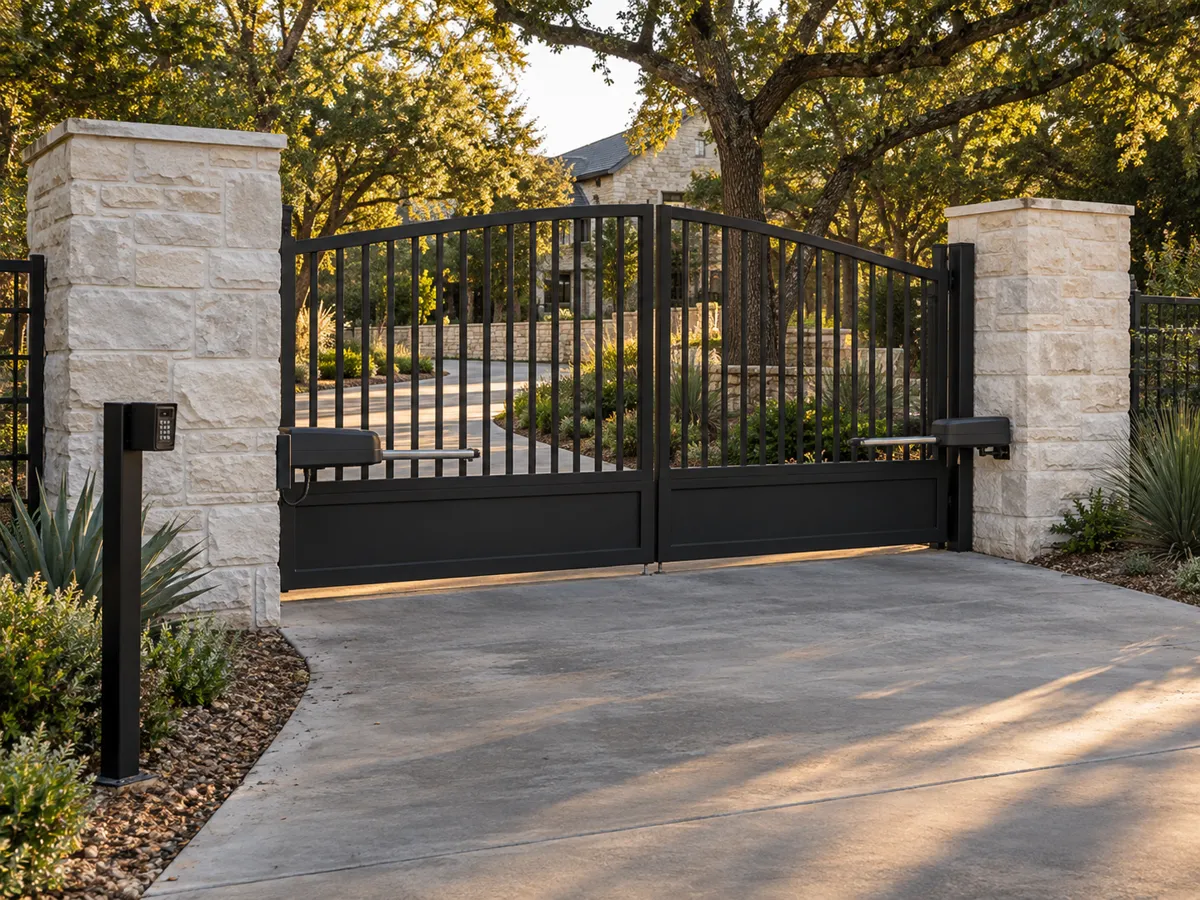
Where the keypad goes is set by the safety standard, not by taste. UL 325 requires user controls to sit at least six feet from any moving part of the gate, placed so nobody can reach over, under, around or through the gate to work them. We set the keypad post on the approach side where a driver can reach it from the window without leaving the car.
Proximity fobs and cards work by holding them near a reader. Common formats include 125 kHz proximity and contactless smart cards, and a fob is small enough to live on a key ring. They suit anyone who comes and goes daily and would rather not type a code in the rain.
Remotes remain the fastest way in for household cars. We program them to the receiver on the operator and keep a list of which remote belongs to whom.
Some cities want codes shared with them. Lakeway's fence code requires the owner of a keyed or coded gate to give keys or codes to the city police department, so a Lakeway installation includes that step.
Cellular, App and Video Intercoms
A gate intercom lets a visitor talk to someone at the house before being let in. The question is how the call gets from the gate to you.
Many older call boxes needed a telephone line run to the gate. On a long drive, or a lot where no line exists, that trench is a real cost. Cellular intercoms connect over an LTE signal instead, so the gate calls your mobile directly and you can answer and open from anywhere, including when you are away from home. Codes and schedules can often be managed from the same app.
Video adds a face to the voice. A video door-phone pairs an outdoor panel carrying a camera, microphone and speaker with a monitor or phone inside, and many outdoor panels include night vision. You see the delivery van before you press open.
Where network cable can reach the gate, an IP intercom can run over the local network on Power over Ethernet, one cable carrying both power and data. Wireless intercoms avoid the cable entirely but can pick up interference from other radio equipment, so we check the path from gate to house before recommending one.
We confirm cellular signal strength at the gate during the survey, because a hilltop house and a drive in a hollow can have very different coverage.
Vehicle Detection Loops and Free Exit
Nobody should need a remote to leave their own property. A vehicle detection loop is a coil of insulated wire laid in the pavement on the inside of the gate. When a car stops over it, the metal in the car lowers the loop's inductance, the detector notices the change, and the operator opens the gate.
Loops are also used as safety and presence sensors, telling the operator a vehicle is still in the gate's path so it does not close on it.
They have one limit owners should know. Small masses of metal, such as a motorcycle or a scooter, may not register on a loop at its default setting. The sensitivity can be adjusted, and we tune it for the vehicles that actually use your drive.
A loop is not the safety system on its own. Since 2016, UL 325 has required two separate means of entrapment protection at each entrapment zone, and the external devices, monitored photo eyes or edge sensors, must be connected and working or a new operator will not run. Loops, eyes and edges each have a job, and a good layout uses all three where they are needed.
On gravel or caliche drives, where a loop cannot be set in pavement, we discuss other exit options at the survey.
Fire Department Access and Key Switches
A locked gate cannot be allowed to slow an ambulance or an engine. Local codes around Austin handle this in different ways, and the entry has to meet the rule for its own address.
- Lakeway: a gate with keyed or coded access needs a key switch for the Travis County ESD 6 fire department, alongside the codes given to police.
- West Lake Hills: every lockable gate carries a security access box approved by Travis County ESD 9, and electric driveway gates need an emergency power source built into the system.
- The Hills: the village adopts the 2021 International Fire Code as adopted by ESD 6, whose fire marshal's office is the fire code official.
- Volente: the village adopts the 2018 International Fire Code, and fire protection comes from ESD 14 through the Volente Fire Department.
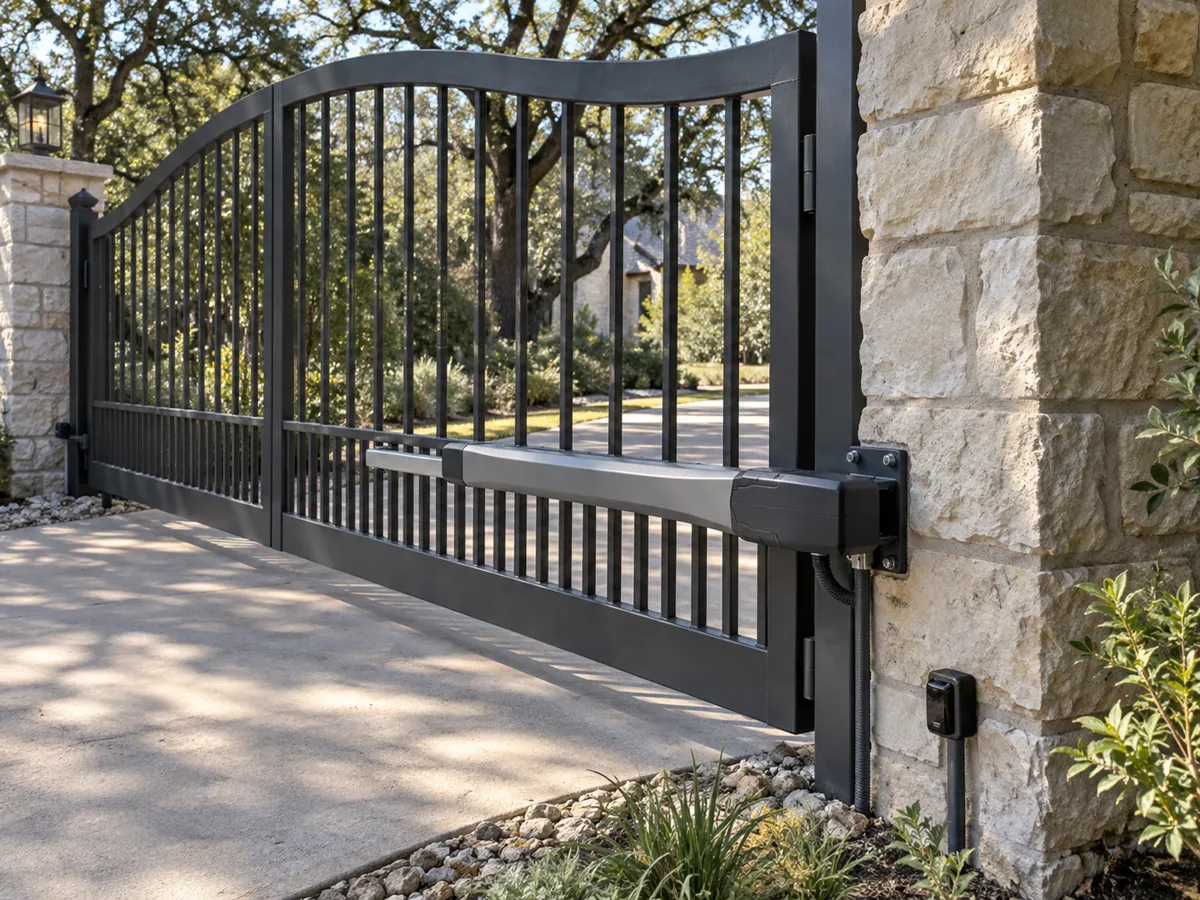
A fire department key switch is mounted beside the keypad. A responder with the district's key turns it to hold the gate open for the length of the call, then returns it to normal and the gate goes back to your keypad and operator. A key box works differently: it is a small wall-mounted safe holding keys the fire department can reach with its master key.
We have not found a published residential gate standard from the local fire districts, so we confirm the required hardware with the district for your address at quote time.
When the Power Goes Out
Every access control system has to answer one question in advance: when power fails, does the entrance open or stay shut? A system set to fail safe releases so people can get through. One set to fail secure stays locked.
For a residential driveway, the usual answer is backup power first and a manual release second. A battery keeps the operator, keypad and intercom running through an ordinary outage, and the manual release lets the gate be opened by hand if the battery is ever exhausted. In West Lake Hills that backup is not optional, because the city requires an emergency power source as an integral part of any electric driveway gate.
We explain the choice for your entrance at the survey and set the system accordingly, so nobody is surprised during a storm.
What Drives the Cost of Gate Access Control
Access control is priced from a survey of the actual gate. What moves the number:
- How many ways in: keypad only, or keypad plus fobs, app access and intercom.
- Audio or video intercom, and whether it connects by cellular, network cable or wireless.
- The distance from gate to house, and whether conduit or a trench is needed for power or data.
- Vehicle detection loops, and whether the drive is paved where they go.
- Photo eyes and edge sensors to complete entrapment protection on the operator.
- Fire department key switch or access box required by your city or district.
- Battery backup, or solar power where the gate has none.
- The operator itself, if the existing one cannot accept the accessories.
- Keypad posts, pedestals and any column work to mount them.
- Any POA or HOA approval for visible equipment at the drive.
It all starts with a free on-site survey. We look at the gate and operator you have or plan, test cellular signal, map where each device should stand, and send you a layout with a written quote.
The process
From Site Visit to a Gate That Runs
Four steps, and nothing is fabricated until you have signed off on the drawings and the price.
Free site visit
We measure the opening, the slope and where power can reach, and talk through style, automation and access.
Drawings and a written price
You get scaled drawings for your approval and for any HOA or city review, with one written price.
Fabricated in our shop
Steel is cut and welded to the approved drawings, then galvanized, powder coated or both.
Installed and tested
Columns and posts set, gate hung, operator set up to UL 325 and every safety device tested with you.
More of What We Build
Questions
Gate Access Control & Intercoms: Common Questions
What does gate access control cost?
It depends on how many ways in you want, audio or video intercom, cellular or wired connection, distance to the house, loops and safety sensors, fire department hardware and backup power. We quote from a free survey of your actual gate.
Can I open the gate from my phone when I am away?
Yes. A cellular intercom calls your mobile when someone presses the button, and app-based systems let you see who is there and open the gate from anywhere with signal. We check coverage at your gate before recommending one.
Do I need a phone line at the gate?
No. Cellular intercoms connect over the mobile network, which is why they suit long drives and rural lots. Where network cable can reach the gate, an IP intercom on Power over Ethernet is another option.
Can I give a delivery driver or contractor a code and remove it later?
Yes. Each person gets their own code, and removing it leaves everyone else's working. Systems that log entries also show when each code was used.
Will a motorcycle trigger the exit loop?
Not always at the default setting, because small amounts of metal barely change the loop's inductance. Loop sensitivity can be adjusted, and we tune it for the vehicles that use your drive.
Does my gate need a fire department key switch?
In Lakeway, a coded gate needs a key switch for the ESD 6 fire department, and West Lake Hills requires an ESD 9 approved access box on lockable gates. Rules vary by address, so we confirm yours with the district at quote time.
Can you add access control to a gate I already have?
Usually. It depends on whether the existing operator accepts modern accessories and meets current entrapment protection. We check the operator at the survey and tell you plainly if it needs replacing first.
Is the system under warranty?
Yes. Everything we install and program is covered by a written warranty, which we walk through with you when the system is handed over.
What happens at the site survey?
We look at the gate and operator, test cellular signal, check the drive surface for loops, measure where the keypad and intercom can legally stand, and ask who uses the entrance. Then we send a layout and a written quote.
Talk to us about gate access control & intercoms
Free on-site measure across Austin and the west side. We call you back to set a time.
Calls only, we do not receive text messages.