Low-E coatings
A low-emissivity coating is a microscopically thin metallic layer on one pane. It reflects infrared heat and cuts part of the ultraviolet, which helps with west sun and protects rugs and wood floors inside the door.
Austin Metal Gates fabricates iron entry doors in Austin, TX, and is Travis County's leading specialist in custom front doors, specializing in thermally broken steel frames, dual-pane insulated glass and tempered safety glazing set behind the ironwork. We offer operable glass panels with screens and arched double doors with transoms.
Our team provides complete door units hung plumb in the opening, delivering an entrance that holds back summer heat at home and a secure, lasting lobby entry for both residential and commercial projects. Your rough opening is measured by the same crew that will set the frame, and the door is welded in our shop only after you approve the drawings.
From EPDM gaskets and a sealed threshold to removing the old unit and fitting the final lockset, our team handles every detail. Serving Austin, Rollingwood, West Lake Hills and Volente, we bring the drawings and finish samples to your front step.
Why Austin Metal Gates
No stock panels cut down to fit, and no handoffs. The crew that measures your opening builds and installs the gate.
Steel is an excellent conductor of heat. A door built from solid steel sections with nothing between the outside face and the inside face carries the afternoon sun straight through to your foyer, and in winter it carries the cold the other way. Austin sees 90-degree highs on about 123 days a year and 100 degrees on roughly 29 of them, so a front door facing west can turn into a radiator.
A thermal break interrupts that path. A strip of low-conductivity material, usually a reinforced polyamide or a high-density polyurethane, is locked between the exterior and interior steel profiles of the frame. Heat has to cross the insulating strip to get inside, and it crosses it slowly.
Performance is judged on the whole unit, glass and frame together, not on the glass alone. When we compare door systems with you, that combined figure is the one we look at.
Most iron doors are as much glass as steel, so the glass matters as much as the frame. An insulated glass unit is two or more panes held apart by a spacer that carries a desiccant to keep the gap dry. The gap is often filled with argon, which insulates better than air. The panes are bonded with two seals: an inner one that keeps the gas in and an outer one that holds the unit together.
A low-emissivity coating is a microscopically thin metallic layer on one pane. It reflects infrared heat and cuts part of the ultraviolet, which helps with west sun and protects rugs and wood floors inside the door.
Door glass is tempered, and laminated glass is available where you want added security or quieter glazing. Where the entry faces the street, obscured glass can trade some view for privacy.
If the edge seal on an insulated unit fails, moisture gets in and the glass fogs between the panes. The fix is a new glass unit, not a new door, so we draw the glazing bead and access so a unit can be swapped later.
A fixed-glass iron door looks beautiful and does one thing. An operable-glass door does two. Each glass panel is hinged inside the ironwork so it can be opened on its own, independently of the door itself.
With the glass open, a screen set between the iron design and the glass lets air through and keeps insects out, while the ironwork stays locked. On a spring evening that turns the front door into a window. It also makes the outside face of the glass easy to clean, because you can reach it from indoors.
Operable glass does add hinges, latches and seals to every panel, so we talk through how often you would actually open it before we draw it in.
Between the door and its frame is a gap, and in a Central Texas thunderstorm that gap is where water and dust try to enter. A properly sealed iron door uses compression gaskets, typically EPDM rubber, on both the exterior and interior sides of the frame, with a center gasket and a weep path in better systems to catch and send out any water that gets past the first seal.
At the bottom, the threshold and door sweep close the gap over the floor. We set the threshold level on the finished floor, then adjust the door so the gaskets compress evenly around all four sides. A door that is out of plumb by a fraction will leak air at one corner no matter how good its seals are.
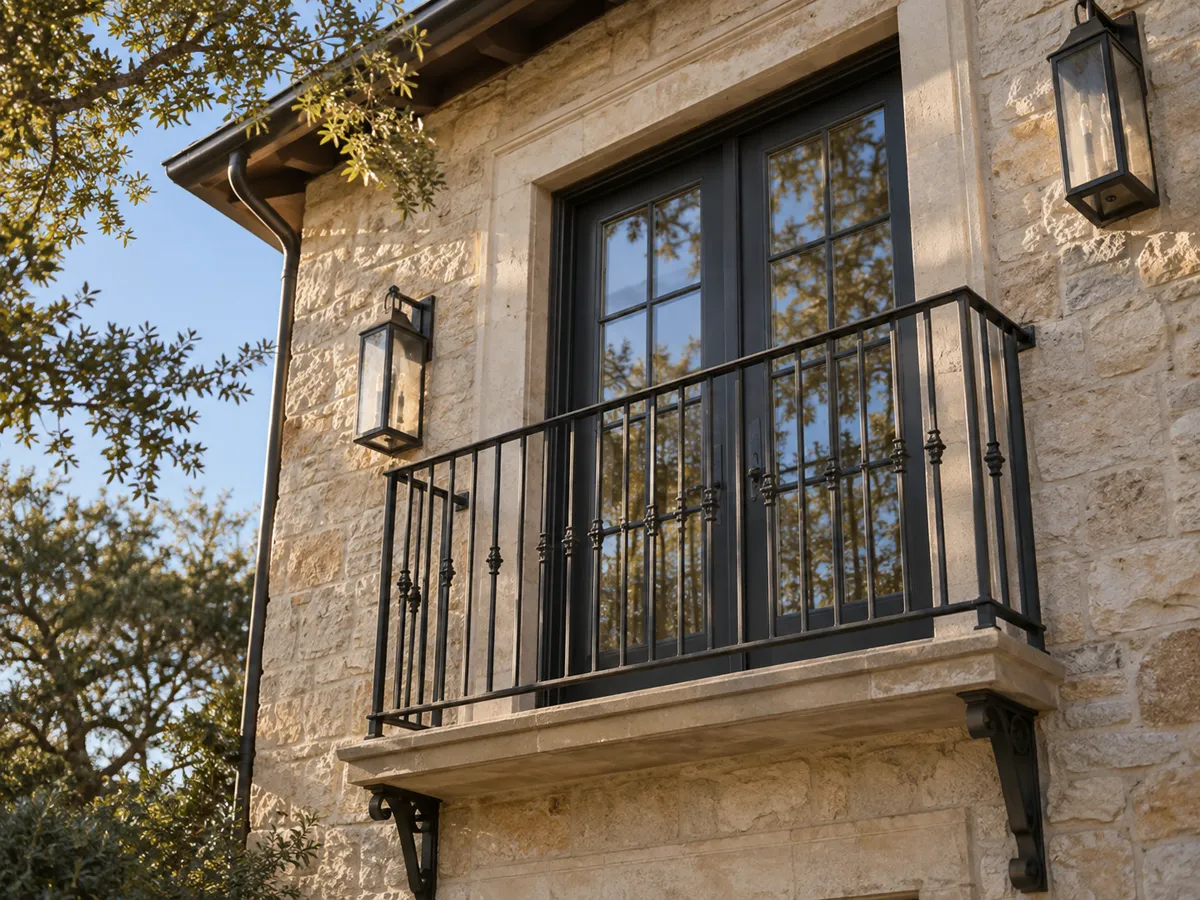
A standard residential exterior door opening is about 36 inches wide and 80 inches tall. A custom iron door does not have to fit that box, and many front entries do not.
We measure the rough opening, the header above it and the floor below it at the site visit. An arched or oversized opening is drawn from those measurements, not from a catalog size.
The steel in a quality door frame is galvanized and then powder coated. Zinc guards the steel even where a scratch reaches through the paint, and the baked powder builds a thick, even film without the solvents of liquid paint.
Color is chosen from powder samples, from black to bronze tones, and we bring those samples to the site visit so you see them against your stone and brick. If your property already has bronze-toned iron fencing, as the Barton Creek Southwest guidelines call for, we can finish the door to sit beside it. Hardware, from the handleset to the hinges and kick plate, is chosen to match.
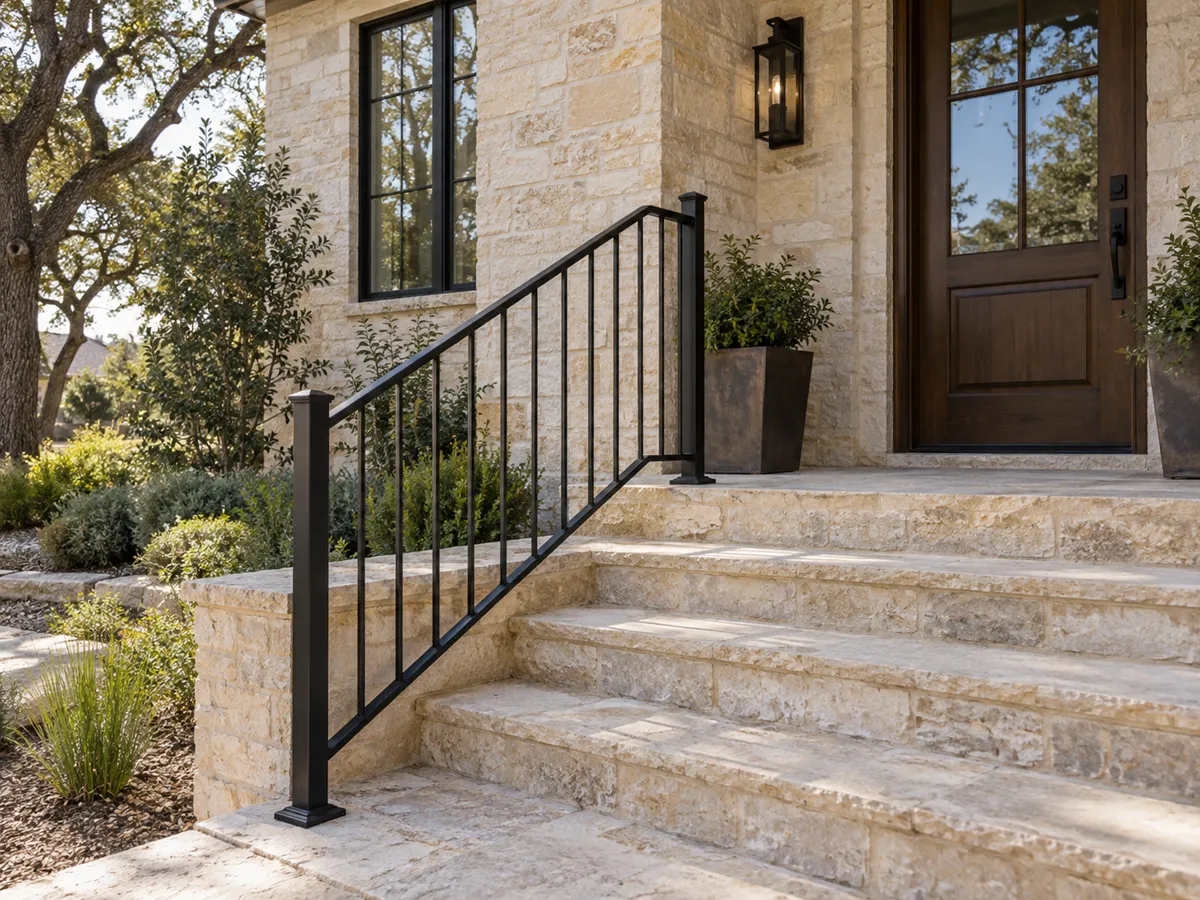
There is no catalog price for a custom door, so we will not print one. What moves the quote:
Every quote starts with a free visit to measure the opening, so the drawing and the number describe your door.
The process
Four steps, and nothing is fabricated until you have signed off on the drawings and the price.
We measure the opening, the slope and where power can reach, and talk through style, automation and access.
You get scaled drawings for your approval and for any HOA or city review, with one written price.
Steel is cut and welded to the approved drawings, then galvanized, powder coated or both.
Columns and posts set, gate hung, operator set up to UL 325 and every safety device tested with you.
Questions
Size, layout, arch, frame system, glass package, operable panels, ironwork detail, finish, hardware and the work needed in the opening. We quote after measuring your entry at no charge.
A door without a thermal break can be. A thermally broken frame puts an insulating strip between the outside and inside steel, and insulated low-E glass does the same for the panes, so the inside stays much closer to room temperature.
Yes, if you choose operable glass. Each panel opens independently behind the ironwork, and a screen keeps insects out while the door stays locked.
It is fitted with compression gaskets around the frame and a threshold and sweep at the floor, then adjusted so the seals press evenly on all sides. That fitting is what keeps water and drafts out.
It depends on size, glass and finish. We give you a schedule with the drawing, and fabrication starts once you approve it and any HOA review is complete.
Many do. The Hills, for example, requires an architectural modification request to its POA before any exterior improvement. We supply the drawing and finish details for your application.
Yes. We measure the arch on site and draw the frame to it, so the door fills the opening rather than needing it rebuilt to a standard size.
We fit doors across Austin and Travis County, including Rollingwood, West Lake Hills, Barton Creek, Lost Creek, Shady Hollow, Sunset Valley, Steiner Ranch, The Hills, Lakeway and Volente.
Each door comes with a written warranty, and we check the swing, the lock and the seals with you before we leave.
Free on-site measure across Austin and the west side. We call you back to set a time.
Calls only, we do not receive text messages.