Skip to content

Commercial Gates in Austin, Built for Heavy Traffic and Fire Access

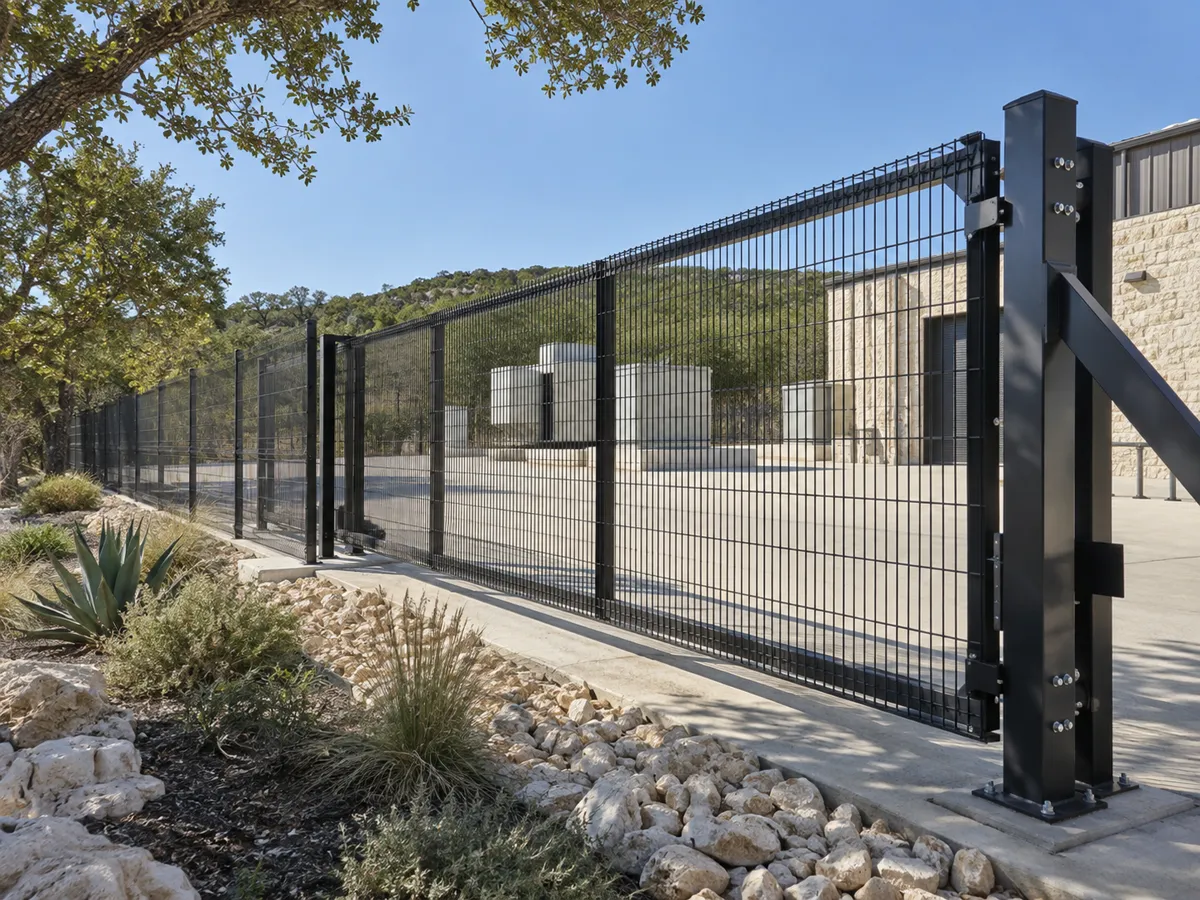
Austin Metal Gates builds commercial gates in Austin, TX, and is a leading Travis County specialist in heavy vehicle entries, specializing in cantilever slide gates, high duty-cycle operators and separated pedestrian gates. We offer bottom-track slide systems for level yards and welded steel swing leaves for low-traffic service drives.

  • Free on-site measure
  • Shop drawings you approve
  • Operators set up to UL 325
  • One written price

Request a free site visit

Or call (512) 503-9203. Calls only, we do not receive text messages.

About our commercial gates & slide gate systems

Our team provides UL 325 Class II and Class III operator setup, delivering entries that cycle all day at a distribution yard and dependable access at a smaller office lot, for both residential and commercial projects. Before any steel is cut, our own crew surveys the opening, the grade and the traffic pattern, and you approve shop drawings of the leaf we then fabricate and weld in our shop.

From the counterbalance tail that carries a cantilever leaf across the opening with nothing touching the drive to a full bid package of submittals, fire access hardware and phased installation, our team handles every detail. Serving Austin, Sunset Valley and Shady Hollow, we price from your site plan and build to your schedule.

Why Austin Metal Gates

How We Work

No stock panels cut down to fit, and no handoffs. The crew that measures your opening builds and installs the gate.

Measured on siteThe opening, the slope and the ground, measured where the gate will hang
Shop drawings firstYou approve the drawings and finish before any steel is cut
Welded in our own shopFrames fabricated and finished to your drawings, not ordered from a catalogue
Set up to UL 325Every operator installed with its safety devices tested before we leave

Commercial Gate Scope We Bid in Austin

This is the page for general contractors carrying a gate line item, developers setting up a new business park, and facility managers replacing a worn entry at a yard that cannot close. The scope below is what we price, fabricate and install as one package, so the steel, the operator and the controls arrive from one shop under one set of drawings.

  • Cantilever slide gates: leaves carried on roller trucks mounted to posts beside the opening, with nothing running across the pavement.
  • Bottom-track slide gates: for flat, paved openings where a track can be kept clean.
  • Swing gates for service drives: single or paired leaves where traffic is light and there is room for the arc.
  • Pedestrian gates: a separate walk-through beside every vehicle opening, because people may not use the vehicle gate.
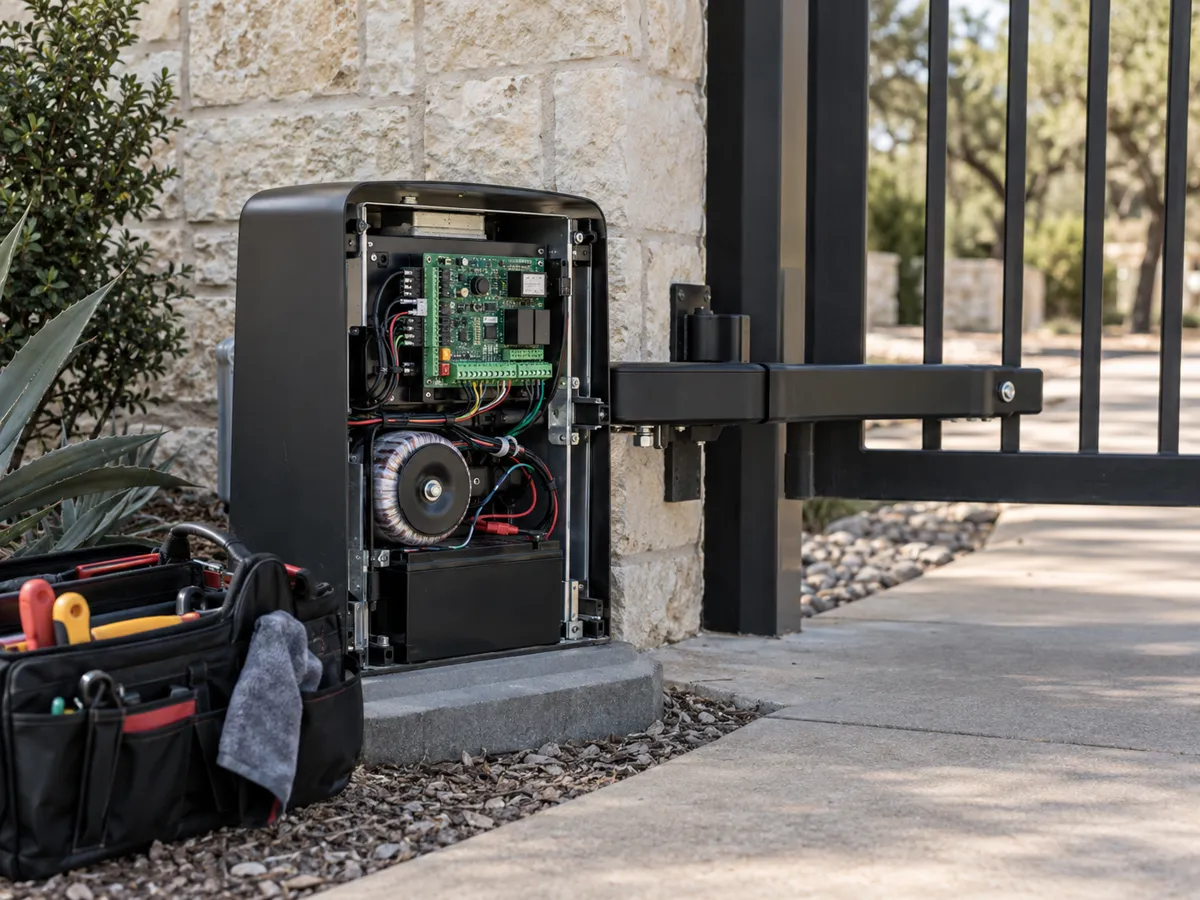
  • Operators and controls: UL 325 listed operators matched to the usage class of the site, with loops, photo eyes and edges.
  • Access control and fire hardware: card readers, keypads, intercoms and the fire department opening device your fire code official approves.

Gated residential entries for HOAs and apartment communities have their own page, as do perimeter fencing and scheduled maintenance agreements. This page covers the heavy commercial opening.

Cantilever, Slide or Swing for a Commercial Opening

The opening decides the gate type long before anyone picks a finish. We look at the width, the ground, what drives through it and how much straight run sits beside it.

Cantilever slide gates

A cantilever leaf hangs from roller trucks on two support posts to one side of the opening, so it never rolls on the ground. That makes it the usual answer where the drive carries gravel, debris or a grade change, and where a track would fill with dirt. The catch is length: the leaf needs a counterbalance section behind the opening, commonly about half the opening width, so a 20-foot opening calls for roughly a 30-foot leaf and a clear run beside it to park that leaf when open.

Bottom-track slide gates

A track gate rides wheels along a rail set in the pavement. It needs less tail than a cantilever and suits a flat, swept loading court. It asks more of whoever keeps the rail clear.

Swing gates

Swing leaves are simple and quick to cycle but need a clear arc on one side, and a solid leaf catches wind like a sail. For a heavily used entry they are usually second choice.

Why Austin's ground matters

Austin straddles the Balcones Escarpment. The east side is flat with heavy clay and loam soils, while the western hills are mostly limestone under thin topsoil. A yard east of I-35 and a business park off Loop 360 can call for different footings and a different gate, and the survey is where that gets settled.

Operators, Usage Classes and UL 325 Safety

A commercial operator is chosen for the site it serves, not for the width alone. UL 325, the safety standard gate operators are listed to, sorts vehicular operators into four usage classes.

  • Class I: a home serving one to four single families.
  • Class II: commercial or general access, such as multifamily housing of five or more units, hotels, garages and retail sites open to the public.
  • Class III: industrial or limited access, such as a factory or loading dock not open to the public.
  • Class IV: restricted access supervised by security staff, such as an airport security area.

Each moving leaf has entrapment zones, and each zone gets monitored protection: inherent sensing in the operator (Type A), non-contact photo eyes (Type B1) or contact edges (Type B2). Monitored devices became mandatory in 2016, so the operator checks that each device is present and working before it moves the gate.

Vehicle loops and gate hardware

Inductive loops cut into the pavement sense the metal of a vehicle above them and hold the gate open or trigger exit. They can miss light vehicles such as motorcycles, so where riders or bicycles use an entry we plan another way to request exit. On the steel side, the gate is built to ASTM F2200, which calls for guarded rollers on slide gates, covered pinch points and openings kept small enough (2.25 inches where the standard applies) that a hand or head cannot be caught.

Fire Department Access and Code Review

A gate across a fire apparatus access road is a fire code item before it is a security item. Under International Fire Code section 503.6, security gates on those roads must be approved by the fire code official, must have an approved means of emergency operation, and must stay operational at all times. Electric gate operators must be listed to UL 325, and gates built for automatic operation must meet ASTM F2200.

Where a jurisdiction adopts the fire code's Appendix D, section D103.5 adds that a gate must be at least 20 feet wide, of the swinging or sliding type, built so one person can operate it by hand, and fitted with a means for fire department personnel to open an electric gate. Methods of locking go to the fire code official for approval.

Around Austin the fire code official is often a numbered county fire district, an ESD, rather than a city. Travis County ESD No. 6 is the fire code official for The Hills and serves Lakeway, whose code requires a key switch for ESD 6 on any keyed or coded development gate. West Lake Hills requires a security access box approved by ESD 9 on every lockable gate. We confirm which district covers your address, what device it wants, whether that is a key switch or a Knox Box, and we show it on the submittal before fabrication.

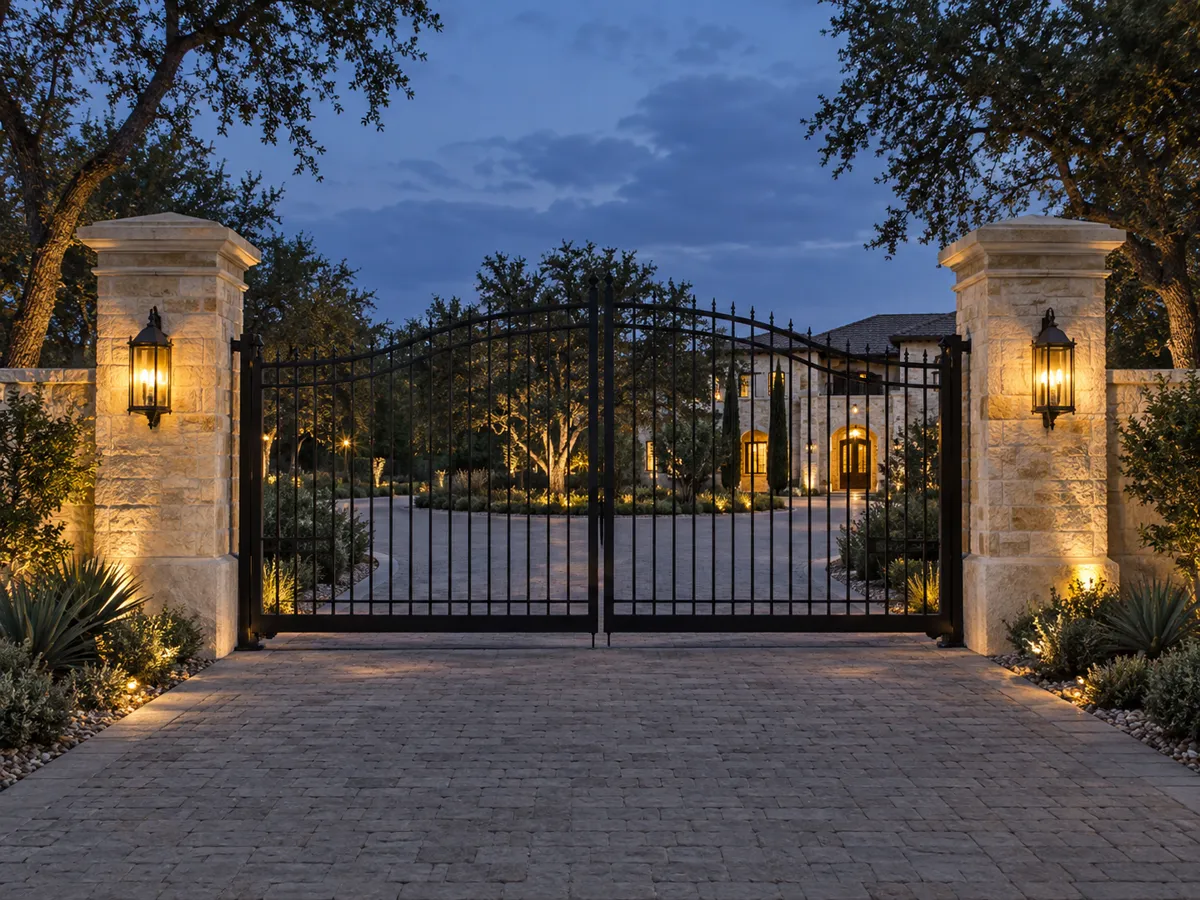
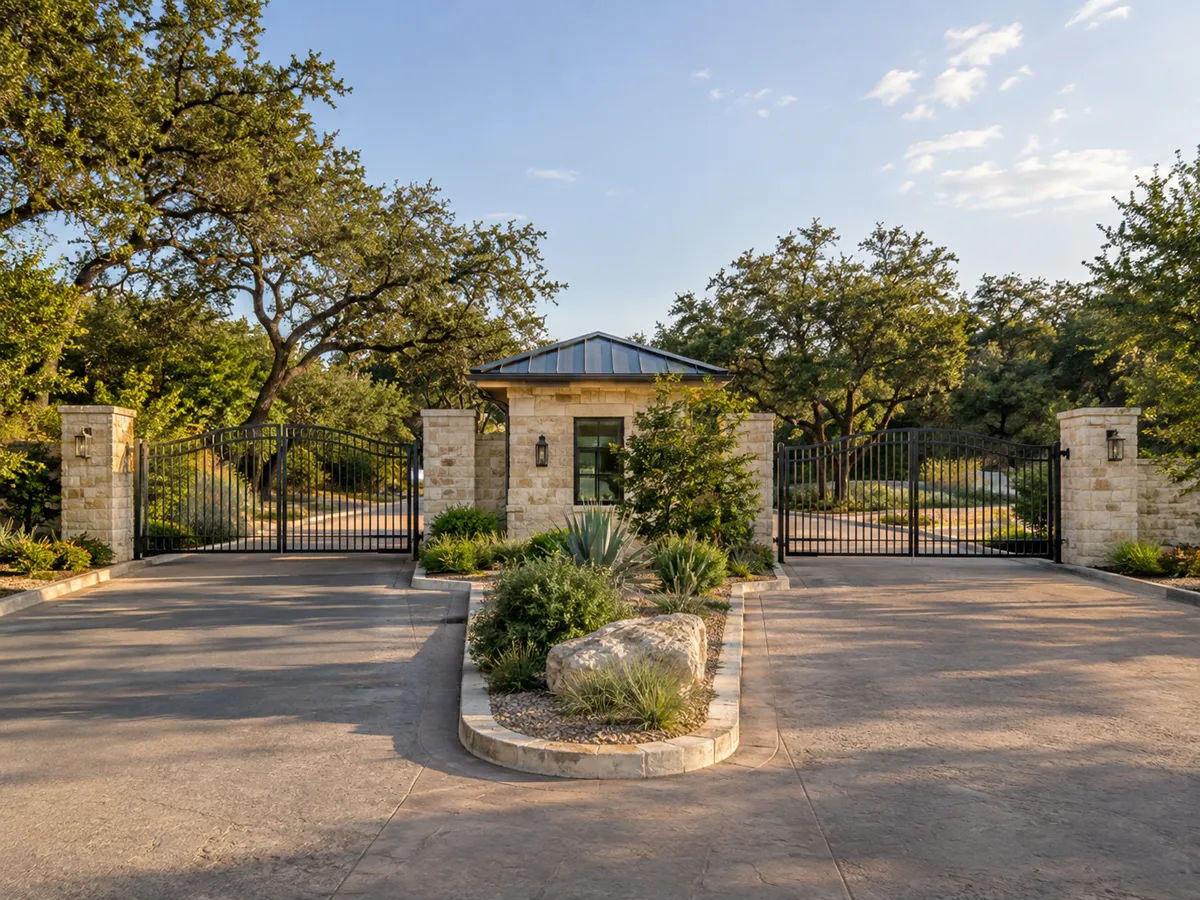
Gated community entrance with a small stone gatehouse, iron gates on the entry and exit lanes, and a landscaped median

The process

How a Commercial Gate Project Runs

  1. Site survey

    We walk the opening with you: width, grade, soil or rock, drainage, power location, traffic direction and where the fire lane runs. This is also where the gate type is settled.

  2. Written bid

    You receive a scope with inclusions, exclusions and clarifications, so nothing about trenching, power or access control is left to assumption.

  3. Submittals and shop drawings

    We send shop drawings with dimensions, post and footing details, the operator product data and the fire access device for review by you, your architect and the fire code official.

  4. Fabrication and finish

    Once drawings come back approved, the leaf is built and welded in our own shop. Steel for an exterior commercial gate is usually hot-dip galvanized, dipped in molten zinc near 450 degrees Celsius so the zinc protects the steel, and it can be powder coated over the zinc for color.

  5. Phased installation

    Footings and conduit go in first, often while the old gate still works. We schedule the swap so the site keeps an entry open, with temporary access arranged where it cannot.

  6. Commissioning and closeout

    Every safety device is tested, the fire access device is demonstrated, and you receive the as-built drawings, operator manuals and our written warranty.

What Drives the Cost of a Commercial Gate

We do not publish a price for a commercial gate, because two openings of the same width can differ by more than the steel. The bid is built from these drivers.

  • Opening width and leaf count: a wider opening means a longer leaf, and on a cantilever a longer counterbalance tail.
  • Gate type: cantilever, bottom-track slide or swing, each with its own hardware and post count.
  • Grade and ground: slope, fill, clay on the east side of the city and limestone to the west change footing work.
  • Frame and infill: tube size, picket spacing, mesh or solid panels, and the wind load a solid leaf has to resist.
  • Finish: hot-dip galvanizing alone or galvanizing with powder coat.
  • Operator and usage class: duty cycle, gate weight and the class of site set the operator.
  • Power: trenching from an existing panel versus a solar supply.
  • Safety devices: the number of entrapment zones sets the number of photo eyes, edges and loops.
  • Access control: card readers, keypads, intercoms and how they tie into existing systems.
  • Fire access hardware and approvals: the device the district requires and any permit review.
  • Phasing: after-hours work or temporary access to keep a site running.

The quickest way to a real number is the free site survey. Call and we will set a time to walk the opening.

More of What We Build

Questions

Commercial Gates & Slide Gate Systems: Common Questions

How do you price a commercial gate without a published rate?

From the site survey and your drawings. Width, gate type, ground, finish, operator class, power, safety devices, access control and phasing all move the number, so we measure first and send a written bid with clarifications.

Should our yard get a cantilever or a bottom-track slide gate?

If the drive carries gravel, debris or a grade change, a cantilever usually wins because nothing rides on the ground. If the opening is flat, paved and kept swept, and there is less room beside it, a track gate can fit. The survey settles it.

What lead time should a general contractor plan for?

Fabrication is scheduled from approved shop drawings, not from the contract date, so the quickest path is a fast submittal review. We give you a date once drawings are approved and material is confirmed.

What does the fire department need at our gate?

An approved means of opening the gate for fire personnel, set by the fire code official. Depending on the district that can be a key switch, a Knox Box or another device. We confirm it before fabrication and show it on the submittal.

What happens to a commercial gate in a power outage?

Gates on fire access roads must be operable by hand by one person where the fire code's Appendix D applies, and operators carry a manual release. Where a site needs the gate to keep working, we specify backup power in the bid.

Can pedestrians walk through the vehicle gate?

No. The safety standards keep people off vehicular gates, so we add a separate pedestrian gate beside the vehicle opening, with its own lock or reader.

Do you cover sites outside the Austin city limits?

Yes, across Travis County, including Sunset Valley, Shady Hollow, West Lake Hills, Lakeway and the surrounding communities. Each site is checked against the code and fire district that covers it.

Is the gate covered after installation?

Yes, by a written warranty handed over at closeout with the as-built drawings and manuals. Scheduled maintenance agreements are available separately.

What happens at the site survey?

We measure the opening and the run beside it, check grade and ground, find power, note the traffic pattern and fire lane, and talk through access control. You get a written scope and bid afterward.

Free site visit

Talk to us about commercial gates & slide gate systems

Free on-site measure across Austin and the west side. We call you back to set a time.

Call to Discuss Scope

Calls only, we do not receive text messages.

Call (512) 503-9203