Skip to content

Gate Operator Installation in Austin, and Older Installs Brought Up to UL 325

Austin Metal Gates handles gate operator installation in Austin, TX, and is Travis County's leading specialist in automating the gate you already own, specializing in operator replacement, UL 325 safety retrofits and ASTM F2200 upgrades to the leaf itself. We offer monitored photo eyes and contact edges.

  • Free on-site measure
  • Shop drawings you approve
  • Operators set up to UL 325
  • One written price

Request a free site visit

Or call (512) 503-9203. Calls only, we do not receive text messages.

About our gate operator installation & ul 325 retrofits

Our team provides a full survey of the existing hinges, posts and rollers, delivering a quieter, safer opener for homes and entrapment-protected entries for both residential and commercial projects. The same crew that inspects your gate and measures every gap does the install, and any screening, roller covers or stops the leaf needs are welded in our shop before the new operator goes on.

From guarding exposed rollers and screening low openings to pairing the new control board with your remotes and keypad, our team handles every detail. Serving Austin, Sunset Valley, Shady Hollow and The Hills, we test every safety device in both directions before we leave.

Why Austin Metal Gates

How We Work

No stock panels cut down to fit, and no handoffs. The crew that measures your opening builds and installs the gate.

Measured on siteThe opening, the slope and the ground, measured where the gate will hang
Shop drawings firstYou approve the drawings and finish before any steel is cut
Welded in our own shopFrames fabricated and finished to your drawings, not ordered from a catalogue
Set up to UL 325Every operator installed with its safety devices tested before we leave

Automating the Gate You Already Own

This service is for owners who already have a driveway gate and want it to open on its own, and for owners whose operator has reached the end of its life and needs a successor. The leaf stays. What changes is the drive unit, the controls and the safety system around it.

Before we quote an operator, we survey the gate it will move. Guidance on the construction standard is plain that an existing manual gate being automated must be brought up to ASTM F2200 first, so the leaf matters as much as the motor. On the first visit we check:

  • whether the leaf hangs true on its hinges, or rolls freely by hand in both directions
  • the weight and length of the leaf, which set the size of the operator
  • the condition of the posts and hinges that will now carry a powered load
  • openings in the pickets and gaps at the posts where a hand, an arm or a child could be caught
  • where power, conduit and a keypad post can go

If the gate itself is the obstacle, we say so. A leaf sometimes needs screening, a roller cover or a heavier hinge post before it can be automated safely, and that work is quoted beside the operator so you see the whole job at once. A driveway with no gate at all is a different project, covered by our automatic driveway gates page.

UL 325 Retrofits for Older Installations

The rule that operators must monitor their external entrapment devices took effect on January 12, 2016, and the seventh edition tables for entrapment protection took effect on August 1, 2018. An operator put in before those dates may still open and close every day, but it was not built to that bar, and neither was the wiring around it.

A retrofit brings the whole installation up to the current standard:

  • Two independent means per direction. Slide and swing operators need at least two independent entrapment protection means in each direction of travel where an entrapment zone exists. The operator's inherent reversing system can count as one, an external photo eye or edge supplies the other, and the same type of device may not be used for both.
  • Monitoring. The operator checks for every external device during each open and close cycle. If one is missing or faulted, the gate may only run on constant pressure for that direction, or be moved by hand.
  • No bypasses. The standard forbids defeating monitoring with added wires, jumpers or switches, and we take out any we find.
  • Second contact. When the inherent system senses a second obstruction in a row, it must stop the gate and sound an alarm until someone resets it with a hard-wired input.
  • Signs and controls. Two warning signs, and activation controls relocated to at least 6 feet from the gate.

Where an old operator cannot accept monitored devices, replacing it is usually cleaner than adapting it. The quote shows both routes so the decision is yours.

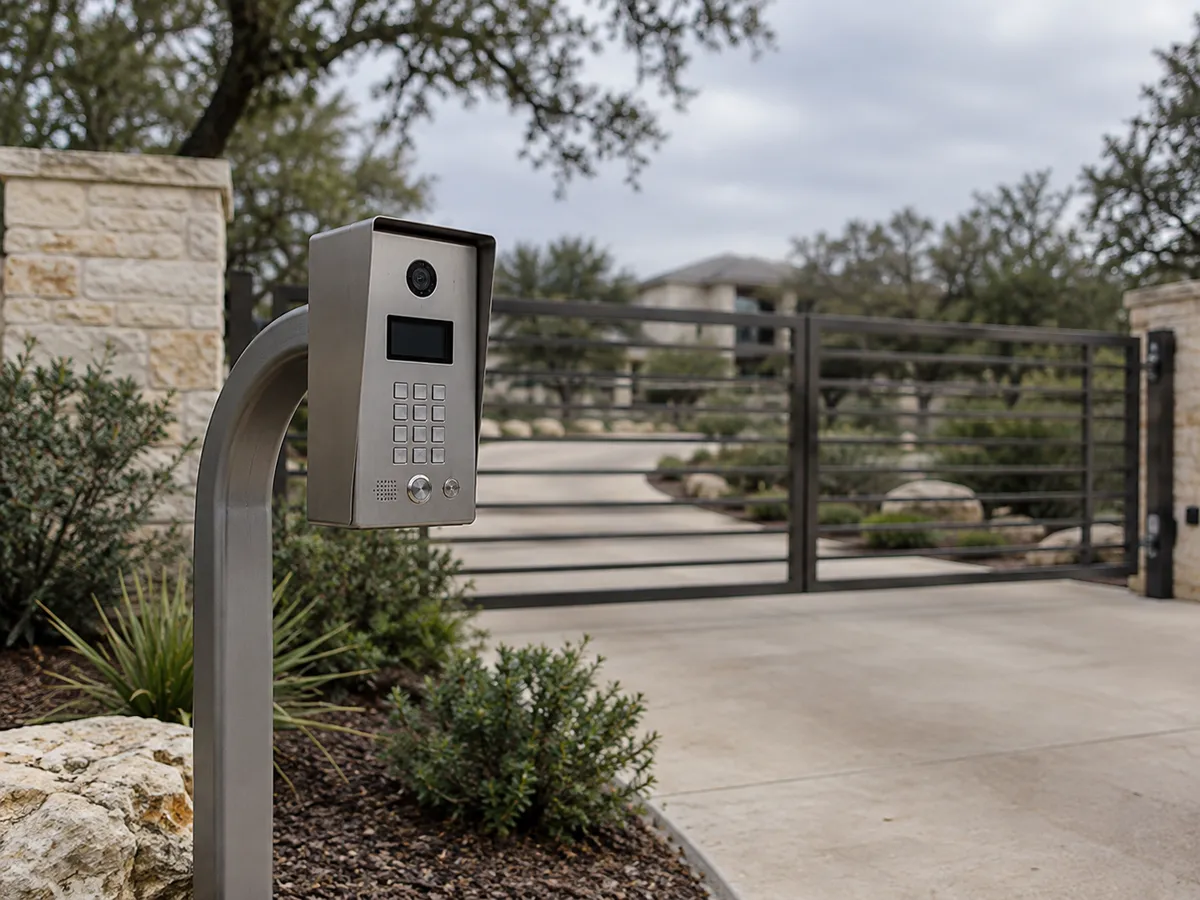
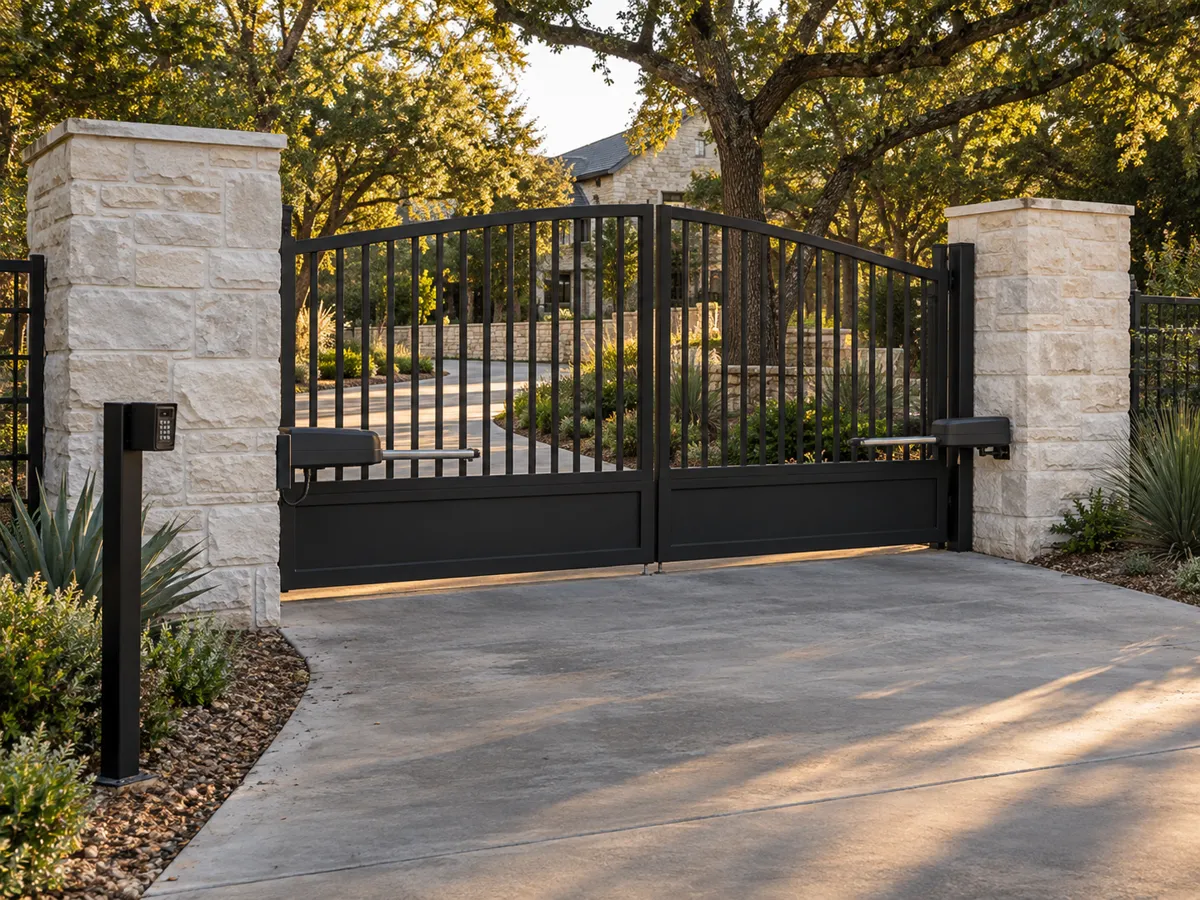
Black steel arched swing gate closed between limestone columns across a concrete drive, with a keypad post beside the drive at sunset

Photo Eyes, Edges and Loops: Placing Each Device

Photo eyes

A photoelectric sensor is a non-contact device: it throws a beam across the path of the leaf and stops or reverses it when something breaks the beam. Placement follows the manufacturer's instructions for each layout, and we set heights and angles to cover the real entrapment zones while cutting down on nuisance trips.

Contact edges

An edge is a pressure-sensitive strip on the face of the leaf that reverses the gate on touch. UL 325 wants wired edges routed so the wiring is protected from mechanical damage, and wireless edges placed where columns, walls and planting do not block the signal.

Vehicle loops

An induction loop is an insulated wire sawn into the pavement. The metal in a car changes the loop's inductance and the detector signals the operator, so an exit loop opens the gate for a departing car. Small metal masses often fail to trigger a loop, and a loop cannot see a person at all, which is why loops sit beside photo eyes and edges and never replace them.

Matching devices to the operator

Manufacturers must name the external sensors, by brand and model, that are compatible with each operator, because the operator and its devices are judged as one system. We fit devices from that list rather than whatever was left on the old install.

ASTM F2200 Upgrades to the Gate Itself

UL 325 covers the operator. ASTM F2200 covers the gate, and a leaf built for hand operation often falls short of it. The points we check and correct:

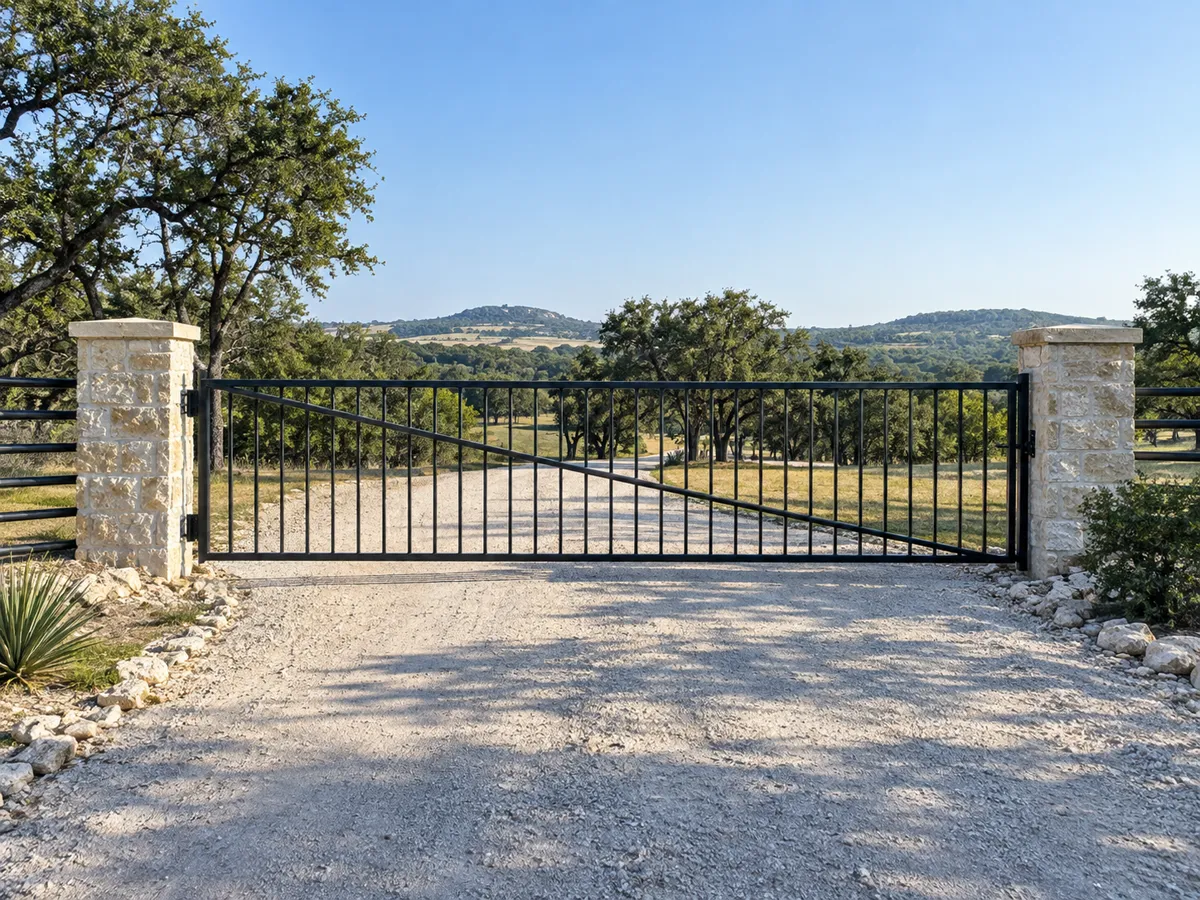
  • Openings from the ground up to 48 inches must stop a 2.25 inch sphere; between 48 and 72 inches, a 4 inch sphere.
  • Gaps between the leaf and a post or other fixed structure may not exceed 2.25 inches.
  • Exposed weight-bearing rollers below 8 feet must be guarded or covered.
  • Positive stops have to limit travel at fully open and fully closed.
  • Protrusions are not permitted, apart from listed exceptions such as ornamental pickets and locks.
  • A swinging leaf needs 16 inches of clearance from fixed objects, or added entrapment protection in that zone.

Screening panels, roller covers and stops are cut and welded in our shop to suit the existing pickets, then galvanized and powder coated or painted to match before they are fitted on site. The finished leaf reads as one piece rather than an old gate with parts added.

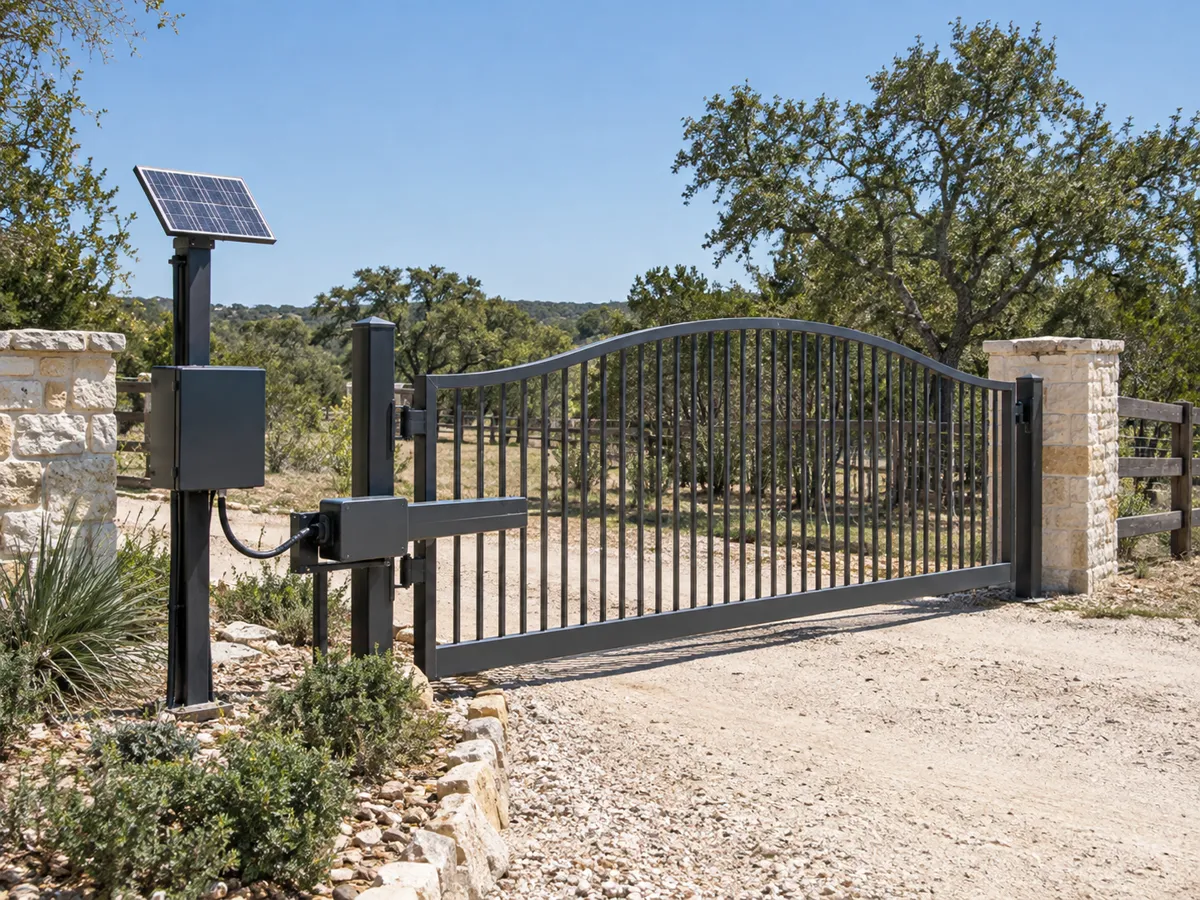
Arched black steel ranch gate with a gate operator and a small solar panel on a steel post beside a gravel drive

Choosing the Operator: Class, Drive Type and Duty

Operators are listed by class. Class I serves a residence of one to four single families. Class II covers commercial locations open to the public, including multifamily housing of five or more units. Class III is for industrial sites not serving the public, and Class IV for guarded, restricted-access sites. A shared private drive can fall outside Class I, so we match the listing to how the entry is really used.

Within the class, the drive type follows the gate:

  • Articulated arm operators are simple to install on a swing leaf, though more visible than other designs.
  • Ram or link arm units are simpler to install and maintain and suit entries with many users.
  • Underground operators sit below the hinge, keep the gate uncluttered and allow a wide swing, and are suited to low-risk domestic gates.
  • Hydraulic operators produce the high torque large, heavy leaves need.
  • Electromechanical operators are the common choice for lower-use residential gates.
  • Slide operators in Classes I and II may not exceed one foot per second when pulling 75 pounds or more.

Duty cycle matters as well. A motor spends only part of its time running, and pushing it past its rated duty lets heat build faster than it can escape, so we size for how often your gate actually cycles, not only for how heavy it is.

What Affects the Cost of an Operator Installation

There is no single figure for this job, because the existing gate decides so much of it. These are the drivers we price against:

  • The condition of the gate. How much ASTM F2200 work it needs: screening, roller covers, stops, hinge or post upgrades.
  • Swing or slide. Each takes a different operator family and device layout.
  • Leaf size and count. A long, heavy leaf or a pair of leaves raises the operator size or doubles the units.
  • Operator class and drive type. Articulated, ram, underground, hydraulic or slide, and the class the site requires.
  • Duty. A busy shared entry needs a unit rated to run more often.
  • Safety devices. The number of photo eyes and edges needed to cover every entrapment zone in both directions.
  • Loops. Saw-cutting exit loops into concrete or asphalt.
  • Power. Existing service at the post, a new trench, or a solar panel and battery.
  • Entry devices. Remotes, keypad or intercom, and fire access hardware.
  • Removal. Taking out the old operator and clearing old wiring.
  • Approvals. HOA or POA review where a keypad post or new column is visible, plus any permit.

The on-site survey is free. The written quote lists the operator, the safety devices and any gate upgrades as separate lines, so you can see exactly what the retrofit involves.

The process

From Site Visit to a Gate That Runs

Four steps, and nothing is fabricated until you have signed off on the drawings and the price.

  1. Free site visit

    We measure the opening, the slope and where power can reach, and talk through style, automation and access.

  2. Drawings and a written price

    You get scaled drawings for your approval and for any HOA or city review, with one written price.

  3. Fabricated in our shop

    Steel is cut and welded to the approved drawings, then galvanized, powder coated or both.

  4. Installed and tested

    Columns and posts set, gate hung, operator set up to UL 325 and every safety device tested with you.

More of What We Build

Questions

Gate Operator Installation & UL 325 Retrofits: Common Questions

Can you put an operator on my existing gate?

Usually, once we confirm the leaf, hinges and posts can carry a powered load and the gate meets ASTM F2200 or can be brought up to it. Some leaves are too light, too racked or too close to a wall, and we tell you that on the survey rather than after the install.

My gate already opens by itself. Why would it need a UL 325 retrofit?

An operator installed before the monitoring rule of 2016 and the 2018 tables may have only one means of entrapment protection, unmonitored devices or bypass jumpers. It still moves, but it does not meet the current standard, and a retrofit closes that gap.

What affects the cost of adding or replacing an operator?

The condition of the gate, swing or slide, leaf weight and count, the operator class and type, how many safety devices the layout needs, loops, power and entry devices. Each one appears as its own line in the written quote.

How long does an operator installation take?

It depends on the gate. If the leaf needs screening or roller covers made in our shop, that fabrication comes first. We give you the schedule with the quote, and the install day ends with every device tested.

Will the gate still work in a power outage?

We can add battery backup so the operator keeps running after mains power drops. When the battery is spent, the operator can be released so the leaf moves by hand.

Do I need HOA or POA approval to add an operator?

If the change is visible, often yes. In Shady Hollow no exterior change may be made without the section's Architectural Control Committee, and in The Hills an architectural modification request goes to the POA first. We supply the drawings and device layout for the application.

How will the fire department get through?

We fit the access hardware your fire district accepts, such as a key switch or an access box, and program it with the operator. Lakeway asks for an ESD 6 key switch on coded gates, and West Lake Hills requires an ESD 9 approved access box.

Do you work in my area?

Yes, if you are in Travis County: Austin, Rollingwood, West Lake Hills, Sunset Valley, Shady Hollow, Barton Creek, Lost Creek, Steiner Ranch, The Hills, Lakeway or Volente. Call with your address to confirm.

Is the work covered?

Every operator installation and retrofit comes with a written warranty, and you keep the manufacturer documentation for the new operator and devices.

Free site visit

Talk to us about gate operator installation & ul 325 retrofits

Free on-site measure across Austin and the west side. We call you back to set a time.

Call (512) 503-9203

Calls only, we do not receive text messages.

Call (512) 503-9203