Skip to content

Security Gate Installation in Austin, Designed to Slow the Wrong Visitor

Austin Metal Gates handles security gate installation in Austin, TX, and is Travis County's trusted specialist in secured entries, specializing in tall welded steel gates, anti-climb infill and lock-ready gate frames. We offer keypad, keycard and magnetic lock hardware.

  • Free on-site measure
  • Shop drawings you approve
  • Operators set up to UL 325
  • One written price

Request a free site visit

Or call (512) 503-9203. Calls only, we do not receive text messages.

About our security gate installation

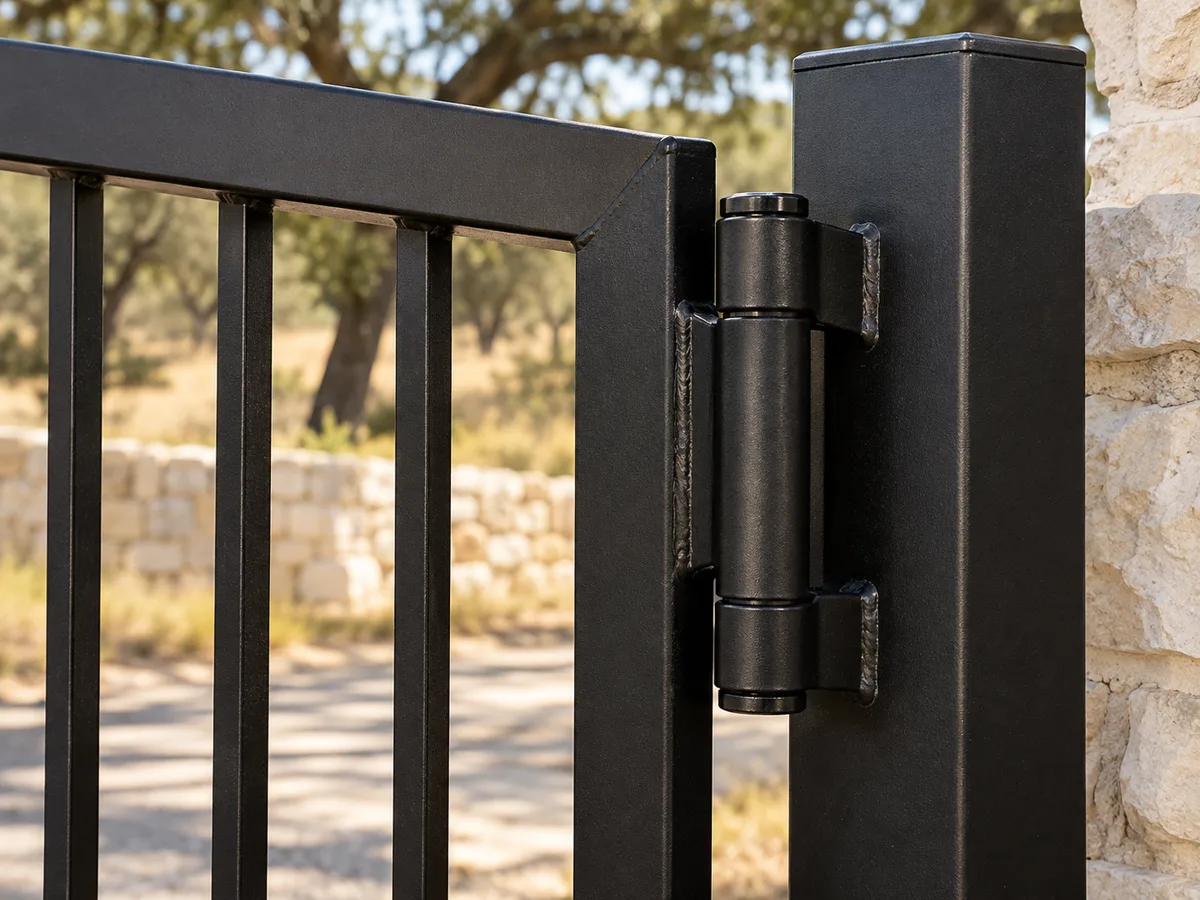
Our team provides the gate, posts and wiring as one design, delivering a firm boundary for homes and a controlled entry for small offices and shops for both residential and commercial projects. Before we quote, the same crew that installs measures the opening and every foothold along the fence line, you approve the shop drawings before any steel is cut, and we weld each frame in our own shop.

From a vertical bar spacing that leaves a boot nothing to grip to a lock that releases for the fire department, our team handles every detail. Serving Austin, Lakeway, Sunset Valley and Steiner Ranch, we design each entry around the rules of the street it faces.

Why Austin Metal Gates

How We Work

No stock panels cut down to fit, and no handoffs. The crew that measures your opening builds and installs the gate.

Measured on siteThe opening, the slope and the ground, measured where the gate will hang
Shop drawings firstYou approve the drawings and finish before any steel is cut
Welded in our own shopFrames fabricated and finished to your drawings, not ordered from a catalogue
Set up to UL 325Every operator installed with its safety devices tested before we leave

What a Security Gate Can and Cannot Do

A security gate raises the effort, the noise and the time needed to get in. That is the honest job description. Crime prevention through environmental design, the field behind this thinking, calls the goal deterrence: it reduces the chance of opportunistic crime by making a property look watched, owned and hard to enter, and it works on the decision a person makes before they try. It does not promise that nothing will ever happen, and we do not either.

The approach has four parts, and a good gate carries all of them:

  • Access control: one clear, defined way in, with the gate as the point that decides who passes.
  • Visibility: an open, see-through gate lets neighbors, cameras and passing traffic watch the entry, which raises the risk for anyone who tries it.
  • Ownership: a well-kept, deliberate gate tells a visitor the property is cared for.
  • Maintenance: a gate that sags, rusts or hangs open invites the disorder it was meant to stop.

Height, Infill and Anti-Climb Design Without Spikes

Height buys time, but infill decides whether a fence can be climbed. A tall gate with a horizontal rail every foot is a ladder. A tall gate with vertical bars and no ledges is a wall of bars.

What we design against

Footholds: horizontal rails, decorative scrolls and rings that a shoe can rest on. We keep the lower two-thirds of the gate to vertical bars where we can. Handholds and gaps: we keep any opening in the frame under 2.25 inches, the limit used to guard against entrapment, which also leaves a hand little to grip. Reaching the latch: the lock is placed so it cannot be reached through the bars from outside. The ground side: a short gap at the bottom, so nothing slips under the leaf.

Where spikes are not allowed

Lakeway has required a continuous flat top on all new fencing since 2019, because deer were being hurt on spiked and open-picket tops. Sunset Valley bans spiked pickets and bars above the top rail as well. In both cities we reach the same goal another way: tall vertical bars welded to a flat top rail, a second rail welded along the backs of the pickets, or a spinning roller cap on top of the gate. Lakeway lists those retrofits itself. The result deters a climber without a point on it.

Locks, Latches and Magnetic Locks That Hold

A latch keeps a gate closed. A lock stops the wrong person opening it. A security gate needs the second one, fitted to the frame so a hard pull does not spring it.

  • Keyed deadbolt-style locks on the pedestrian leaf, the simplest and most reliable option for a home.
  • Keypad and keycard locks so codes and cards can be issued and cancelled without changing a key.
  • Electric strikes that release a latch on a signal from the house, an intercom or a reader.
  • Magnetic locks that use an electromagnet and an armature plate to hold a gate shut with a strong force, and that release the moment power is cut.

That last point is the trade-off with a magnetic lock. Because it lets go when power fails, it needs a battery backup to stay secure, and fire code requires a separate release. An electric strike can be set fail-secure so the gate stays locked in an outage, with a mechanical way out. We choose between them with you at the site visit, along with the fire department's requirements.

Access Control and Camera Tie-In

Electronic access control answers three questions: who may enter, where, and when. It also keeps a record, which a mechanical key never does. For a small business, that log matters when a delivery or a cleaner is disputed.

Credentials

Cards, fobs, PIN codes and phone credentials all work, and each can be canceled the day someone leaves. A shared code is the weakest choice, because it cannot tell who used it.

Cameras at the gate

A camera aimed at the entry gives you a face and a time. Research on video surveillance reports crime reductions in some settings, such as commercial areas, and little effect in others, so we treat a camera as one layer and place it where it sees the gate and the keypad. We run the conduit and power to the gate during the build, so a camera or intercom can be added later without cutting into finished work. We install the gate side of the system: frames, hardware, conduit and wiring. Your camera or alarm provider connects their equipment to it.

Fire Department Access and Power Outages

A security entry that firefighters cannot open is a liability. Fire code officials decide what the gate must allow, and the answer changes by district.

  • Lakeway asks for a police code on coded gates and an ESD 6 key switch.
  • West Lake Hills asks for an ESD 9 access box and backup power on driveway gates.
  • The Hills uses ESD 6 as its fire code official, and its guard gate is owned by the community association.

We confirm the current requirement for your address at quote time and build the key switch, access box or manual release into the drawing. For a power outage, we plan a battery backup or a manual release, so the gate can be opened and, where it matters, can stay locked.

Homes, Small Offices and Shops: Who This Is For

This service is for an owner who wants a gate designed for security rather than for looks alone. The scale is a house, a small office, a shop or a storage yard, not a full perimeter.

  • Homeowners who want a taller, tighter gate at a driveway, a side yard or a courtyard.
  • Small business owners who need a controlled entry for staff and deliveries.
  • Property managers with a single building that needs a real lock on a gate that has only had a latch.

Long fence runs around a whole site are our security fencing service, and large sliding systems for big properties are a separate commercial job. This page is about the gate itself and the security design around it.

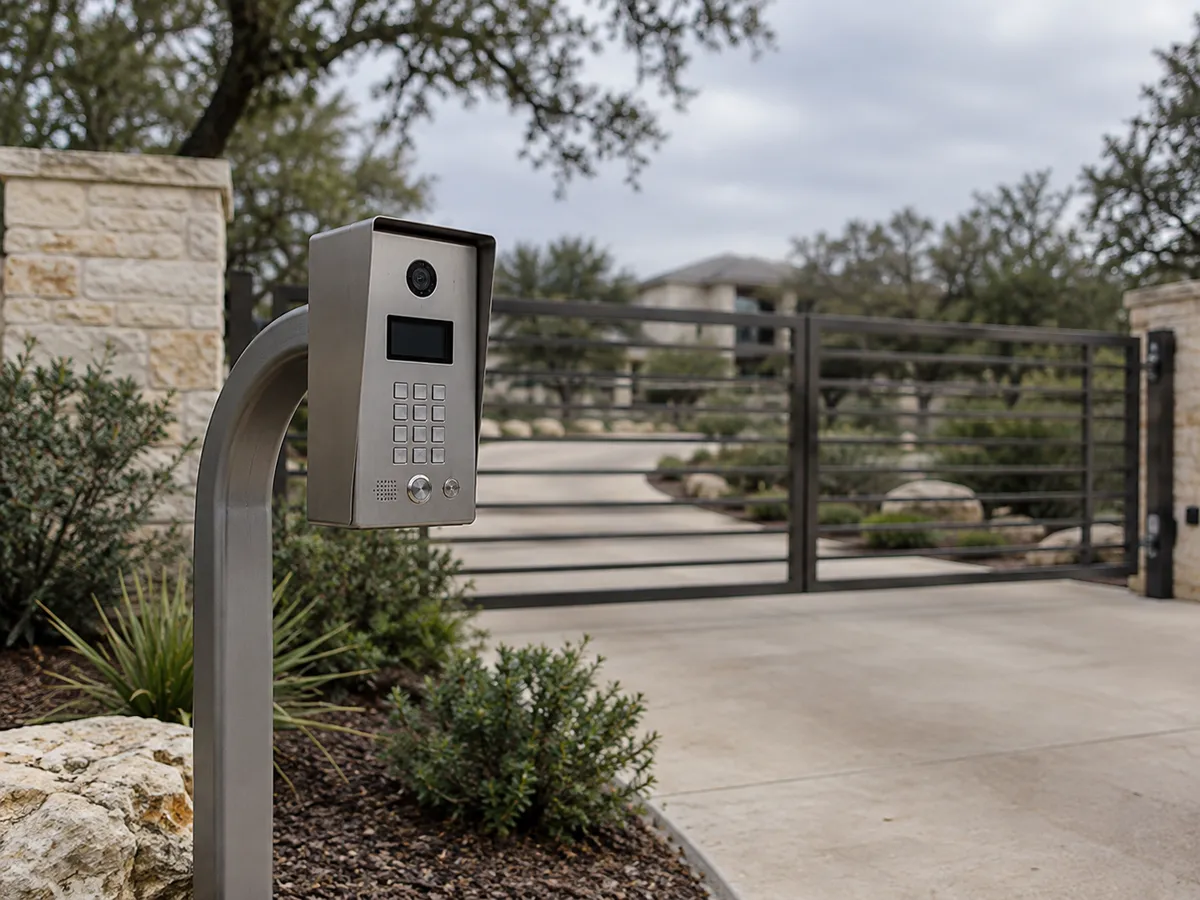
Stainless steel video intercom and keypad on a gooseneck post beside a closed horizontal-slat driveway gate

Security Gate Installation Cost and What Drives It

The cost of a security gate depends on what it has to resist and what it has to connect to, and every quote here is written after a measure. The main drivers are:

  • Opening width and height, and whether the leaf is single or double.
  • Bar and frame gauge, since heavier steel resists more and needs stronger posts.
  • Anti-climb detailing, such as tight vertical spacing, a rolled cap or a second rail.
  • Lock hardware: keyed, keypad, keycard, electric strike or magnetic lock.
  • Access control: a reader, an intercom, a log and the controller behind them.
  • Wiring and power: trenching to the gate, conduit for cameras and a battery backup.
  • Fire access: a key switch, access box or manual release your district requires.
  • Finish and posts: galvanizing, powder coat, and footings in Hill Country limestone.
  • Approvals: an HOA or POA submission and any city permit.

Any price you see is an estimate and subject to change, since your written quote after the free on-site measure sets the final price, and it depends on the gate size, the lock and control choices, and the wiring the site needs.

The process

From Site Visit to a Gate That Runs

Four steps, and nothing is fabricated until you have signed off on the drawings and the price.

  1. Free site visit

    We measure the opening, the slope and where power can reach, and talk through style, automation and access.

  2. Drawings and a written price

    You get scaled drawings for your approval and for any HOA or city review, with one written price.

  3. Fabricated in our shop

    Steel is cut and welded to the approved drawings, then galvanized, powder coated or both.

  4. Installed and tested

    Columns and posts set, gate hung, operator set up to UL 325 and every safety device tested with you.

More of What We Build

Questions

Security Gate Installation: Common Questions

How tall should a security gate be?

Tall enough to make climbing slow and awkward, which usually means well above head height for a home, within what your city and HOA allow. Height alone does not stop a climb, so we draw the infill to remove footholds as well.

Can I have anti-climb protection in Lakeway or Sunset Valley?

Yes. Both cities ban spiked tops, so we use tight vertical bars on a flat top, a rail welded along the backs of the pickets or a rolling cap. You get the deterrent without a spike.

Will a security gate stop a break-in?

No gate can promise that. It deters by adding time, effort and visibility, and it works best alongside lighting, cameras and neighbors who can see the entry.

Should I choose a magnetic lock or an electric strike?

A magnetic lock releases when power is cut, so it needs backup power and a separate fire release. An electric strike can hold locked in an outage. We help you choose at the site visit.

What happens to the gate in a power outage?

We plan a battery backup or a manual release, and we set the lock to fail the way you and your fire district need. You will see how it behaves at handover.

Can the fire department get in?

Yes. We build in the key switch, access box or manual release your district requires, and we confirm which one applies to your address when we quote.

Can you connect my cameras and intercom?

We run conduit and power to the gate and mount the hardware, and your camera or alarm provider connects their equipment. That way nothing has to be cut out of finished work later.

What does security gate installation cost?

It depends on size, frame gauge, anti-climb detailing, locks, access control, wiring and approvals. Any figure is an estimate, and your written quote sets the final price after the measure.

Does my HOA need to approve a security gate?

Most associations around Austin review a gate that faces the street, and some limit height or style. We provide the drawing and hardware details for your submission.

What happens at the site visit?

We measure the opening, look at footholds and sightlines along the fence, and talk through locks, power and fire access. You then approve a drawing before any steel is cut, and a written warranty covers the finished gate.

Free site visit

Talk to us about security gate installation

Free on-site measure across Austin and the west side. We call you back to set a time.

Call (512) 503-9203

Calls only, we do not receive text messages.

Call (512) 503-9203