Skip to content

Automatic Gate Repair in Austin, for the Gate That Sags, Drags or Stops Short

Austin Metal Gates provides automatic gate repair in Austin, TX, and is Travis County's trusted specialist in the moving parts of a driveway gate, specializing in hinge and post correction, roller and track repair, and welded restoration of damaged leaves. We offer alignment work for gates that stick, drag or stop short and restoration of the leaf itself.

  • Free on-site measure
  • Shop drawings you approve
  • Operators set up to UL 325
  • One written price

Request a free site visit

Or call (512) 503-9203. Calls only, we do not receive text messages.

About our automatic gate repair

Our team provides an honest diagnosis of what is binding, delivering a gate that swings or rolls the way it was built to for both residential and commercial projects. The same crew that diagnoses your gate on site does the repair, we reweld a damaged leaf in our own shop, and every safety device is re-tested against UL 325 before we leave, with a written warranty on the work.

From a hinge pin worn oval to a bent bottom rail and a roller that has left its track, our team handles every detail. Serving Austin, Rollingwood, West Lake Hills and Lakeway, we look at the whole moving assembly rather than resetting the opener and hoping.

Why Austin Metal Gates

How We Work

No stock panels cut down to fit, and no handoffs. The crew that measures your opening builds and installs the gate.

Measured on siteThe opening, the slope and the ground, measured where the gate will hang
Shop drawings firstYou approve the drawings and finish before any steel is cut
Welded in our own shopFrames fabricated and finished to your drawings, not ordered from a catalogue
Set up to UL 325Every operator installed with its safety devices tested before we leave

Finding Out What the Gate Is Actually Fighting

Most automatic gate complaints sound electrical and turn out to be mechanical. The opener strains, reverses halfway, or quits before the gate is shut, and the owner assumes the motor is failing. Often the motor is doing its job against a leaf that has grown heavier to move than it was the year it went in.

That is why this page is about the gate itself. If your problem is a dead control panel, a keypad that does nothing or a gate with no power at all, read our electric gate repair page. If the drive unit is grinding, slipping or noisy, read our gate opener repair page. Here we cover the part the opener pushes.

On the diagnostic visit we work through the assembly in a set order, and we tell you what we find before any quote is written:

  • whether the leaf swings or rolls freely by hand with the operator released
  • where the leaf drags, rubs or catches, and at which point in its travel
  • the plumb of the posts and the gap between the leaf and each post
  • hinge play, roller wear and any cracked or bent steel
  • where the open and closed stops sit

A gate that will not move freely by hand will not be cured by a stronger motor, and pushing it harder only wears everything else faster.

Sagging Leaves, Worn Hinges and Leaning Posts

Why a swing leaf drops

A hinge has one degree of freedom: it lets the leaf rotate about a single axis and nothing else. When the pin and the knuckle around it wear, the leaf gains slop along that axis, and a heavy leaf hung on a wide opening settles at its latch end. The corner then drags on the drive or scrapes the latch post.

What we correct

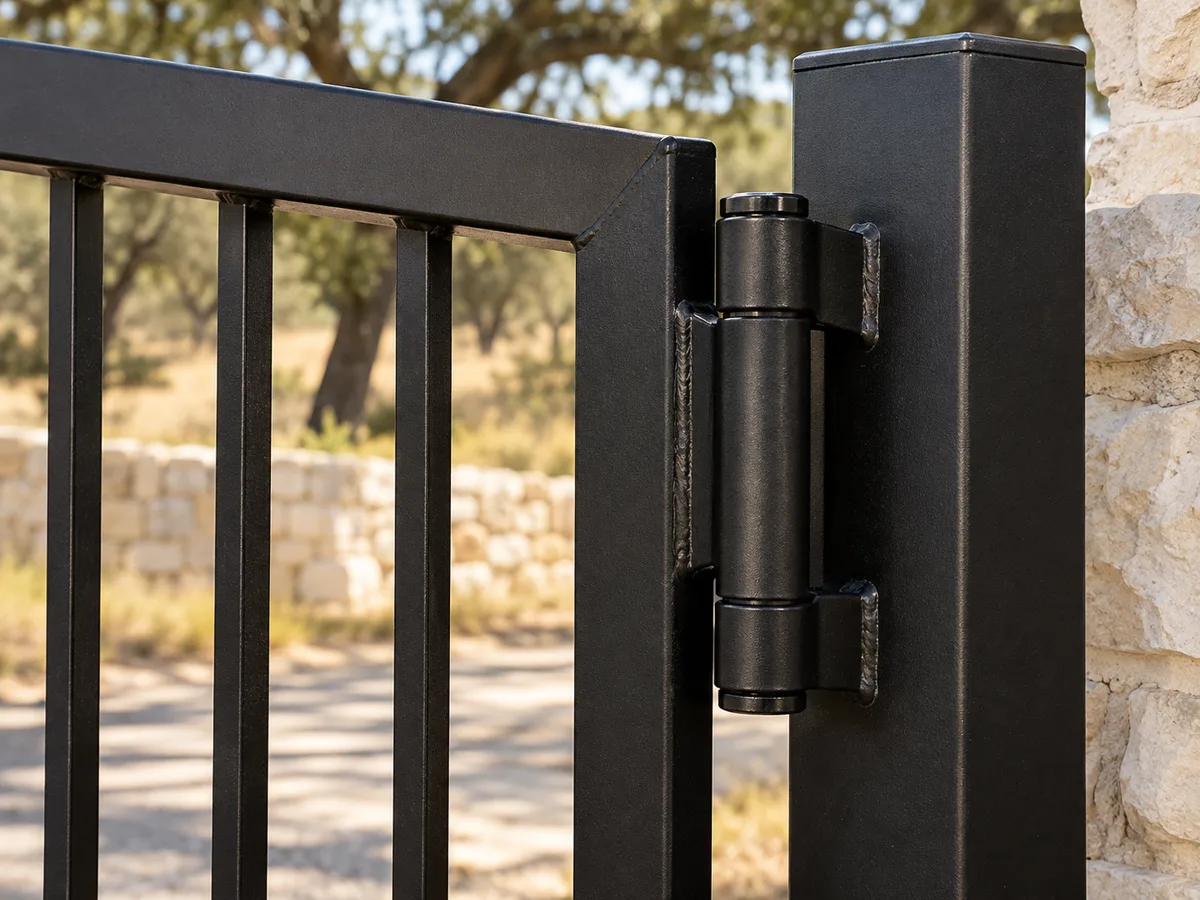
Where a hinge is worn we replace the pin and bushings or the whole hinge, and we reset the leaf level. Where the post has moved, a hinge cannot fix it, so we straighten or reset the post before rehanging. A continuous hinge spreads load down the full edge of the leaf, which helps a light gate, but a heavy driveway leaf usually wants heavy barrel hinges with adjustable pins so the gate can be trued again later.

Latches and strikes

A latch that no longer lines up with its strike is a sag symptom more often than a hardware failure. After we true the leaf, we reset the latch and strike so the gate closes without being forced. A leaf that has racked out of square is a different job. It goes to our shop, where the frame is checked, pulled true and rewelded, and the paragraph on shop welding below covers that work.

Rollers, Track and Stops on Sliding Gates

A sliding gate rides on wheels, and those wheels run in a track or along a guide. Debris in the track, a flat spot on a wheel or a track that has heaved out of level will each make the gate stutter, jump or stop.

  • Wheels and bearings. We replace worn or seized rollers and check that the load is shared between them rather than carried by one.
  • Track and guides. We clear, straighten or re-lay the track and reset the upper guides so the leaf cannot lean out of line.
  • Positive stops. The construction standard for automated gates calls for positive stops that limit travel at fully open and fully closed, so a leaf can never roll off its hardware. If yours are missing or knocked loose, we fit new ones.
  • Guarded rollers. The same standard says exposed weight-bearing rollers below 8 feet above grade must be guarded or covered. We add covers where an older gate has none.

A cantilever gate has no track, and it carries its weight on a pair of roller carriages. The failure signs are the same, a leaf that tilts or a tail that rubs, and the repair is to reset the carriages and the leaf height together.

Limit settings sit at the boundary between this page and the drive unit. A limit switch tells the machine where its travel ends, and if the leaf now stops short because it is binding, moving the limit hides the fault rather than curing it. We fix the binding first, then set the end points.

Safety Devices Knocked Out of Line

A gate that reverses for no reason, or will not close at all, is frequently reporting a real fault in the only way it can. Photo eyes are the usual cause, and they are easy to disturb: a leaf that sags carries its beam with it, a post that leans shifts the sensor, and a mower or a delivery truck can nudge a housing by a few degrees.

A through-beam photoelectric sensor needs its emitter and receiver aimed at one another, and a misaligned pair gives false trips. Dirt on a lens, or low sun shining straight into a receiver, can trip the same sensor even when it is aimed correctly. We realign the pair, clean the lenses, and move a housing when its position is the cause.

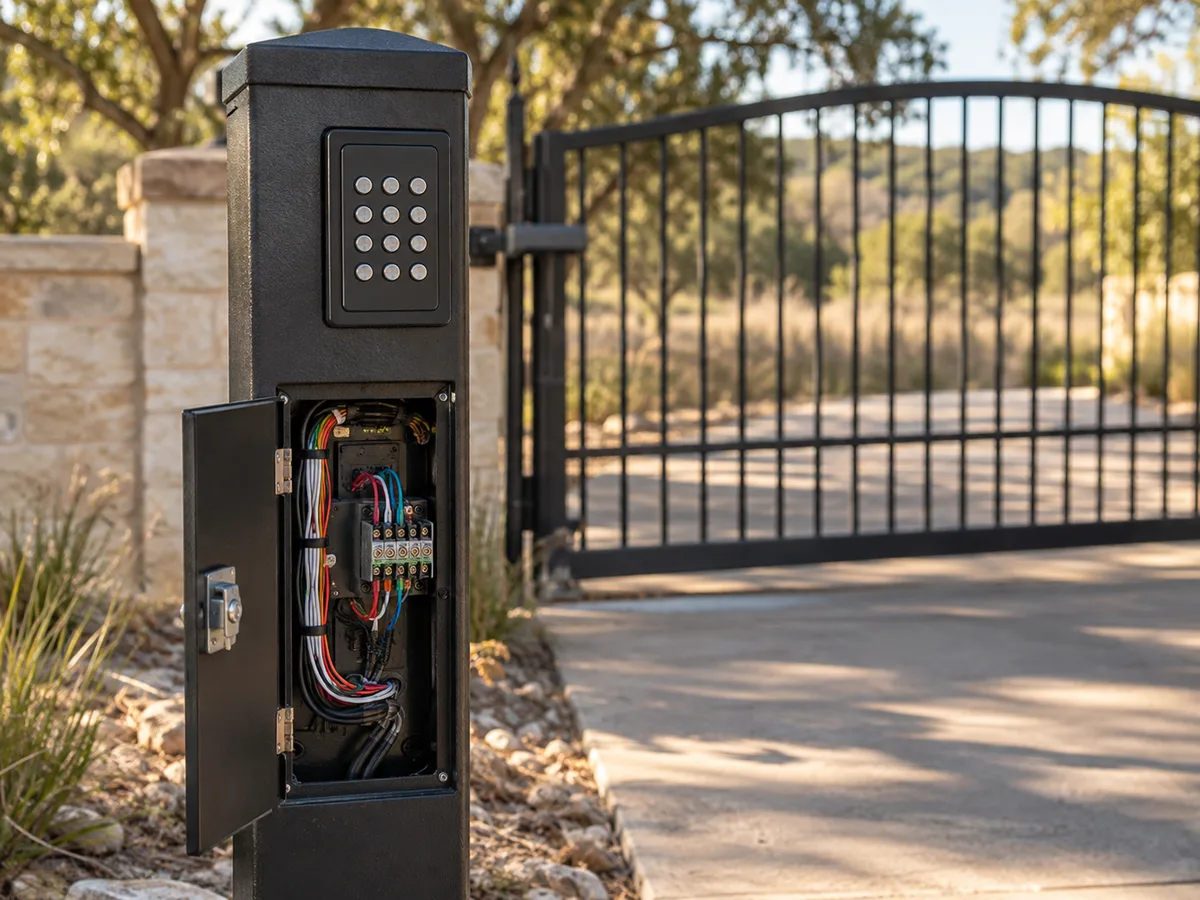
Contact edges take knocks too. A crushed or cut edge, or a cable pulled loose by a swinging leaf, will stop a gate on every cycle. We replace damaged edges and reroute the wiring so the leaf no longer works on it.

UL 325 requires at least two independent means of entrapment protection per direction of travel where an entrapment zone exists, and the operator checks its external devices as the gate moves. Because of that, a bypass wire or a jumper that someone added to get the gate moving again is something we take out, not leave in. After every repair we test each device in both directions, and the test is the last thing we do before we hand the remote back to you.

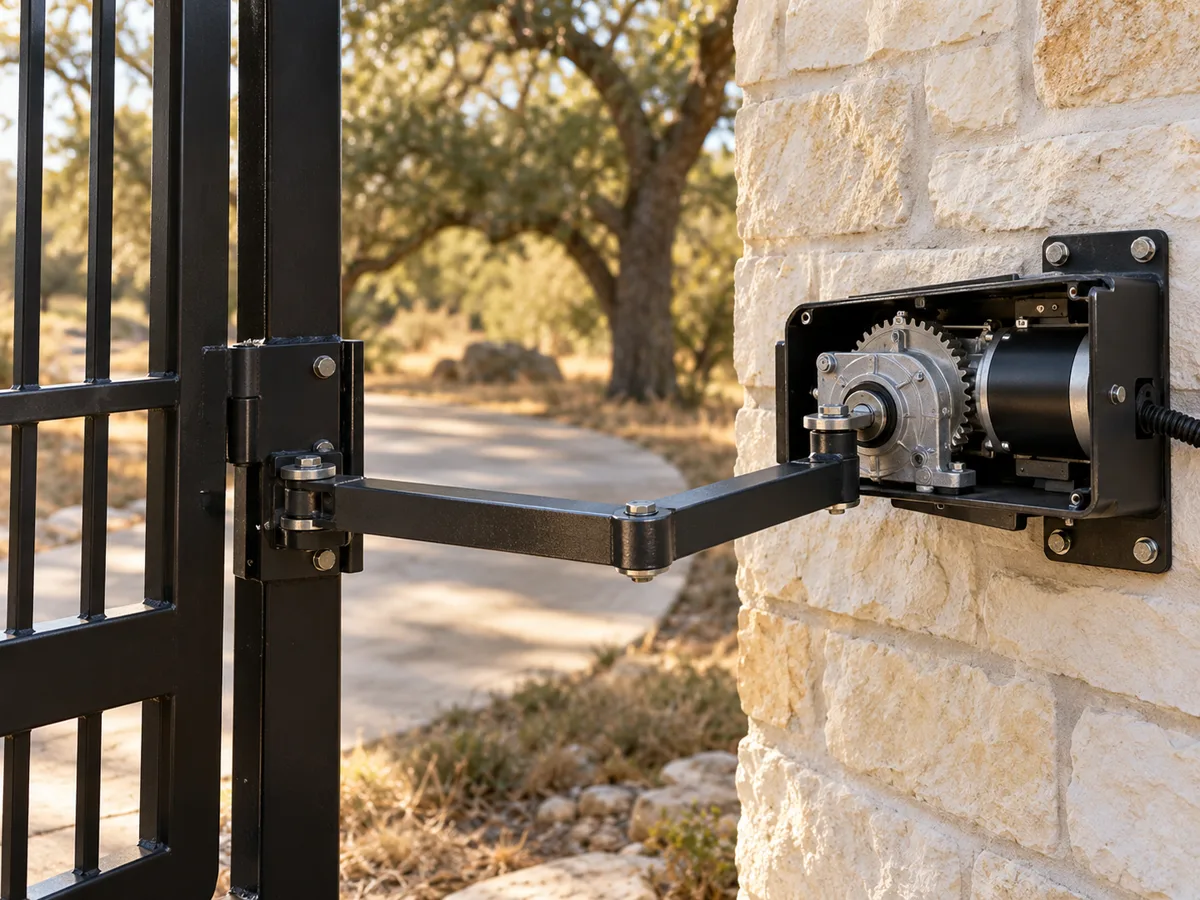
Swing gate operator with its cover off, showing the motor, gear and jointed arm, mounted on a limestone wall beside the gate post

Damaged Leaves Rewelded in Our Own Shop

A leaf gets damaged in ordinary ways: a vehicle clips the latch end, a post settles and the frame twists, or a bottom rail rusts through where water sat. Bending a gate back on site rarely lasts. Steel remembers where it was and cracks along the bend.

When the frame needs real work, we take the leaf to our shop. There we lay it flat, check it for square, cut out the damaged section and weld in new steel. Damaged pickets are replaced to match rather than patched. Bare steel is then protected the way new work is, with a zinc coating and paint or powder coat, because zinc bonded to steel forms a layer that protects the metal underneath from further corrosion, and a weld left bare will rust first.

If the repair would leave the gate weaker or uglier than a new one, we say so. A leaf twisted beyond saving is better replaced, and our gate replacement page covers that route. We would rather tell you at the diagnostic visit than weld something we do not expect to last.

What Affects the Cost of Automatic Gate Repair

Repair cost swings widely because the same symptom can come from a ten minute adjustment or a shop rebuild. We do not print a number here, because the gate in your drive decides it. These are the drivers we price against:

  • What failed. A misaligned sensor, a worn hinge, a seized roller and a twisted frame are very different jobs.
  • Parts. Hinges, pins, bushings, rollers, track sections, stops and edges, and whether the original size and type can still be had.
  • Shop time. A leaf that has to come off the posts, be rewelded and be recoated costs more than one repaired hanging in place.
  • Leaf size and weight. A long, heavy or double leaf takes more people and more equipment to lift and reset.
  • Post condition. A leaning post or a cracked footing has to be corrected before anything hung on it will stay true.
  • Safety upgrades a repair triggers. Guarding for rollers or screening for openings, where the older gate has neither.
  • Access. Slope, tight approaches and how far the leaf must be moved to be worked on.

Any figure we give is an estimate, and it is subject to change if the gate turns out to be worse under the surface than it looks. Your written quote sets the final price, and the diagnostic visit is where we find out what that quote should contain.

The process

From Site Visit to a Gate That Runs

Four steps, and nothing is fabricated until you have signed off on the drawings and the price.

  1. Free site visit

    We measure the opening, the slope and where power can reach, and talk through style, automation and access.

  2. Drawings and a written price

    You get scaled drawings for your approval and for any HOA or city review, with one written price.

  3. Fabricated in our shop

    Steel is cut and welded to the approved drawings, then galvanized, powder coated or both.

  4. Installed and tested

    Columns and posts set, gate hung, operator set up to UL 325 and every safety device tested with you.

More of What We Build

Questions

Automatic Gate Repair: Common Questions

My gate sags at one end. Is it worth repairing?

Usually, yes, when the frame is sound and the cause is a worn hinge or a shifted post. If the leaf is twisted, rusted through or built too light for its span, we tell you at the diagnostic visit and price a replacement beside the repair so you can compare them.

Will you work on a gate you did not build?

Yes. We diagnose what is in front of us, whoever made it, and we say what condition the hinges, posts and stops are in before any quote is written.

What happens at the diagnostic visit?

We release the operator, move the gate by hand through its full travel, and find where it binds. We check the posts, hinges or rollers, the stops and the safety devices, then explain what we found and what each fix involves.

The opener is fine. Why is the gate still stopping?

A drag point, a misaligned photo eye or a stop that has shifted can all make a healthy operator quit. We check the moving assembly first, so you are not replacing a motor to solve a problem in the steel.

Can you repair a gate while it is still hung?

Many jobs, such as hinges, rollers, stops and sensor alignment, are done in place. A twisted frame or a rusted rail comes to our shop for welding and recoating, and we tell you which applies to your gate up front.

How will the fire department get through while the gate is being worked on?

Any access hardware your fire district requires, such as a key switch or an access box, stays part of the gate. We test it after the repair, and in Lakeway that means the ESD 6 key switch on a coded gate.

Do I need HOA approval to repair a gate?

A like-for-like repair often needs none. A visible change to the look of the gate, such as a new finish or a different picket style, may need your architectural committee, and we supply drawings when one is required.

Do you repair gates outside the city limits?

Yes, anywhere in Travis County, including the private communities west of the lake. Call with your address and we confirm we cover it.

Is the repair covered?

Repair work comes with a written warranty, and we go over what it covers in the quote before you approve anything.

Free site visit

Talk to us about automatic gate repair

Free on-site measure across Austin and the west side. We call you back to set a time.

Call (512) 503-9203

Calls only, we do not receive text messages.

Call (512) 503-9203