Drives that fall away from the gate
If the driveway slopes down from the gate toward the house, inward swinging leaves clear easily. This is the simplest case and the most common layout for a pair.
Austin Metal Gates installs dual swing gates in Austin, TX, and is Travis County's leading specialist in two-leaf driveway entries, specializing in center-parting leaf pairs, heavy-duty hinge posts and matched swing gate operators. We offer inward-swinging layouts and rising hinge hardware for drives that climb.
Our team provides a leaf-by-leaf swing arc survey, delivering a grand, balanced entrance for homeowners and dependable daily cycling for both residential and commercial projects. We weld both leaves as a pair in our own shop so the meeting stiles line up, and the operators are set up to UL 325 with monitored safety sensors in each direction of travel.
From checking the rise of the drive inside each leaf's arc to fine tuning operator force on the finished pair, our team handles every detail. Serving Austin, West Lake Hills, Shady Hollow and The Hills, we plan every pair around the ground it has to clear.
Why Austin Metal Gates
No stock panels cut down to fit, and no handoffs. The crew that measures your opening builds and installs the gate.
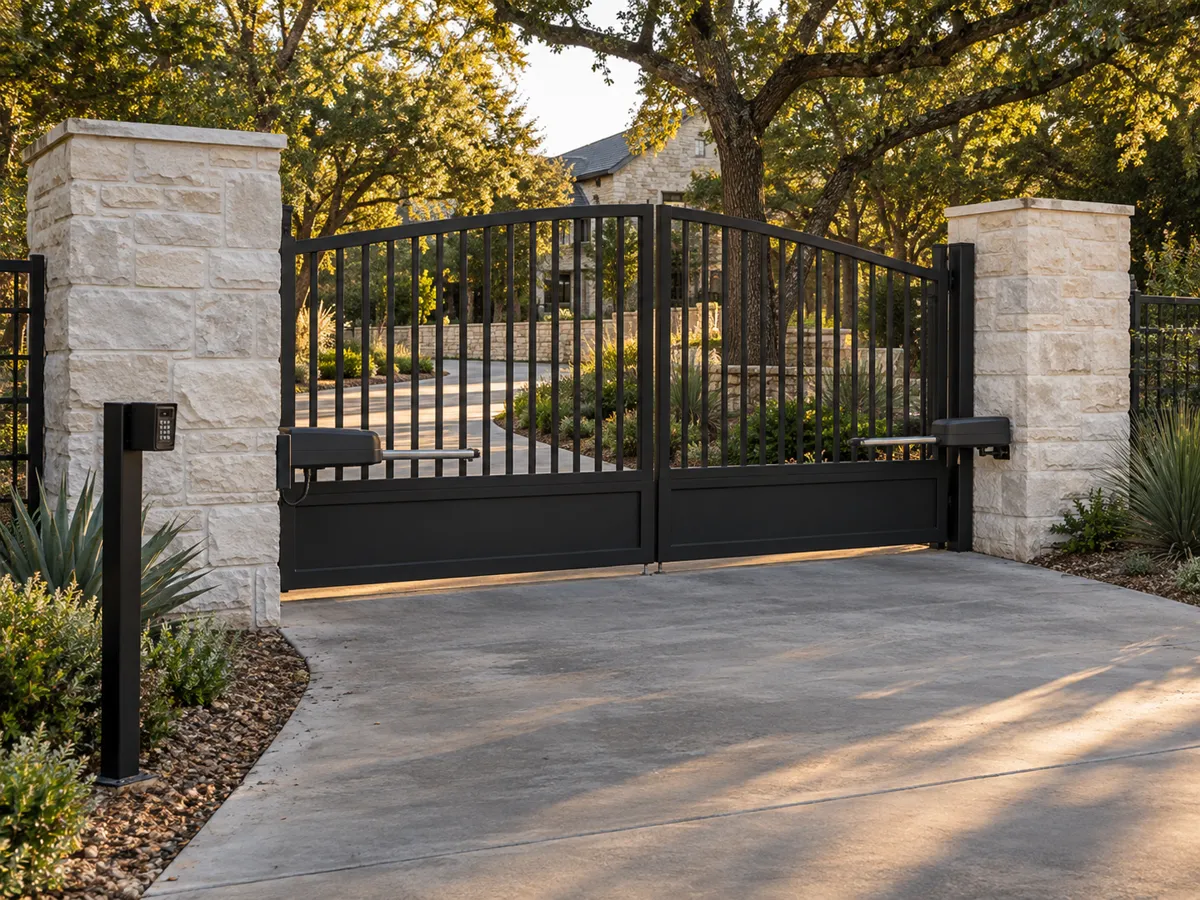
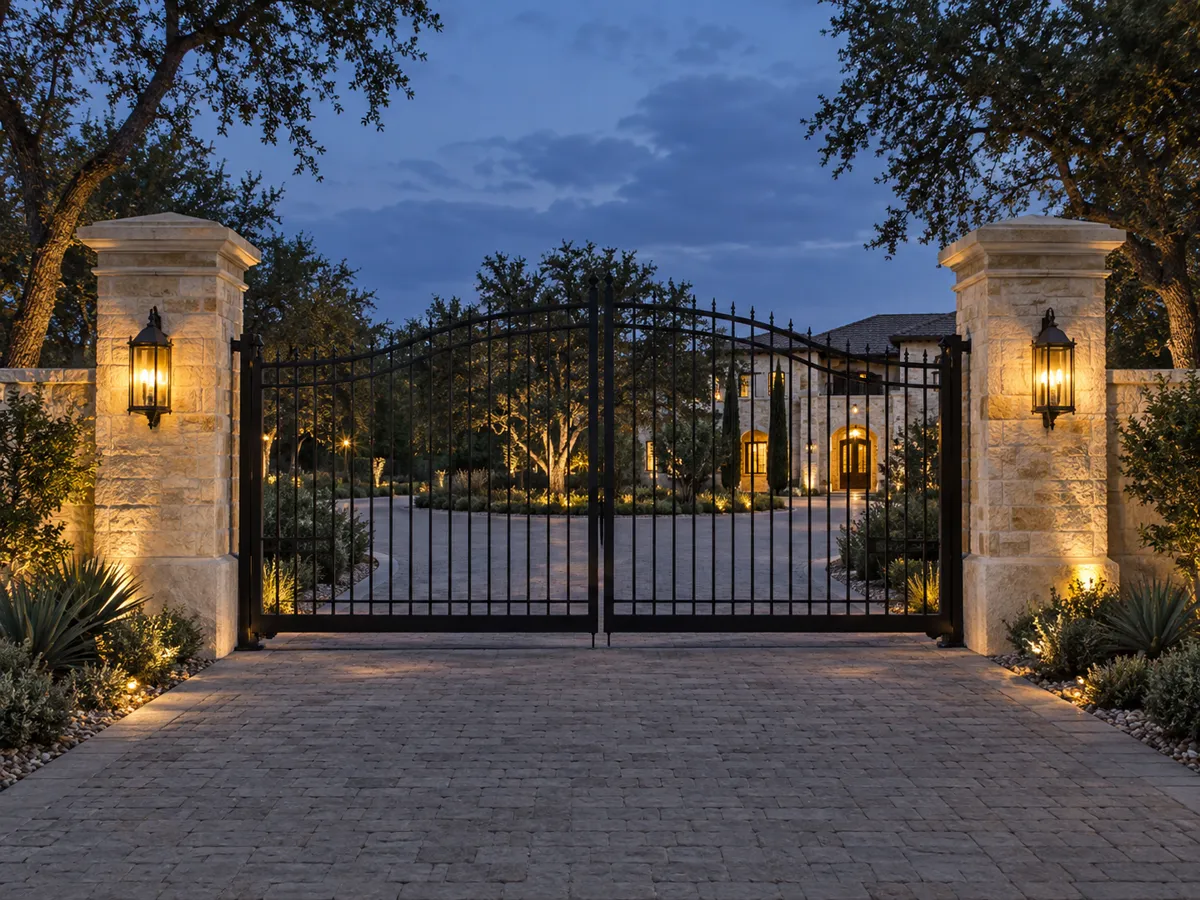
A dual swing gate splits the opening into two leaves hung on opposite posts. They meet at the center when closed and swing apart to open, the way a pair of French doors does. It is the classic estate entry, and it is symmetrical from the street.
Splitting the width has a practical payoff too. Each leaf is half the span of a single gate, so each one sweeps a shorter arc and needs less room behind the posts to open fully. Shorter leaves are also lighter on their hinges than one long leaf, which helps them stay level for years.
If the drive climbs steeply toward the house, or the ground inside the posts is crowded with landscaping, a sliding or cantilever gate may serve you better, and we will say so at the site visit.
Before we draw a single picket, we map the ground each leaf will pass over. A swing gate travels in a quarter circle, and every inch of pavement under that arc has to stay below the bottom rail.
If the driveway slopes down from the gate toward the house, inward swinging leaves clear easily. This is the simplest case and the most common layout for a pair.
When the drive climbs inside the gate, an inward swinging leaf meets higher pavement as it opens and will scrape unless something changes. The options are: Rising hinges. Offset hardware that lifts the leaf as it swings, so it climbs with the grade. A raised leaf. Hanging the pair higher, which leaves a gap under it when closed. An outward swing. Opening toward the street, where local rules allow it. A different gate. Sliding and cantilever gates travel across the opening instead of into the drive.
In several nearby cities the outward option is off the table. Rollingwood and West Lake Hills both require a driveway gate to open parallel to or away from the street and to let a car stop fully clear of the road. We check the current code for your address at quote time and design the swing to it. We measure elevation at the hinge side and the latch side of every leaf. A difference of more than about an inch per foot is where hinge height and placement start to need adjusting.
Each leaf hangs from one side only, so its entire weight tries to pull the top of the hinge post inward. That leverage is why a dual swing gate lives or dies on its posts.
Heavy steel posts are compact and strong. Masonry columns give a grander entry and hide hardware and wiring, but they need their own footing and a steel core or embedded plates to carry the hinges. Codes can shape them as well: Lakeway requires masonry supporting columns to be at least 14 by 14 inches and no more than 6 inches taller than the fence they carry.
West Austin sits on limestone under a thin covering of topsoil. That rock makes a solid base once it is reached, but it has to be drilled or broken to set a footing to depth. We plan footing depth and diameter for the leaf weight and the wind the pair will catch, rather than for the easiest dig.
A swing leaf acts like a sail. When wind presses on it, the hinges and posts carry the load, and an operator has to push against it as well as move the leaf's own weight.
Austin sees severe spring thunderstorms, so we design for gusts rather than calm days. Solid privacy leaves catch the full pressure of the wind across their face. Open picket leaves let most of it through.
Aluminum leaves weigh about a third as much as steel of the same size, which reduces the load on hinges and operators when a pair is wide or tall.
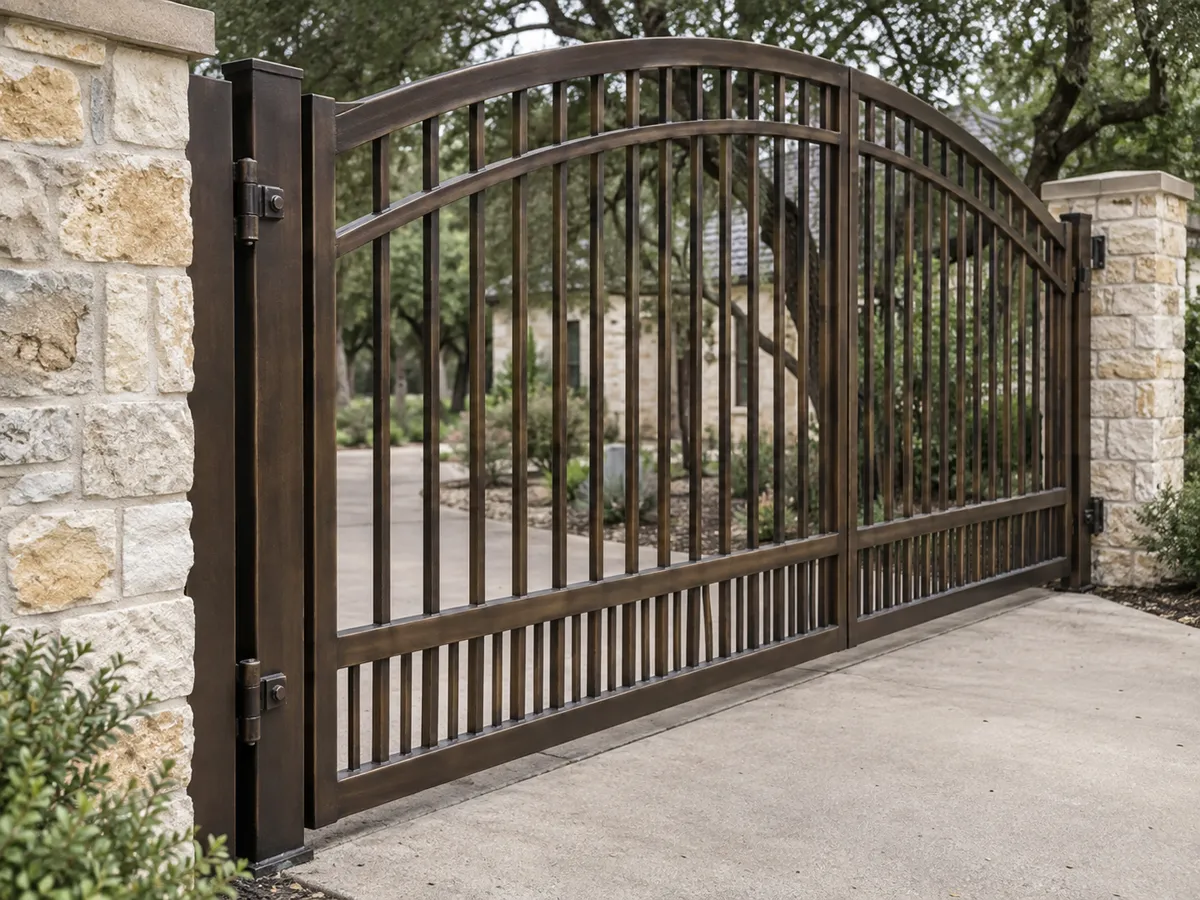
A dual swing gate automates with one operator per leaf, set up so the pair opens and closes together and meets cleanly at the center.
Hydraulic operators generate high torque and are the usual choice for large, heavy leaves. Electromechanical operators suit lighter residential gates with lower daily use. We match the operator to the finished leaf weight, width and wind exposure.
UL 325 is the safety standard gate operators are listed to, and residential operators for one to four single-family homes fall in its Class I. The standard calls for at least two monitored entrapment protection devices for each entrapment area in each direction of travel. On a swing pair that typically means photo eyes across the path and contact edges where a leaf could pin someone against a post or wall.
West Lake Hills requires electric driveway gates to carry an emergency power source as an integral part of the system and a Travis County ESD 9 approved access box on lockable gates. Lakeway requires a key switch for the ESD 6 fire department on coded gates. We build these in where your city asks for them and offer battery backup everywhere.
No two pairs price the same, so we quote from a measured drawing instead of a published figure. The main drivers are:
It all starts with a free on-site measure of your opening, your grade and your setback.
The process
Four steps, and nothing is fabricated until you have signed off on the drawings and the price.
We measure the opening, the slope and where power can reach, and talk through style, automation and access.
You get scaled drawings for your approval and for any HOA or city review, with one written price.
Steel is cut and welded to the approved drawings, then galvanized, powder coated or both.
Columns and posts set, gate hung, operator set up to UL 325 and every safety device tested with you.
Questions
A pair suits a level or downhill drive with room inside the posts for two arcs. If the drive climbs toward the house or there is no room for the leaves to swing, a sliding or cantilever gate is often the better fit.
Sometimes, where there is room and the local code allows it. Rollingwood and West Lake Hills require driveway gates to open parallel to or away from the street, so outward swinging leaves are not an option there.
With battery backup, the operators keep cycling for a period after the power drops. Every operator also has a manual release so the leaves can be opened by hand.
We fit whatever your fire district or city requires, such as the ESD 9 access box in West Lake Hills or an ESD 6 key switch in Lakeway, and confirm the requirement for your address when we quote.
Most associations do. Under Texas SB 711 an HOA may also require a driveway gate to sit at least 10 feet back from the right-of-way. We provide the drawings and details the committee asks for.
Yes, across Travis County, including Austin, West Lake Hills, Rollingwood, Shady Hollow, Sunset Valley, Lost Creek, Barton Creek, Steiner Ranch, The Hills, Lakeway and Volente.
Each installed pair comes with a written warranty, handed to you along with the quote so you know exactly what it says before you sign.
We measure the opening, the grade under both arcs, the hinge side and latch side elevations and the setback, look at where power can reach, and note any HOA or city rules before drawing the pair.
Free on-site measure across Austin and the west side. We call you back to set a time.
Calls only, we do not receive text messages.