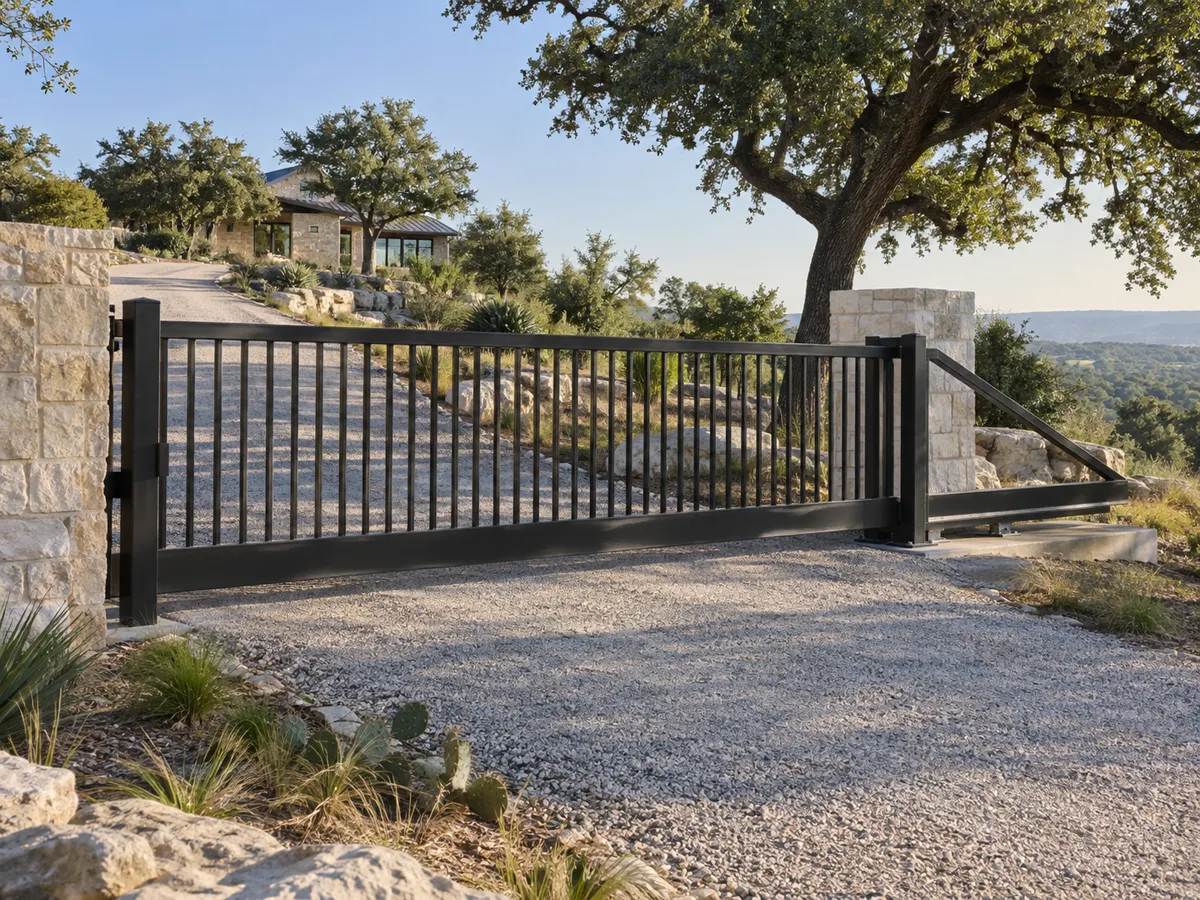
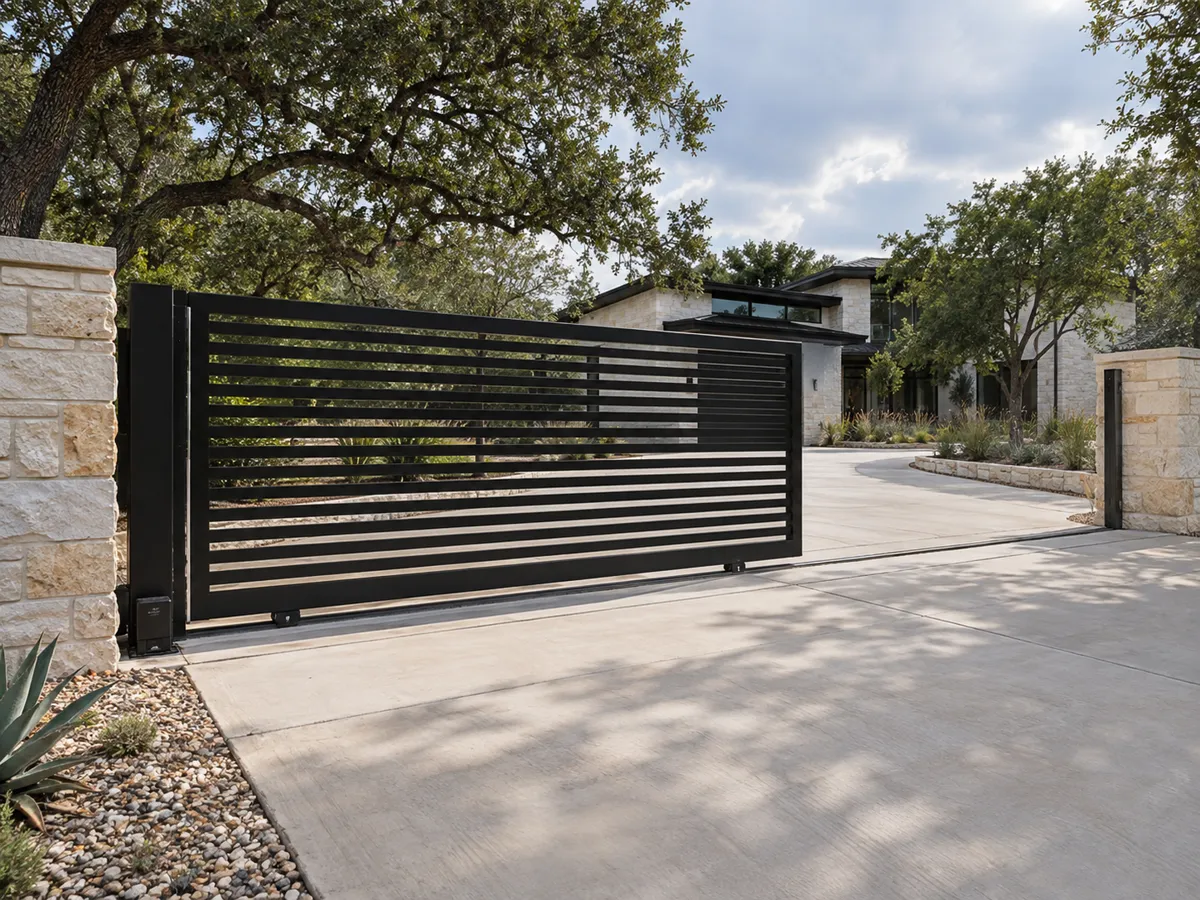
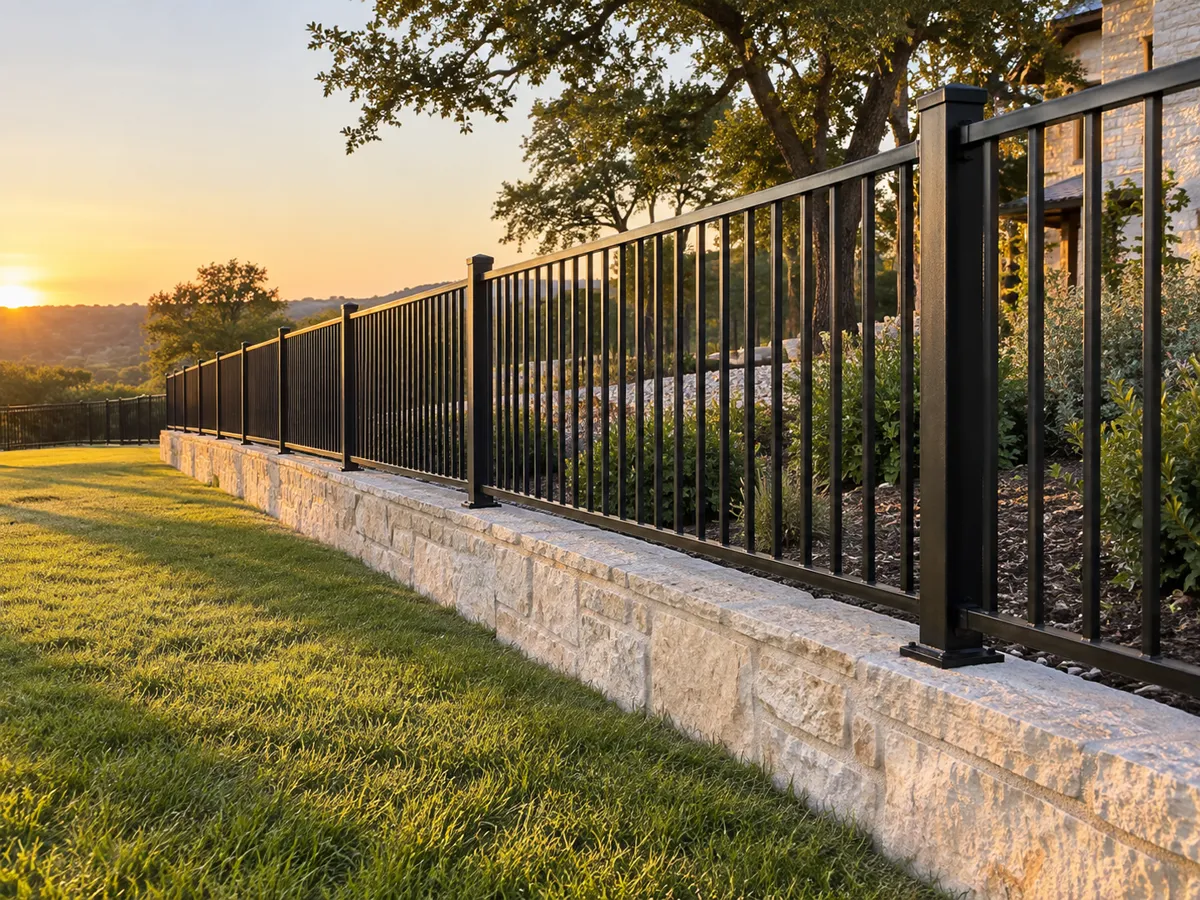
Articulated arm
A folding arm mounts on the face of the pillar and pushes the leaf through its swing. It copes well with deep pillars and large hinge offsets, which makes it a common fit for thick limestone columns where a straight ram cannot reach.
Austin Metal Gates provides electric swing gate installation in Austin, TX, and is Travis County's leading specialist in automating hinged gates, specializing in articulated arm, linear ram and underground operators mounted to limestone pillars and steel posts. We offer new automated swing gates and openers fitted to existing leaves.
Our team provides an operator chosen for your pillars and leaf weight, delivering a gate that opens at the touch of a remote for homeowners and a quiet, reliable entry for both residential and commercial projects. We measure the hinge geometry on site, build any brackets in our own shop, and the same crew sets each operator up to UL 325 with a written warranty.
From routing cable through a stone pillar to setting the soft stop at the end of each swing, our team handles every detail. Serving Austin, Barton Creek, West Lake Hills and The Hills, we automate swing gates so the hardware looks like it belongs there.
Why Austin Metal Gates
A swing operator works only as well as its geometry. We measure the hinge, the pillar and the leaf before choosing a single part.
Three kinds of operator move a swing leaf, and each suits a different pillar and look. The right one depends on how the gate hangs.
A folding arm mounts on the face of the pillar and pushes the leaf through its swing. It copes well with deep pillars and large hinge offsets, which makes it a common fit for thick limestone columns where a straight ram cannot reach.
A screw-driven ram runs from a bracket on the post to a bracket on the leaf. It is slim and strong, and suits steel posts or slim pillars where the hinge sits close to the pillar face.
A sealed motor sits in a steel box below the hinge, out of sight. It keeps the entry clean, but the box must drain well, so we plan a drain line or a gravel sump before choosing one in Flash Flood Alley.
On a stone entry we finish arm covers and brackets in the same powder coat as the gate, or tuck a ram behind the leaf, so the hardware reads as part of the design. HOAs in Steiner Ranch and Lakeway often review visible equipment, and a tidy mount helps that approval.
Every swing operator is rated for a range of A and B dimensions, the distances from the hinge pin to the operator's pivot. Get those wrong and the gate strains, stalls or will not open fully.
We measure how far the hinge sits from the pillar's front face and how deep the pillar runs. Deep stone columns often push a ram outside its range, which is where an arm or an offset bracket earns its place.
Natural or cut limestone pillars can crack if a bracket is bolted near an edge. We set chemical anchors well back from the edges, or tie the bracket to a steel post cast inside the column, so the operator pulls against steel rather than loose stone.
Power and control cable run through conduit inside the pillar where we can reach it, or along the leaf's back face, so no wire hangs where it can be cut or chewed.
An operator exposes any stiffness a hand never notices. Before mounting, we check that each leaf is square, swings freely and hangs on sealed bearing hinges, and we replace worn hinges or posts that lean, because a motor fitted to a binding leaf wears out early.
On a double gate, one controller drives both leaves with a short delay, so the leaf that carries the center stop closes last and the pair meets cleanly every time.
A solid or tightly slatted leaf behaves like a sail, and Central Texas storms bring strong gusts. The operator has to hold the leaf closed and push it open against the wind.
We size the operator for the leaf's area and face style as well as its weight, since a light solid panel can need more force in wind than a heavier open picket gate. Positive stops at both ends take the strain off the gearbox.
An electric lock or the operator's own locking gear keeps the leaves shut in gusts. Two-leaf gates get a center stop so neither leaf flexes past the other.
Modern operators let us set the opening speed, the soft stop near each end and the force at which the leaf reverses. We tune those for your leaf's weight and the wind it sees, so the gate closes firmly without slamming and still reverses gently if it meets a car or a person.
An automated gate has to open when the power is out and stop when something is in its way.
A new gate circuit inside the city usually needs an electrical permit from the City of Austin Development Services Department, with service from Austin Energy or, on much of the west side, Pedernales Electric Cooperative. Many owners also add solar on remote lots.
The February 2021 winter storm left many homes without power for days, so we fit battery backup that keeps the gate running and a manual release that lets you open it by hand.
Photo eyes and safety edges stop and reverse the leaf on contact. We add a Knox key switch where the fire department or ESD needs access, and seal control boxes against fire ants and heat.
An electric swing gate is quoted from the operator choice and the mounting it needs, and we list both in your quote. The main factors:
Adding an operator to a sound existing gate typically takes a day or two on site, an estimate that depends on the power run and the pillar work.
If your gate still needs hanging or its layout settled, start with our swing gate installation page. For the full range of motors we fit, see gate openers and automation. You can also browse our work from our Austin home page.
The process
Four steps, and nothing is drilled until you have approved the operator choice and the price.
We measure each hinge and pillar, check the leaf weight and face, and plan the power route.
You get the operator type, mounting detail and safety layout for each leaf, with one written price.
We set anchors or steel posts, run conduit and mount the operator, lock and controls.
We set travel limits, soft stops and force, then test every sensor and the backup before handing over.

Questions
The operator style sets most of it: an articulated arm costs less than an underground unit, and two leaves need two motors. Leaf weight, any pillar repair and the distance to your panel add the rest, and your quote after a free visit lists each part.
Arms suit deep pillars, rams suit slim posts with a small hinge offset, and underground units suit entries where you want no visible hardware and the box can drain.
Usually, yes, if the leaf is square, the hinges are sound and the posts are solid. We check those on site and tell you if anything needs fixing first.
Yes, when the operator is sized for the leaf's area and the gate has positive stops and a lock. We allow for wind in the sizing.
Battery backup keeps the gate working through most outages, and a manual release lets you open each leaf by hand.
We can fit a Knox key switch so the fire department or ESD can open the gate without a code.
Most visits happen within the same week you call. Fitting an operator to a gate that already swings true is usually a day or two of work, an estimate your quote confirms.
Yes. The operator, its brackets and our wiring are covered by a written warranty, and the terms sit on the quote so nothing is a surprise later.
Free on-site measure across Austin and the Hill Country. We call you back to arrange a visit.
Calls only, we do not receive text messages.