Skip to content

Automatic Gate Installation in Austin, Hands-Free and Safe to Live With

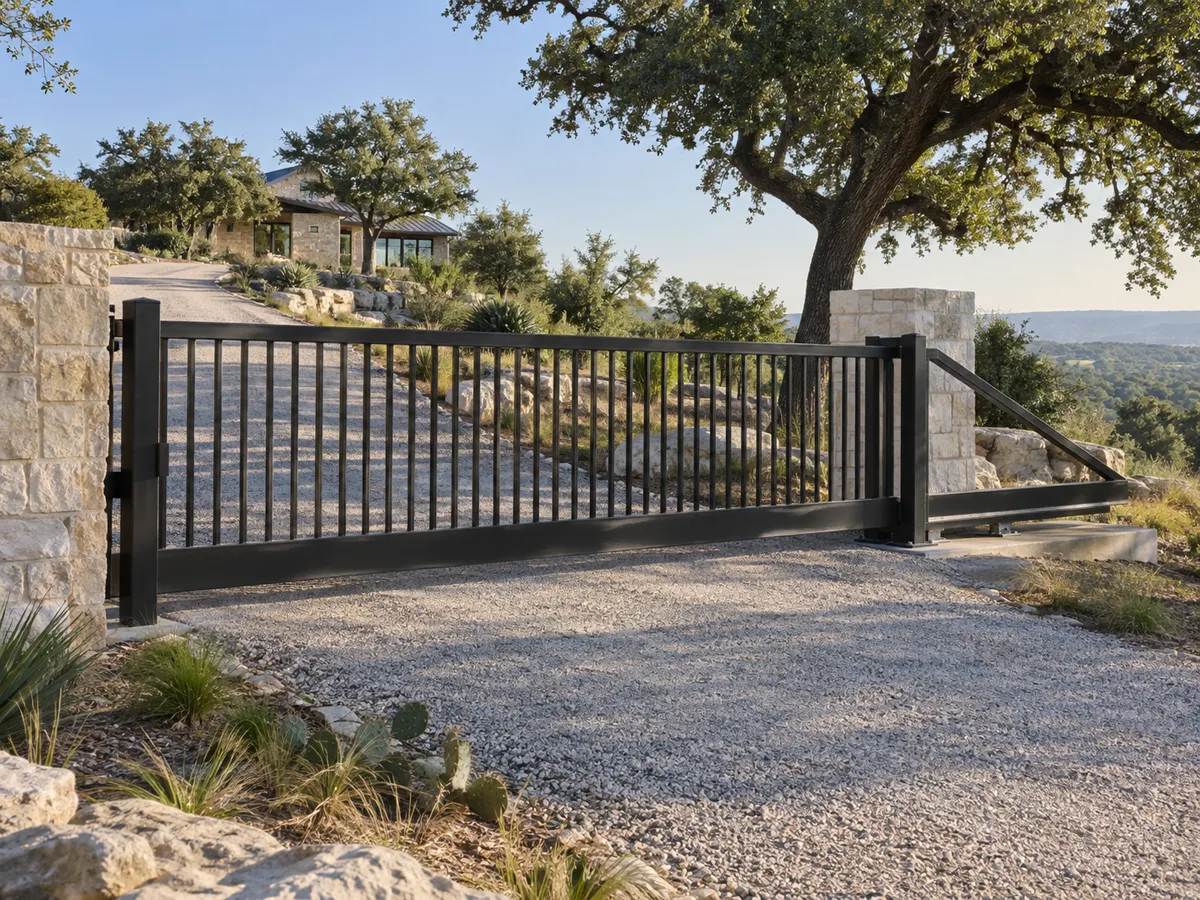
Austin Metal Gates delivers automatic gate installation in Austin, TX, and is Travis County's leading specialist in hands-free entry, specializing in vehicle exit loops, entrapment protection and remote access control. We offer buried exit probes for gravel drives and phone app access for owners who travel.

  • Free on-site measure
  • Exit loops and probes
  • Tested to UL 325
  • One written price

Request a free site visit

About our automatic gates

Our team provides a full behaviour plan for how the gate opens, waits and closes, delivering a drive that lets your car out without a button press for homeowners and controlled, logged access for both residential and commercial projects. The same crew that measures your drive sets every loop and photo eye, and we test each safety device against UL 325 with you before we leave.

From saw-cutting an exit loop into a concrete apron to programming the auto-close timer, our team handles every detail. Serving Austin, Lakeway, Barton Creek and Shady Hollow, we tune gates for households where children, pets, couriers and fire crews all use the same entry.

Why Austin Metal Gates

How We Work

An automatic gate is judged by how it behaves every day. We plan the behaviour first and fit the hardware to it.

Drive measured on siteWhere cars stop, turn and wait, measured so sensors sit in the right place
Behaviour agreed firstOpen, hold and close settings written down with you before installation
Safety testedEvery photo eye and edge checked against UL 325 with you watching
Access set upRemotes, codes and app users programmed and handed over on the day

How the Gate Knows a Car Is There

Hands-free exit is the feature owners notice most. A sensor in or beside the drive detects a vehicle leaving and tells the operator to open, with no remote needed.

Exit loops in concrete

An inductive loop is a coil of wire set into a saw cut in the drive and sealed over. When the metal mass of a car passes over it, a detector in the operator registers the change and opens the gate. On concrete or asphalt it is the most reliable choice.

Probes for gravel and pavers

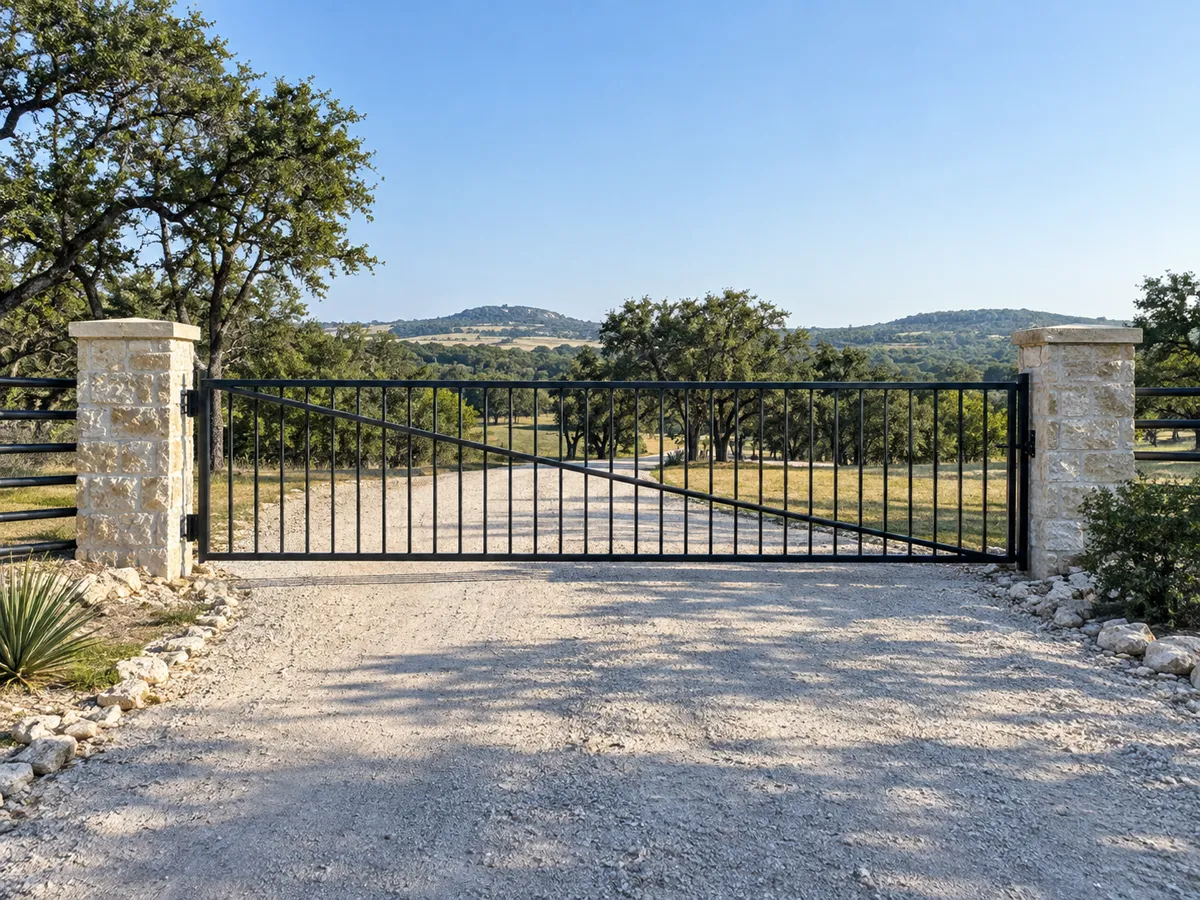
Gravel, crushed granite and loose pavers cannot hold a sealed saw cut, which rules out a loop on many Hill Country drives. A buried exit probe beside the drive senses a car the same way without cutting the surface, and it survives the grading and washouts gravel drives see.

Auto-Close Timers and Hold-Open

An automatic gate should close behind you without leaving the drive open all afternoon, and it should never close on a car still in its path.

Setting the timer

Most owners settle on an auto-close delay of typically 15 to 45 seconds, estimated by the length of the drive and how fast cars clear the opening. A second loop or sensor in the gate's path holds it open while a vehicle sits there, so the timer never starts until the way is clear. A trailer or a long truck gets the same protection, because the sensor holds the gate for as long as any metal sits over it.

Hold-open for parties and moves

For a party, a move or a landscaping crew, the gate can be held open from a remote, the keypad or the app, or on a schedule. It returns to normal automatically, so nobody has to remember to switch it back that night.

Entrapment Protection: UL 325 and ASTM F2200

Two standards keep automatic gates safe. UL 325 covers the operator and its sensors; ASTM F2200 covers how the gate itself is built. We meet both on every install.

Monitored safety devices

Under current UL 325, an operator must monitor its external entrapment protection and will not run in automatic mode if a device is missing or faulty. That is why we wire every sensor to the operator's monitored inputs instead of leaving any of them as optional extras.

Photo eyes and edges

Photo eyes throw an invisible beam across the opening and stop or reverse the gate when it is broken. Contact edges on the leading edge reverse it on touch. We cover each direction of travel, including the space a swinging leaf sweeps or a slide gate pulls back into.

ASTM F2200 on the gate

The standard asks for guarded rollers, positive stops and, on slide gates, openings near the ground small enough that a hand cannot reach through into the moving frame. Older gates often fail it, which is why we check the panel before we automate it.

Remotes, Keypads and Phone Apps

Getting in is the other half of hands-free. Most homes use a mix of remotes for the family, a keypad for regular visitors and an app for everything else.

Remotes and keypads

Rolling-code remotes keep a neighbor's opener from copying yours. We set the keypad post at driver's window height and far enough back from the road that a waiting car is fully off the street, which matters on busy roads like Bee Cave Road and RM 620.

Phone apps and cellular

App control lets you open the gate for a delivery from anywhere and see who came through. Home Wi-Fi often does not reach a gate at the end of a long drive, so on larger lots we fit a cellular module or an outdoor access point rather than leaving the signal to chance.

Fire Access and Deliveries

An automatic gate has to open for people you never gave a code to, starting with the fire department.

Knox key switch

Austin Fire Department and the surrounding emergency services districts use a Knox key switch to open coded gates in an emergency. Requirements vary by district and city, so we confirm yours and mount the switch where crews expect to find it.

Couriers and guests

Temporary keypad codes, scheduled codes for a cleaner or a pool service, and app invitations for guests let you control who gets in and when. Each one can be deleted the moment it is no longer needed, without changing anyone else's access.

When the power fails

We set what the gate does on a dead battery before you need to know: fail open for a busy household or a property the fire district wants reachable, or fail secure where privacy matters more. Either way the manual release stays reachable from inside, and we show you how to use it on the day we hand the gate over.

What Shapes the Cost of Automating a Gate

Automation is priced from how the gate needs to behave, because sensors and access devices add up faster than the operator itself. What moves the number:

  • Gate type: swing or slide, and whether the existing gate meets ASTM F2200.
  • Exit detection: a saw-cut loop in concrete or a buried probe in gravel.
  • Safety devices: photo eyes and edges for each direction of travel.
  • Access devices: remotes, keypad, intercom and app control.
  • Connectivity, including cellular for gates beyond Wi-Fi range.
  • Fire access hardware your district requires.
  • Power at the gate, if it is not already there.

Automating an existing, compliant gate is typically an estimated one to two days on site.

For a side-by-side look at motor types, see the gate openers we install. If the gate still needs a power feed, our electric gate installation page covers the circuit and trenching. Or head back to Austin Metal Gates to browse every gate we build.

The process

From Site Visit to a Gate That Runs Itself

Four steps, and the behaviour settings are agreed with you before anything is installed.

  1. Free site visit

    We watch how cars use the drive, check the gate against ASTM F2200 and agree how it should open and close.

  2. Plan and a written price

    You get the sensor layout, the access devices and the timer settings on paper, with one written price.

  3. Sensors and access installed

    Loops or probes set, photo eyes and edges mounted, keypad and receivers wired to the operator.

  4. Tested and handed over

    Every safety device tested to UL 325 with you, remotes and app users programmed, timers set.

More of What We Build

Questions

Automatic Gates: Common Questions

How much does it cost to make a gate automatic?

It typically depends on the sensors and access devices more than the motor. A simple setup costs far less than one with loops, an intercom and app control. Your written quote sets the final price.

Can my existing gate be automated?

Often, yes, if it swings or slides freely and meets ASTM F2200. Where it does not, we can usually modify the gate rather than replace it.

Will the gate close on my car?

Not when it is set up properly. A sensor in the gate's path holds it open while a car is there, and photo eyes and edges stop or reverse it.

Do I need a remote to leave?

No. An exit loop or probe opens the gate as your car approaches from inside, so leaving is hands-free.

Can I open the gate from my phone?

Yes, with an app controller. On long drives we add cellular so the gate stays connected where Wi-Fi does not reach.

How does the fire department get in?

Through the key switch or access device your fire district requires, which we confirm and install as part of the job.

Do you work in my area?

Yes, across Travis County: Austin, Lakeway, Barton Creek, Shady Hollow, Steiner Ranch, Lost Creek, The Hills, West Lake Hills, Rollingwood, Bee Cave and Volente.

Is there a warranty on the automation?

Yes, a written warranty covers our installation and setup, alongside the manufacturer's warranty on the operator.

Free site visit

Talk to us about an automatic gate

Free on-site measure across Austin and the west side. We call you back to set a time.

Call (512) 503-9203

Calls only, we do not receive text messages.

Call (512) 503-9203